Frank Gehry, who died Friday at 96, challenged the notion that buildings needed to behave themselves — creating artful, strange, kinetic combinations of structure, material, form and light, and transforming cities in the process. Here are 10 of his most famous structures that pushed the boundaries of architecture, culture, taste and technology.
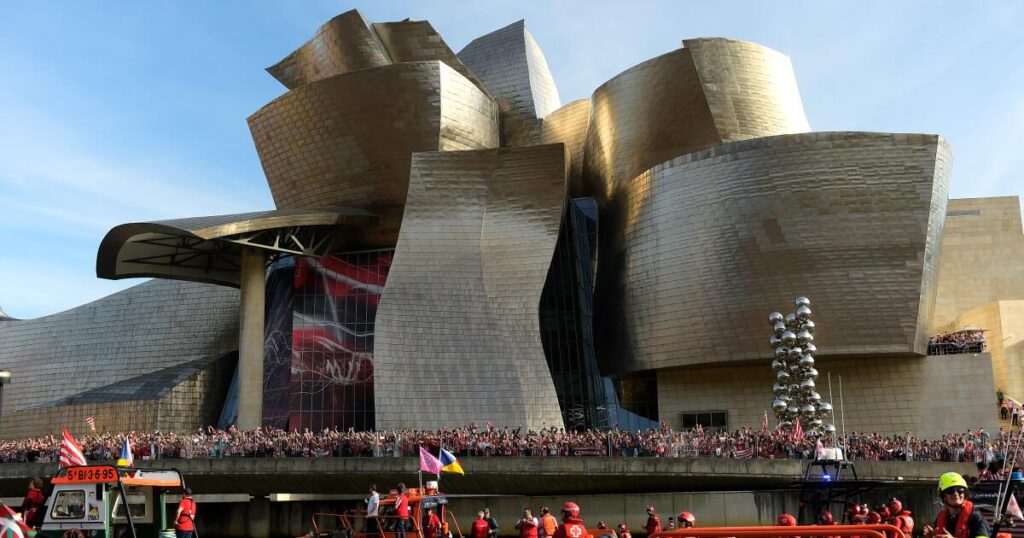
Guggenheim Museum Bilbao, Bilbao, Spain, 1997
While only one piece of a much larger urban transformation, this uproarious structure, perched at the edge of the Basque city’s industrial waterfront, utterly transformed its image, giving birth to the overused phrase “Bilbao Effect.” Its curving, ever-changing titanium facade — with offset panels catching the light and wowing millions of visitors — became a symbol of a new era of baroque, digitally-driven architecture. (Gehry and his team worked with CATIA, a software formerly employed by aircraft designers.) Inside, a dizzying atrium ties together a fluid series of galleries, all sized for contemporary art’s expanding scale. “I didn’t mean to change the city, I just meant to be part of the city,” Gehry told the design magazine Dezeen in 2021. The project would achieve the former, and transform the field of architecture in the process.
Walt Disney Concert Hall, Los Angeles, 2003
Dreamed up by Walt Disney’s widow, Lillian, in 1987, the project wouldn’t be completed until 2003. But it was worth the wait. Now the cultural and visual anchor of downtown Los Angeles, Disney’s riot of titanium sails reflect rippling waves of music, Gehry’s love of sailing, fish scales and other nautical themes, and the frenetic city around it. Inside, the boat-like, wood-clad hall has an intimate, vineyard-style seating arrangement, with its superb acoustics shaped by Yasuhisa Toyota. Don’t forget the 6,134-pipe organ, which resembles a box of exploding French Fries. Lillian Disney, a connoisseur of flowers, would die before the hall was finished, but its hidden rear garden is centered around the “Rose for Lilly” fountain, composed of thousands of broken blue and white Delft china pieces.
Fondation Louis Vuitton, Paris, 2014
Commissioned by LVMH Chief Executive Bernard Arnault, the Fondation Louis Vuitton, set in Paris’ Bois de Boulogne, is wrapped in 12 massive, curved glass sails, hovering above a white concrete “iceberg.” The museum’s billowing forms, which help lighten its considerable scale, were realized via head-spinning structural complexity: None of its 3,600 glass panels are the same, while each timber and steel supporting beam is curved uniquely. Inside and out, Gehry orchestrates a meandering gallery of paths and multistory overlooks that frame both art and landscape. While marooned on Paris’ western edge, the spectacular building has nonetheless become a cultural icon in a city where that’s very hard to achieve.
Vitra Design Museum, Weil am Rhein, Germany, 1989
While tame in comparison to his later work, Vitra marked Gehry’s transition from rough-edged, industrial bricolage to sculptural spectacle. Its tumble of white plaster forms — cubes, cylinders, sweeping curves — seem to freeze mid-collision, as if the gallery had been torn apart by seismic forces. (Just a year before, Gehry had been included in MoMA’s “Deconstructivist Architecture” exhibition, but he always rejected that label.) The structure also helped launch a string of impressive experiments on the Vitra campus, including buildings by Zaha Hadid, Tadao Ando, Nicholas Grimshaw, Álvaro Siza, Herzog & de Meuron and more.
8 Spruce (formerly New York by Gehry), New York, 2011
Gehry’s first skyscraper, 8 Spruce, reimagined the Manhattan high-rise as a kind of gleaming, pleated fabric, its shifted stainless steel panels rippling downward, catching daylight in a constantly shifting display. A buff brick base contains a public school and retail frontages, activating the street and helping establish the financial district as a legit residential neighborhood. Inside, apartments are far more rational, organized around generous windows that frame the city. Only 30 of the building’s 76 floors had been constructed when the Great Recession hit. For a time, the developer, Forest City Ratner, considered cutting the building’s height in half. But by 2010, the structure was back on.
Dancing House (Fred and Ginger), Prague, 1996
Designed with Czech architect Vlado Milunić, the building — a major step forward for Gehry, who increasingly dabbled in digital design — pits a leaning glass tower against an upright, solid partner, creating a kinetic duet that instantly earned the nickname “Fred and Ginger.” The complex’s opaque tower is clad in cream-colored concrete panels, stepping rhythmically with protruding windows that drift off-center. Its frenetic steel-ribboned crown, which stands out amid 19th century facades along Prague’s Vltava River, is nicknamed “Medusa.” The glass tower — emerging from a cluster of angled columns — cinches inward at its waist, bulging outward again as it rises, like a figure leaning into a twirl. Traditionalists panned the project when it first opened, but it’s now core to the city’s identity.
Stata Center, Cambridge, Mass., 2004
The Stata Center tilts, twists and fractures, its brick towers — referencing traditional Cambridge architecture — leaning into planes of glass, mirrored steel, aluminum, titanium, corrugated metal and plywood. The village-like building’s spatial looseness was part of a concerted effort to encourage chance encounters and interdisciplinary exchange at the school. The fragmented forecourt echoes the building around it, with skewed paving patterns, angled retaining walls and unpredictable sight lines. In 2007, MIT filed suit against Gehry’s firm and the general contractor Skanska USA, alleging persistent leaks, cracking masonry, poor drainage and sections where ice and snow slid off the building. The lawsuit was “amicably resolved” in 2010, but it represented one of several instances in which Gehry’s ambition would butt up against practical realities.
Weisman Art Museum, Minneapolis, 1993
Perched on a bluff above the Mississippi River at the University of Minnesota, the museum was a trial run for Bilbao and Disney, without the help of advanced digital tools. Its stainless steel facade unfurls toward the river in faceted, reflective forms that contrast with the building’s campus-facing facade, a series of various-sized cubes wrapped in earth-toned brick, matching the rest of campus. Inside, a series of flexible galleries support changing exhibitions. The museum is named for Frederick R. Weisman, a Minneapolis-born entrepreneur, art collector and philanthropist who broke sharply with conventional wisdom to support a Gehry-designed building that would loudly announce the arts and become an artwork in its own right.
Jay Pritzker Pavilion, Chicago, 2004
The centerpiece of Chicago’s wildly successful Millenium Park, the bandshell’s billowing 120-foot proscenium, supported by a web of aluminum arms, is fronted by dozens of torqued stainless steel ribbons, which exuberantly frame the stage. The ribbons connect to an overhead trellis of crossed still pipes that house lights and speakers, while the stage itself is sheathed in warm Douglas fir, and includes a colorful light projection system (first planned for Disney Hall, but scuttled for budget reasons) that transforms the pavilion’s face. Seating 4,000, the Pritzker envelopes a “Great Lawn,” with room for another 7,000.
DZ Bank Building, Berlin, 2000
A stone’s throw from the Brandenburg Gate, DZ’s stone facade aligns seamlessly with its blocky neighbors on Pariser Platz, providing little hint of its shocking interior. A curved stainless steel conference hall, clad inside with a riot of warm wood panels, resembles an angry sea creature, its humpbacks, saddles, bulges, tucks and pinches creating one of the most kinetic building forms this author has ever seen. The piece dominates a soaring atrium, capped with a curved, crystalline glass roof. Locals nicknamed the split-personality building the “Whale at the Brandenburg Gate.” It remains one of the architect’s most underrated masterpieces.
The post 10 iconic Frank Gehry buildings that transformed their environments appeared first on Los Angeles Times.