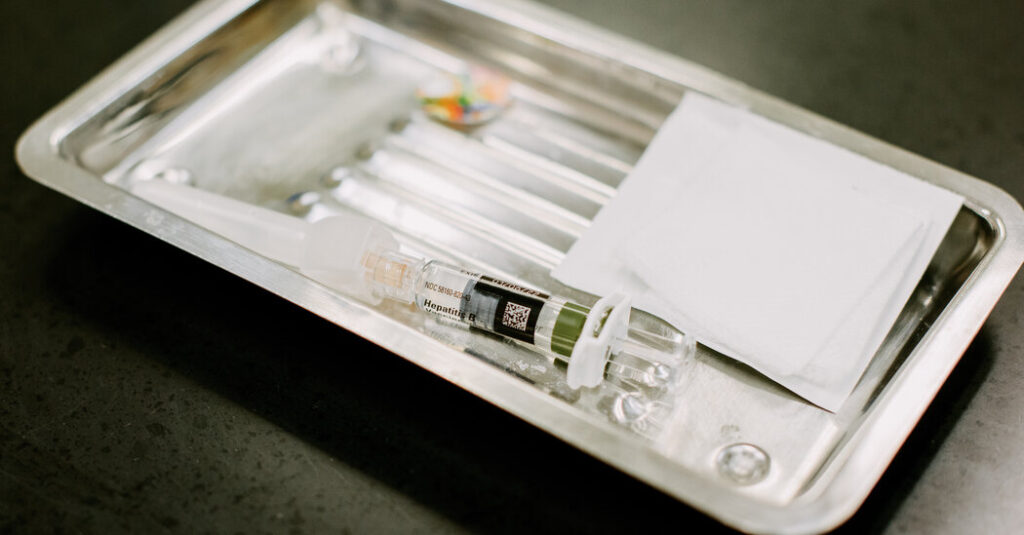
A federal vaccine committee is expected to vote on a significant change to the nation’s vaccine policy on Thursday, deciding whether to end a decades-long recommendation to immunize all babies at birth against hepatitis B, a highly contagious virus that can damage the liver.
The committee, whose members were appointed by Health Secretary Robert F. Kennedy Jr., is most likely to end the practice, and to delay vaccination for most babies until they are older, Dr. Kirk Milhoan, the panel’s newly appointed chair, said in an interview. But, he added, the panel was likely to continue to recommend the immunization of newborn children of women known to be infected with the virus, and perhaps also the infants of women who were not screened for infection.
The committee, called the Advisory Committee for Immunization Practices, will meet again on Friday to debate broader changes to the timing of vaccines given to children, as well as the composition of the shots. They will also address whether aluminum salts, which are added to vaccines to increase the immune response, should be removed from vaccines, Dr. Milhoan said.
Although the committee members will not vote on Friday on the issues they discuss, some public health experts see the debate as a likely prelude to sweeping changes in the childhood vaccine schedule. Aluminum salts are present in dozens of vaccines, for example, and their removal would require the development of entirely new shots.
The members of the panel were handpicked by Mr. Kennedy, who has long campaigned against many childhood vaccines, and some panelists share his skepticism of vaccines in general. Nearly all of the new members have spoken out against Covid vaccines.
Officials at the Health Department gave the committee the task of evaluating whether hepatitis B shots for infants whose mothers tested negative for hepatitis could be delayed, Dr. Milhoan said, adding, “That’s what we’ve been asked to do.”
Decisions by the group are not legally binding, but they have significant implications as to whether private insurance and government assistance programs are required to cover the vaccines.
Mr. Kennedy has long questioned the hepatitis B vaccine’s safety and claimed, incorrectly, that it was not tested properly. He has also said, without evidence, that the vaccine causes autism and he has upbraided the C.D.C. for recommending universal vaccination at birth.
But some public health experts said that delaying the first dose could endanger children who may share a home or other space with someone who unknowingly has hepatitis B. One woman who became infected with the virus in early infancy is expected to speak at the meeting on Thursday.
As many as 70 percent of the roughly two million Americans with hepatitis B are unaware of their diagnosis, said Chari Cohen, president of the Hepatitis B Foundation.
“You don’t know who is going to be exposing them to the infection, so you’re not protecting those babies,” she said.
Many public health experts are concerned about Thursday’s vote because children are especially vulnerable to hepatitis B. More than 90 percent of infants infected with the virus develop chronic hepatitis B — which can lead to cirrhosis, liver failure and liver cancer — compared with less than 5 percent of people who are infected as adults. The vaccine committee was set to vote on the hepatitis B birth dose at its previous meeting in September, but the members deferred the vote after some said they needed more time to review the data.
During that meeting, Martin Kulldorff, then the panel’s chair, acknowledged that the members were “rookies” when it came to performing their duties. Given the importance of their decisions, the members were sharply criticized by outside experts for not using the established “evidence-to-recommendations” format, which typically entails detailed presentations on effectiveness, feasibility, cost-benefit ratio and equity.
The committee’s discussions at times devolved into heated arguments during the meeting; at one point, a live microphone caught one member calling another “an idiot.”
This time around, committee members have spent dozens of hours poring over data and learning the meeting’s format, Dr. Milhoan said.
Still, comments by Dr. Milhoan and other panelists, as well as by President Trump and Mr. Kennedy, suggest that the vote may be a foregone conclusion. Uncertainty about the outcome centers mainly on what age the panel will recommend that children receive the first dose. The ages proposed range from 2 months to 12 years.
Routine immunization at birth has cut the number of babies infected at birth to fewer than 20 per year, from about 20,000 per year before the practice was implemented. Delaying the first dose to 2 months for babies of women with unknown hepatitis B status could result in at least 1,400 additional infections per year; delaying the dose to 12 years of age would lead to at least 2,700 additional cases, according to a modeling study released on Monday. The study, led by Eric Hall at Oregon Health and Science University, was posted online and has not been vetted for publication in a scientific journal.
Senator Patty Murray, Democrat of Washington, said in a statement that a decision to end the universal birth dose would be “heartless.” She urged Senator Bill Cassidy, Republican of Louisiana and chair of the Senate health committee, to compel Mr. Kennedy to appear before that group.
Dr. Cassidy, a gastroenterologist, has been vocal about his support for the hepatitis B vaccine, but cast the vote to confirm Mr. Kennedy after receiving reassurances that as secretary he would not take vaccines away from anyone who wanted them. “If vaccines are working for somebody, I’m not going to take them away,” Mr. Kennedy said then.
The C.D.C. makes recommendations, but it is the states that decide to impose mandates, requiring certain vaccines for entry into day care programs or school.
Apoorva Mandavilli reports on science and global health for The Times, with a focus on infectious diseases and pandemics and the public health agencies that try to manage them.
The post Will All Newborns Still Receive Hepatitis B Shots? A Committee’s Vote Will Tell. appeared first on New York Times.