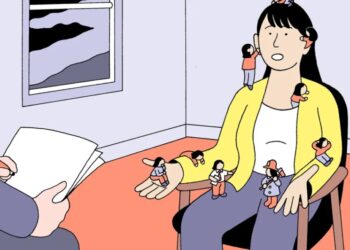
This year I created a WhatsApp group called “Take back control!” I added all the parents of my 14-year-old daughter’s friends and suggested we take their phones away. (Spoiler alert: It went nowhere.)
So I’m looking enviously to Australia, where they’re introducing sweeping social media restrictions for teenagers and children next week. What a change from the early 2010s, when phones and social media were being promoted as tools to help students learn.
But just as the pendulum swings back on phones, countries are investigating whether A.I. chatbots can — you guessed it — help students learn. Today, my colleague Natasha Singer writes about something called the “Hype Cycle” and why it should make us skeptical of policies that evangelize or demonize new technology.
Kids and tech: from hype to backlash
By Natasha Singer
Over the last few years, I’ve covered accelerating government efforts to curb young people’s social media use and student phones in schools. I’ve also reported on how some schools are introducing new artificial intelligence chatbots for teaching and learning.
At first glance, banning tech with one hand and encouraging tech with the other may seem inconsistent. But this month, with Australia poised to sharply restrict social media for teenagers and children, I’ve been struck by a familiar pattern.
Gartner, a research and consulting firm, named it the technology “Hype Cycle”: First comes tech enthusiasm, then rapid adoption, and finally disenchantment. Social media and smartphones are at a later stage of the cycle. Classroom A.I. use is just gearing up.
From boon to bane
In 2011, UNESCO, the United Nation’s educational and cultural agency, published an upbeat policy brief encouraging “social media for learning.” At the time, Facebook and Twitter seemed full of promise. The UNESCO brief argued that “social media can help schools allow the real world into their classrooms, and hence prepare students for a real, better future.”
Fast-forward 14 years. The perception of social media has changed a lot. Public concern is mounting over risks — including predators, disturbing content and cyberbullying. Instagram and TikTok have introduced a variety of safeguards and parental controls. Some governments contend that’s not enough.
Now Australia is preparing to institute a landmark social media ban. The new rules will require apps like Instagram, TikTok and YouTube to prevent Australians under 16 from signing up for accounts and to deactivate accounts belonging to underage users. Last month, Denmark and Malaysia announced plans to enact similar social media crackdowns.
Peter Malinauskas, the premier of South Australia who helped drive his country’s ban, has described the new rules as a “blunt instrument” that will give parents a new kind of leverage with their children.
“It gives parents the ability to say to their child, ‘Hey, Jenny or Johnny, you’re not allowed to have a social media account because it’s against the law — and the law applies to everyone,’” Malinauskas told me.
Some advocacy groups have raised questions about the ban, noting that it could hinder the benefits of social media, like education and connections with friends, without addressing the manipulative techniques used by some tech firms or the safety risks children face online.
“There’s a lot more we could be doing to get to the underlying systems and make those spaces safer,” says John Livingstone, the policy manager for UNICEF Australia.
A blunt-instrument ban
Kids’ mobile phone use has followed a familiar cycle of enthusiasm and disillusionment.
In the early 2010s, prominent global groups like the World Economic Forum promoted mobile phones as revolutionary new educational tools that could provide students with personalized “anytime, anywhere” learning.
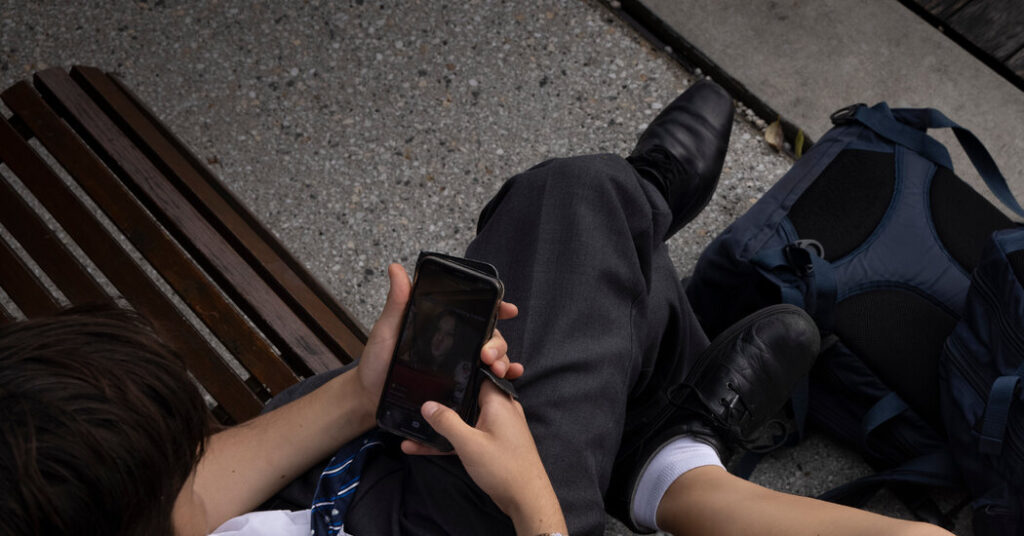
But by 2023, the tide had turned, with groups like UNESCO warning that mobile devices could distract students. By the end of last year, 79 countries had banned or restricted student phone use at school. More countries, including Brazil, Senegal and South Korea, recently moved to do the same. Anecdotally, some schools say the bans have helped increase student concentration in class. But there have been few rigorous studies to suggest the bans improve students’ academic outcomes or mental well-being.
Not everyone agrees on the phone rules. Some experts say schools should educate students about online risks and responsible phone use, rather than rush to impose blanket tech bans.
The A.I. school boom
Recently, American tech giants like Google, Microsoft and OpenAI have set their sights on spreading A.I. training in schools worldwide.
But evidence of concrete educational benefits remains thin, and some early studies point in the opposite direction: Relying on A.I. for core tasks like research and writing may weaken critical-thinking abilities.
Iceland is taking a cautious approach, with a research effort this fall in which several hundred teachers are trying A.I. chatbots from Google and Anthropic for tasks like creating lesson plans. No students are involved in the pilot.
With Australia now considering a national A.I. literacy plan, I asked Malinauskas, the South Australia premier, what government leaders had learned from the rush-and-regret cycle of phones and social media.
“I think the lesson from the evolution of social media on mobile phones is that something can happen over time and you don’t realize it’s bad until it’s too late — almost,” he said.
OTHER NEWS
-
Top U.S. military officers showed members of Congress a video of a September attack on a boat off the coast of Venezuela and defended the follow-up strike that killed two survivors.
-
Police arrested a 30-year-old man in Virginia on charges of planting two bombs near the U.S. Capitol the night before the Jan. 6, 2021 riot.
-
Yasser Abu Shabab, the leader of a Palestinian militia backed by Israel, was killed in a clash in southern Gaza, an Israeli official said.
-
Hamas returned the body of the last Thai hostage in Gaza. The remains of all but one other hostage have been recovered.
-
The leaders of Rwanda and the Democratic Republic of Congo met at the White House to advance a deal meant to end the devastating war in eastern Congo.
-
A U.K. inquiry found that President Vladimir Putin of Russia “must have” authorized a 2018 poisoning attack in the British city of Salisbury.
-
Putin is in India to meet with Prime Minister Narendra Modi.
-
A U.A.E.-backed separatist group seized most of a resource-rich region of southern Yemen.
-
Cambodia shut down a notorious hub used to launder billions of dollars in scam profits.
-
Kenya kept a diplomat on the job despite many accusations that he had sexually abused Kenyan women working in Saudi Arabia.
-
Spain, Ireland, the Netherlands and Slovenia said they would boycott next year’s Eurovision contest because of Israel’s participation.
SPORTS
Football: Ranking all 64 teams in today’s World Cup draw.
Ultramarathons: Meet the doctor who breaks records between emergency room shifts.
QUOTE OF THE DAY
“I never had a treehouse when I was a kid, a place where you’d be up hanging with your gang. As soon as I walked on the set and met the Muppets and Jim, I had a treehouse.”
— Paul Williams, the 85-year-old songwriting legend who wrote Kermit the Frog’s signature tune, “Rainbow Connection,” and many others, reflecting on his career.
MORNING READ
A recent theft has shaken France, and no, it’s not the Louvre heist. Think snails, not sapphires.
About 450 kilograms (990 pounds) of escargot — worth more than $100,000 — were recently taken from a farm in northeastern France, just in time for the prime holiday snail-eating season. The police have no suspects yet, but it’s clear the thieves were escargot-getters. Read more.
AROUND THE WORLD
What they’re eating before Christmas … in Britain
In Britain, the beginning of the festive season is marked by the arrival of pantomime performances, skating rinks and the supermarket Christmas sandwich, filled with holiday-adjacent ingredients like turkey, stuffing and cranberry sauce.
Quality varies widely, and newspapers vie to rank the year’s offerings. The Telegraph gave five stars to the “Fa La La La Fel Wrap” from Marks & Spencer, which features falafel, pickled cabbage and cranberry harissa. An offering from Tesco was deemed “a monstrosity” — “The bread is pappy, the lettuce floppy, the ham artificial, and the less said about the cheese the better” — and given zero stars.
The sandwiches are wildly popular, with an estimated 200 million sold every year. They’re a chance to cash in on the holiday spending frenzy, but also to offer some affordable cheer to people having lunch at their desks, or waiting in the cold for a delayed train. — Desiree Ibekwe
RECIPE
Croustade, a classic French double-layer pie, is perfect for a cold night. The flaky crust holds sweet-tart apples and plums that pair perfectly with a dollop of crème fraîche or a scoop of vanilla bean ice cream.
WHERE IS THIS?
Where is this retreating glacier?
BEFORE YOU GO …
We’ve been writing a lot about China — its leadership in renewable energy; the rising tensions over Taiwan; and, in yesterday’s newsletter, the way China is challenging the prevailing Western story of World War II.
I confess I didn’t know much about China’s role in that war, even though I’m German, and we studied the war a lot. That made me think of something Peter Frankopan, a professor at Oxford, said in a lecture a couple of years ago: China understands the West much better than the West understands China.
One reason may be that the West is easier to study. But Frankopan’s comment was meant as a warning: China wants to understand the West, he was saying. By contrast, the West’s recent period of dominance has made it complacent about understanding other cultures. If you find this compelling, try Frankopan’s book “The New Silk Roads.”
I also want to recommend a podcast by my former colleague Jane Perlez. Jane was our Beijing bureau chief and is now a fellow at the Harvard Kennedy School, where she hosts the podcast “Face-Off: The U.S. vs. China.”
Here’s a teaser: Jake Sullivan, a former U.S. national security adviser who has met President Xi Jinping, had this description of one of the world’s most powerful leaders: “He leans back in his chair; he exudes a certain kind of calm, almost like the cool kid in the class.”
Today I give you Chinese American rap: “New World,” a collaboration between VAVA from Sichuan and Krewella from Chicago. It’s fun.
Have a great weekend. — Katrin
TIME TO PLAY
Here are today’s Spelling Bee, Mini Crossword, Wordle and Sudoku. Find all our games here.
You’re done for today. See you tomorrow! — Katrin
We welcome your feedback. Send us your suggestions at [email protected].
Katrin Bennhold is the host of The World, the flagship global newsletter of The New York Times.
The post When Kids Adopt New Technologies, Hype Can Turn to Backlash appeared first on New York Times.