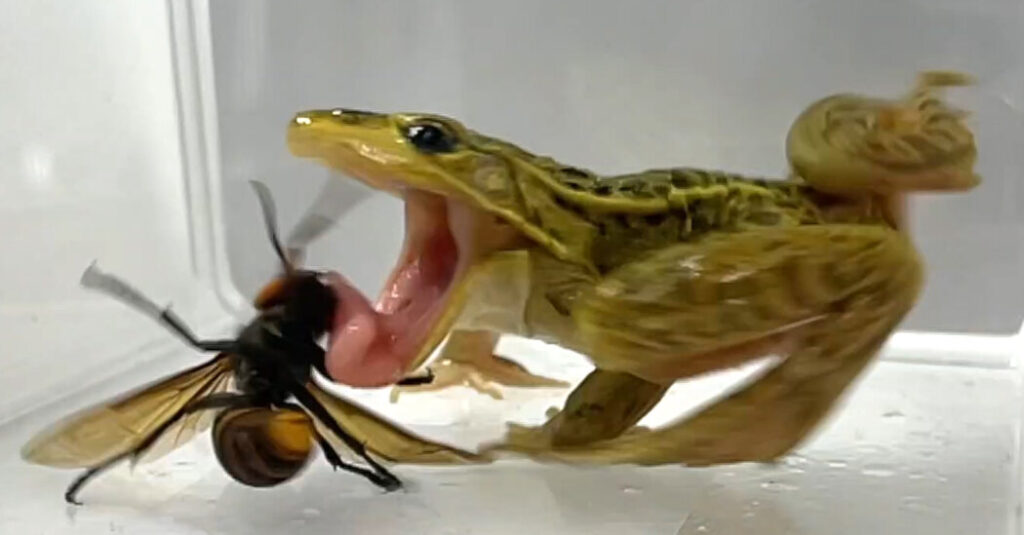
A northern giant hornet does not look like it would make a great meal. These mammoth insects are armed with a quarter-inch-long stinger and powerful venom. In humans, a giant hornet’s sting causes searing bouts of pain. A series of stings can even be fatal, earning the insects their popular “murder hornets” moniker.
However, to a hungry pond frog, these deadly hornets are a tasty treat.
This is what Shinji Sugiura, a biologist at Kobe University in Japan, recently discovered when he placed giant hornets in tanks with a species of frog native to Japan. Video he filmed revealed the amphibians making quick work of their stinging snacks. “What amazed me was that when I watched the recorded videos in slow motion, the frogs were clearly stung multiple times yet showed no apparent injury or mortality,” Dr. Sugiura said.
The new findings, published Thursday in the journal Ecosphere, add another layer to the intense evolutionary bout between amphibians and the insects they eat, which Dr. Sugiura has explored in all its strange, stomach-churning glory.
During one of his previous projects, Dr. Sugiura noticed that pond frogs often scarfed down female wasps, seemingly unfazed by their venomous stingers. He found reports of giant hornet remains turning up in the stomachs of black-spotted pond frogs, a species native to East Asia. However, no one had observed exactly how the frogs managed to choke down the insects.
To learn more, Dr. Sugiura placed black-spotted pond frogs in a tank with a worker hornet from one of three species of Japanese hornets, including the northern giant hornet. In these species, female workers wield a modified ovipositor, an organ many insects use to deposit eggs. For the murder hornet, this structure has been fashioned to deliver a venomous cocktail of toxins that can paralyze prey and subdue much larger animals. A single sting can kill a mouse several times its size.
However, this deadly weapon was of little use against a ravenous frog. Despite being repeatedly stung around the mouth and tongue and even in the eyes, the frogs gobbled the hornets up with zest. Nearly 80 percent of the frogs paired with a northern giant hornet successfully devoured the insect. Frogs paired with the other two hornet species had an even higher rate of feeding success.
Based on the results, Dr. Sugiura posits that larger frog species like black-spotted pond frogs are likely resistant to hornet venom. He hypothesizes that the hornet’s venom is fine-tuned to damage foes like birds and mammals. Frogs are less frequently a threat to the venomous bugs.
Brian Gall, a biologist at Hanover College in Indiana, said the findings illustrate the incredible iron stomachs of frogs and their relatives. “Amphibians seem to have the perfect weaponry to consume dangerous prey,” said Dr. Gall, who was not involved in the new study. “Their prey is consumed whole and swallowed immediately and they produce considerable mucus that can envelop the prey.”
In his own work, Dr. Gall discovered that two species of American toads are capable of stomaching velvet ants, insects that most animals avoid because of their thick exoskeletons and painful stings. Another group of researchers found that a South American toad, Rhinella icterica, eats the Brazilian yellow scorpion and is impervious to the arachnid’s powerful venom — putting a new spin on the age-old scorpion and frog fable.
Poison dart frogs are a particularly well-known example. These colorful amphibians consume noxious ants and utilize the insects’ poisons to create their own toxic tang. Dr. Gall also noted that many amphibians produce their own poisons, which most likely gives them a built-in resistance to certain types of toxins.
Dr. Sugiura thinks that exploring how amphibians can stomach toxins may provide insights for how other species, including humans, could weather painful stings and bites. “If pond frogs do possess physiological mechanisms that suppress pain or resist hornet venom,” Dr. Sugiura said, “understanding them could help develop ways to reduce pain or inflammation in humans.”
The post When a Murder Hornet Becomes a Tasty Meal appeared first on New York Times.