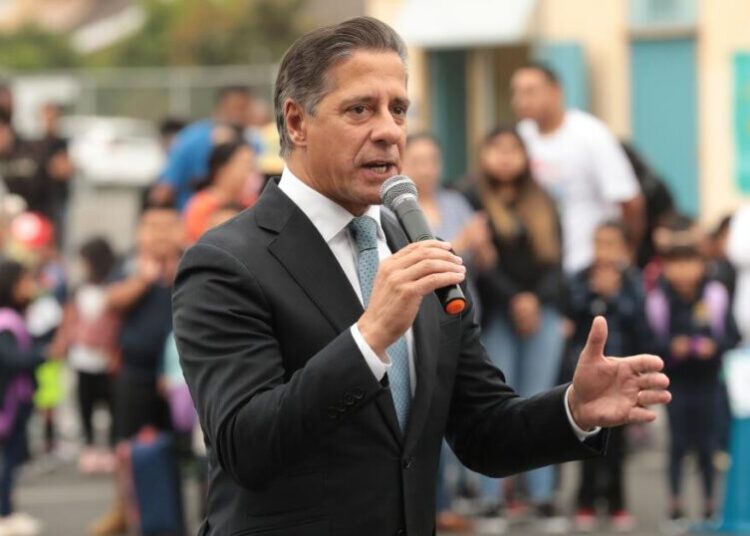
The leaders of Rwanda and the Democratic Republic of Congo met Thursday at the White House to sign a peace deal mediated by President Donald Trump. The conflict in Central Africa is one of the eight that Trump says he has “solved” since entering office, a claim he often repeats, casting himself, including in an address in September to the U.N. General Assembly, as a global peace broker worthy of the Nobel Peace Prize.
The ceremony was held at the United States Institute for Peace building, recently renamed the Donald J. Trump Institute for Peace. Trump issued an executive order to dismantle the independent nonprofit created by Congress in February.
Trump’s peacemaking track record so far is mixed. In some instances, Trump has applied pressure to secure ceasefires that have largely held, like in the conflict in the Gaza Strip and the 12-day war between Israel and Iran. But in other cases, violence has continued despite elaborate White House signing ceremonies. Russia’s invasion of Ukraine, which Trump pledged to end, persists as Trump continues to pursue a resolution.
Here’s a list of the conflicts that Trump has said he has solved and where they stand.
Democratic Republic of Congo-Rwanda
Presidents Félix Tshisekedi of Congo and Paul Kagame of Rwanda attended the Thursday signing ceremony. The agreement is expected to include economic partnerships and support for potential investment opportunities in critical minerals, energy and tourism.
The pact follows months of peace efforts by the U.S., the African Union and Qatar, following an earlier deal signed in June on security coordination, state commitments to stop arming local groups and commitments to return refugee populations displaced since the 1994 Rwandan genocide.
Trump celebrated the deal brokered in June as “a glorious triumph for the cause of peace,” but some experts and diplomats have been more circumspect, noting that one of the main parties in the conflict, the M23 rebel group, was not party to the U.S. deal and continues to operate.
“This hasn’t solved the problem,” said Michelle Gavin, a former U.S. ambassador to Botswana and National Security Council member during the Obama administration. Armed forces have yet to withdraw from eastern Congo following the deal, she said.
The June deal promised the expansion of “significant” investments facilitated by the U.S. government and private groups, hoping to tap into the region’s mineral reserves, valued at $24 trillion by the U.S. Commerce Department.
“It is a mineral deal first, an opportunity for peace second,” Lewis Mudge, Human Rights Watch’s Central Africa director, wrote in a statement. “Making the deal work will depend on continued monitoring by the U.S. government and support from Congress.”
Tshisekedi said in September that the U.S.-brokered peace accords have not led to an end to fighting.
There is a difference between “President Trump’s will and the situation actually happening in the field,” Tshisekedi said, blaming Rwanda for not keeping its promises.
The war in Gaza
Israel and Hamas announced they accepted a ceasefire deal in October to end over two years of devastating war in Gaza that left tens of thousands dead and much of the enclave destroyed. In the days and weeks since Hamas has returned all the living hostages to Israel and the remains of all but one Israeli hostage.
Israel has continued to hit some targets in Gaza with airstrikes, attacks that Hamas says are violations of the ceasefire, but the deal has largely held.
The future of Gaza remains uncertain. The ceasefire was short on details about how the initial steps would move into the deal’s second phase where the two sides are expected to address critical issues like the disarmament of Hamas, governance of Gaza, security in the enclave and reconstruction. Hamas has issued contradictory statements on disarmament and countries that have indicated they are willing to commit troops to secure Gaza say they don’t want to do so until Hamas disarms.
Like much Trump administration diplomacy, the Gaza ceasefire also has a strong economic component. The plan calls for a “Board of Peace” that would oversee governance and reconstruction. Trump would chair the board; former British prime minister Tony Blair would be a member. The plan specifically states the board will work with Israel and U.S. allies in the Persian Gulf, who are expected to fund much of the reconstruction. But those Persian Gulf nations also do not want to commit reconstruction funds until Hamas disarms.
Armenia-Azerbaijan
The ethnic Armenian population of Nagorno-Karabakh, an enclave long administered by Armenia within the internationally recognized borders of Azerbaijan, fled en masse in September 2023 as Azerbaijani forces took the territory by force.
After four decades of conflict, the leaders of Azerbaijan and Armenia signed a deal that included a peace framework meant to settle the Nagorno-Karabakh dispute, at the White House in August. “It’s a long time, 35 years they fought, and now they’re friends, and they’re going to be friends for a long time,” Trump said to the cameras at the signing ceremony.
Under the agreement, the U.S. gained exclusive rights to develop a transit corridor linking Azerbaijan with the contested territory of Nakhchivan, an energy-rich enclave sandwiched between Armenia, Iran and Turkey. The corridor, dubbed the Trump Route for International Peace and Prosperity (TRIPP), could shift the regional security balance, giving the U.S. a foothold between Iran and Russia and offering Turkey new trade access to Asia.
What the leaders signed on Aug. 8 was largely an economic partnership, not a full-on peace deal.
Khazar Ibrahim, the Azerbaijan ambassador to the United States, said the Trump deal was not a formal peace agreement and that Azerbaijan has not signed one because the Armenian constitution still refers to territory claimed by Azerbaijan as Armenian.
“We have been very clear, the Armenia constitution still has territorial claims against us, so we don’t want to have a stillborn document,” Ibrahim said. Until Armenia’s constitution is changed, peace would not be possible, he said.
But Ibrahim said he believed Trump’s efforts would result in more peaceful relations with Armenia.
“It’s essential to have a strong political will from a strong global leader. That is what I believe was lacking and that is what I believe now exists,” he said.
Iranian President Masoud Pezeshkian has expressed concerns over the U.S.-brokered deal, describing the prospect of U.S. companies near Iran’s northern border as “worrying” in an interview with state television before his trip to Armenia in August.
Serbia-Kosovo
Serbia and Kosovo have not been engaged in active conflict since the late 1990s, but the Trump administration said it prevented new violence.
The president of Kosovo backed Trump’s claim, saying that Serbia had planned to attack Kosovo in May before Trump intervened.
“What I can say at this point is that there were renewed efforts by Serbia to endanger peace,” said Vjosa Osmani, the president of Kosovo, who credited Trump with preventing the outbreak of war but said she couldn’t reveal additional information because the specifics were “classified.” The president of Serbia, Aleksandar Vucic, has denied any plans for an attack.
Egypt-Ethiopia
The White House says it has resolved tensions between Egypt and Ethiopia over a long-standing dam dispute, but in this case there is no apparent agreement.
Egypt and Ethiopia have been at odds for years over water rights and the massive Grand Ethiopian Renaissance hydroelectric dam in Ethiopia on the Blue Nile, a major Nile tributary upriver from Egypt. Cairo fears the dam, the construction of which began 14 years ago, could rob Egypt of its share of Nile waters.
Trump attempted to mediate the dispute during his first term, but negotiations stalled. It’s unclear to what extent talks have restarted under Trump’s second term, but tensions between the two counties appear to have eased, which analysts say is due in part to heavy rainfall. Egypt is primarily concerned with how Ethiopia will operate the dam during times of drought.
The embassies of Egypt and Ethiopia in Washington did not respond immediately to queries about the status of the dispute or Trump’s role in mediating it.
India-Pakistan
After 10 days of conflict between two nuclear armed powers, India and Pakistan agreed to a ceasefire May 10. Trump said he headed off the escalatory tit-for-tat.
Pakistan praised Trump as a peacemaker. But India denied a U.S. role, a stance that appears to have contributed to the fading friendship between Trump and Indian Prime Minister Narendra Modi.
In a tense call on June 17 after Trump left a world leaders’ summit early and canceled his in-person meeting with Modi, the Indian premier told Trump that India “does not and will never accept mediation,” according to an Indian readout.
Trump took offense at being denied credit and imposed a punishing 50 percent tariff on India in August, amid a trade dispute in part over India’s Russian oil imports.
Thailand-Cambodia
On July 24, Thailand launched airstrikes on Cambodia, escalating a skirmish between the two countries, which share a disputed 508-mile border and a decades-old enmity. As Cambodia retaliated with artillery and the casualty count rose, tens of thousands of civilians on both sides of the border fled.
Two days later, Trump stepped in. “We happen to be, by coincidence, currently dealing on Trade with both Countries, but do not want to make any Deal, with either Country, if they are fighting — And I have told them so!” Trump posted on Truth Social.
The threat appeared to work. On July 28, Trump said a ceasefire had been reached and instructed his trade teams to restart negotiations. “I have now ended many Wars in just six months — I am proud to be the President of PEACE!” he posted.
During remarks in September, Trump appeared to conflate the Armenia-Azerbaijan and Thailand-Cambodia conflicts.
Israel-Iran
After 12 days of fighting between Iran and Israel in June that began with an Israeli attack on Iran — a conflict that included U.S. strikes on sites key to Iran’s nuclear program — the Trump administration pushed for a ceasefire, which has held.
“We basically have two countries that have been fighting so long and so hard that they don’t know what the f— they’re doing,” Trump told reporters when attacks launched by both sides threatened the ceasefire in its infancy.
In the run-up to the conflict, Trump had been pushing for a renewed nuclear deal with Iran.
Adam Taylor and Cat Zakrzewski contributed to this report.
The post Trump says he has ‘solved’ 8 conflicts. Here’s what to know about them. appeared first on Washington Post.