The House and Senate Armed Services Committees are scrutinizing a Sept. 2 attack by the U.S. military on a speedboat in the Caribbean Sea that the Trump administration has claimed was smuggling drugs — and especially whether a decision to fire a second missile at the vessel, which killed two survivors of the first blast, was a war crime.
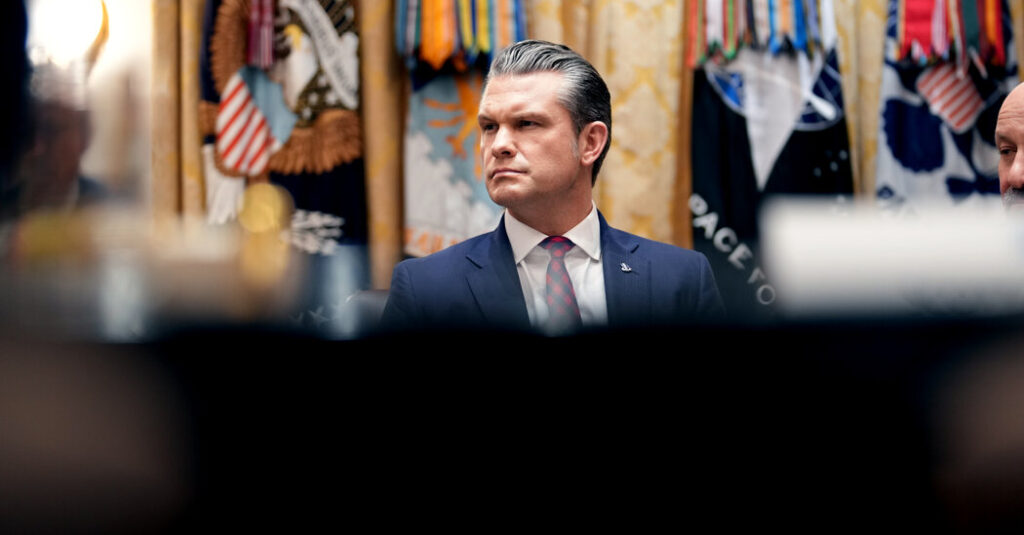
The oversight effort is dissecting the specific orders of Defense Secretary Pete Hegseth and the Special Operations commander overseeing the attack, Adm. Frank M. Bradley. The admiral and Gen. Dan Caine, the chairman of the Joint Chiefs of Staff, are scheduled to go to Capitol Hill on Thursday to answer questions about the strike.
A broad range of legal experts argue that the killings have been murders.
The Trump administration insists that its lethal campaign, including the second strike on Sept. 2, is lawful.
Here is a closer look.
What is the boat attacks operation?
President Trump has ordered the military to kill people on boats in international waters who are suspected of smuggling narcotics on behalf of drug cartels. Since Sept. 2, the administration has announced 21 such attacks in the Caribbean Sea and the eastern Pacific Ocean that have killed 83 people.
This is a change from the longstanding U.S. approach of having the Coast Guard intercept such vessels and, if suspicions prove accurate, seize illicit cargos and arrest the people on board. The legality of the new policy has been widely disputed.
What is the legal dispute?
The Trump administration says the operation is lawful because Mr. Trump “determined” that the United States is in a formal armed conflict with drug cartels, even though Congress has not authorized one, and that people suspected of running drugs are “combatants.”
A Justice Department memo endorses Mr. Trump’s claims and, relying on the premise that this is an armed conflict, says the suspected drug cargos aboard the boats are lawful targets.
Legal experts have rejected the idea that there is any armed conflict with drug cartels. The military is not permitted to target civilians who do not pose an imminent threat of violence, even if they are suspected of committing crimes.
Why is the Sept. 2 attack now in focus?
Basic facts about the Sept. 2 attack — including that the boat had turned back before the attack — were reported that month.
But since then, the administration has announced its disputed theory that the United States is in an armed conflict with cartels, and a group of Democratic lawmakers recorded a video telling members of the armed service that they could refuse illegal orders, prompting a furious White House response.
Against that backdrop, on Nov. 28, The Washington Post published a more detailed account of the Sept. 2 attack. It said Admiral Bradley had ordered the second strike to fulfill a spoken directive from Mr. Hegseth to kill everyone, prompting bipartisan questions about war crimes. The administration has denied certain aspects and implications of that account.
What makes the follow-up strike different?
Even if one accepts Mr. Trump’s claim that the United States is in an armed conflict and the boat attacks are generally lawful, the Sept. 2 follow-up strike might still be a war crime. The Pentagon’s law of war manual says that “orders to fire upon the shipwrecked would be clearly illegal.”
And while the administration has defended the entire attack, which killed 11 people in all, Mr. Trump has distanced himself from the second strike. He told reporters on Nov. 30 that he thought the first strike was fine but that he “wouldn’t have wanted that, not a second strike.”
What seems clear?
It appears to not be in dispute that Mr. Hegseth was the “target engagement authority” who signed an execute order telling Special Operations forces to sink boats, destroy their suspected cargo and kill their crews. It also appears clear that he gave the go-ahead order to Admiral Bradley for the Sept. 2 attack.
Admiral Bradley was the commander in control of the mission, which was carried out by SEAL Team 6 operators. He gave them an order to strike the boat. After the smoke cleared, surveillance video showed the disabled vessel was still afloat and two people were still alive. He ordered follow-up strikes that killed them and sank the vessel.
Were the initial survivors ‘shipwrecked’?
Their boat was wrecked, but there is a complication.
The Pentagon’s law of war manual says that “to be considered ‘shipwrecked,’ persons must be in need of assistance and care, and they must refrain from any hostile act.” A naval commander handbook says combatants “qualify as shipwrecked persons only if they have ceased all active combat activity.”
Two U.S. officials have said the military intercepted radio communications from the survivors to suspected cartel members, raising the possibility that any drugs on the boat that had not burned up in the first blast could have been retrieved. The military, they said, interpreted the purported distress call as meaning the survivors were still “in the fight” and so were not shipwrecked.
What did Mr. Hegseth order?
Mr. Hegseth has denied that he ordered the killing of the two survivors, and officials have told The New York Times that he gave his orders before the attack commenced and did not communicate further ones to Admiral Bradley when there turned out to be survivors.
The officials said that Mr. Hegseth’s execute order was explicit that the mission was a lethal one, but that it did not address what should happen if the first strike did not kill everybody.
They also said he did not give a spoken directive, in a meeting with Admiral Bradley about the order, that went beyond its written terms. It is not clear whether they spoke outside of that meeting.
However, the officials also said Mr. Hegseth had reviewed and approved contingency plans the military had developed that included scenarios in which there were survivors. They described those plans as saying the military would attempt to rescue survivors who appeared shipwrecked and out of the fight, but would try again to kill the survivors if they committed hostile acts.
What are the limits of this analysis?
The laws of war were written for fighting between organized armies and armed combatants trying to kill each other.
The rules do not fit attacks on small, unarmed boats suspected of smuggling cocaine, or address what counts as being in or out of “the fight,” when the crews on the boats were not actually fighting anyone in the first place.
“Focusing on the shipwrecked is a distraction insofar as it suggests everything else preceding and after that strike was all legitimate,” said Ryan Goodman, a New York University law professor and former Pentagon lawyer. “Even under a law of armed conflict, they were all civilians, and we are not actually in armed conflict. Either way, it was all murder.”
Julian E. Barnes contributed reporting.
Charlie Savage writes about national security and legal policy for The Times.
The post The Furor Over Trump’s Boat Attacks and a Particular Follow-Up Strike, Explained appeared first on New York Times.