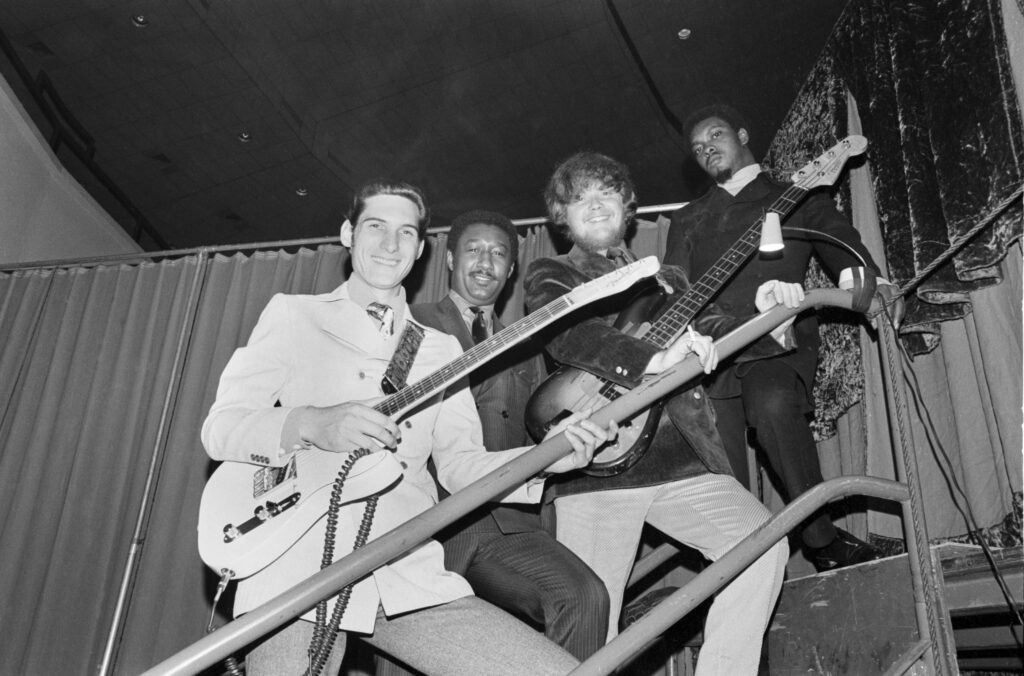
“Play it, Steve,” Sam Moore chants during the chorus of 1967’s “Soul Man,” and it’s no mystery why.
Sam & Dave’s No. 2 hit is driven by Steve Cropper, who opens the song with a series of sliding double stops, delivers a funky progression for the verse, and slides up the neck with a lick played with a Zippo lighter on the chorus.
The “Play it, Steve,” probably an improvised aside during a recording session, effectively becomes a piece of the song. We hear it again when John “Joliet Jake” Belushi utters the phrase as the Blues Brothers perform their cover 11 years later on the “Saturday Night Live” stage with Cropper, in thick beard and shades, as part of the band.
And yet, Cropper was anything but famous. Which is notable as we mourn his death this week at 84.
For all the weeping we do over singers and frontmen, it is so often the unrecognizable guy who was the true genius behind the music that defines an era. And no guitarist defined the rise of groove soul more than Cropper and the crisp riffs he delivered on his Fender Telecaster.
He is part of a long line of criminally overlooked session musicians, a thread that runs through “5” Royales guitarist Lowman Pauling, Elvis Presley TCB bandleader James Burton and contemporary sideman king Charlie Sexton. But Cropper’s influence is easily the most expansive of the group.
As a member of the Memphis-based Stax Records house band, we hear his guitar on “Soul Man,” Eddie Floyd’s “Knock on Wood,” Wilson Pickett’s “In the Midnight Hour” and Otis Redding’s “(Sittin’ on) the Dock of the Bay,” which Cropper also co-wrote. As a member of Booker T. & the MG’s, he was a key part of 1962’s unexpected instrumental hit “Green Onions,” which was recorded during a jam after singer Billy Lee Riley failed to show up for a session.
And as a member of the Blues Brothers, Cropper ended up on the big screen and also helped introduce a rich catalogue of rhythm-and-blues classics to an audience drawn to the music by a pair of comic actors — John Belushi and Dan Aykroyd — who truly were on “a mission from God.” Elwood and Joliet Jake were not the greatest singers, but they were true lovers of the genre, and their decision to form the band with Cropper, bassist and fellow MG Donald “Duck” Dunn and a host of top-notch players helped return the music to the charts during the era of Gloria Gaynor and the Village People.
There is no shortage of guitarists whose fingers moved faster than Cropper. Instead of the filet mignon, his playing was the spicy mustard on a ballgame sausage, all body English, no performative extras. But as with the greatest musicians of the past century — Thelonious Monk, Nina Simone, Clarence White — you knew exactly who was playing as soon as you heard his first notes.
My favorite Cropper? It’s definitely not his best-known work, but I love Booker T. & the MG’s “Hip Hug-Her.” Every piece of what made Cropper special is on display in that song, from the tasteful opening notes to the swampy pulls in the solo. The song was a semi-hit in 1967, but my entrée to it was in Barbet Schroeder’s 1987 film “Barfly,” based on the life of post-Beat writer Charles Bukowski. The song opens and closes the film. And at that moment, we watch Mickey Rourke as Bukowski’s alter ego, Henry Chinaski, his arm around the boozy Faye Dunaway, taking off his jacket to challenge Frank Stallone to another back-alley fight. Schroeder’s camera pulls back, the door to the Golden Horn swings shut, and we hear the perfect notes to kick off the end of the film and the beginning of the next brawl. The notes played by Steve Cropper.
The post The essential twang of Steve Cropper appeared first on Washington Post.