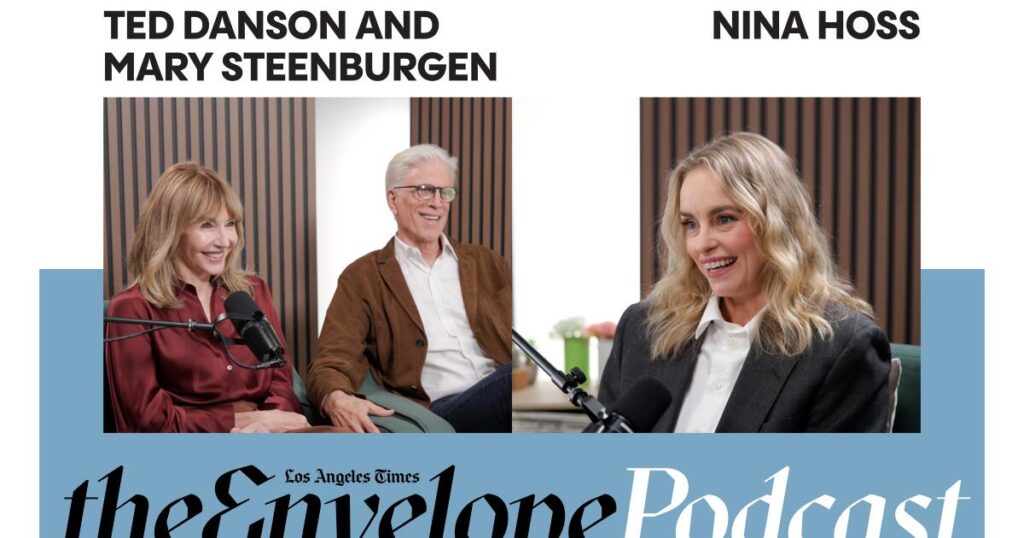
In the latest episode of The Envelope video podcast, beloved Hollywood couple Ted Danson and Mary Steenburgen discuss working together on “A Man on the Inside” and Nina Hoss explains the work that went into her gender-swapped performance in “Hedda.”
Kelvin Washington: Hey everyone and welcome to a new season of The Envelope. I’m Kelvin Washington alongside the regulars, Yvonne Villarreal and Mark Olsen. Great to have both of you here. Hopefully everything’s been well since the last time we chatted. Everything been good?
Vilarreal: Yeah.
Olsen: Doing great. Was that like a question mark with you, Yvonne? Is there something you want to tell us? This is like a therapy moment.
Villarreal: Life. Life. You’re never too sure, I feel. Are you sure?
Washington: Listen, that’s why I opened it up. Because I know that response.
Villarreal: We’re getting there.
Washington: Well, it’s good to see both of you. And we got some great stuff to talk about here. Yvonne, you had a chance to talk to Ted Danson and Mary Steenburgen about Netflix’s Season 2 of “A Man on the Inside.” Tell us a little bit how that went.
Villarreal: Look, you guys know I love my romantic comedies, and I felt like I was just in the presence of one when they were here. Season 2 of “A Man on the Inside,” Ted Danson’s show on Netflix, he plays Charles, who’s this retired professor and a widower, and he’s also found this new lease on life as a detective of sorts. And this season has him infiltrating a college and pretending to be a professor to solve a case. And there is where he meets Mona, who’s a music professor there. And he’s very smitten by Mona. And it’s, you know, the first time that he’s felt this way since his wife has passed.
It’s such a tender look at love at this stage in life, and it was really fun to watch them together talking about the role. And they’ve worked together before, so you know, the fact that they continue finding ways to sort of reconnect onscreen, it’s really lovely.
Washington: That must be lovely at home. Because a lot of people use work to get away from their partner. They’re like, “Let me get away from you. No, I gotta go to work. I gotta go to work. No, you stay over there.”
Mark, I swing over to you. You had a chance to sit down with Nina Hoss in Henrik Ibsen adaptation “Hedda.” Oscar Buzz, a lot of folks talking about it. What was that conversation like?
Olsen: That’s right. So German actress Nina Hoss has actually played the title role of Hedda Gabler onstage. But here in Nia DaCosta’s new film “Hedda,” she takes on a supporting role. It’s a part that is originally written for a man but here is being played by a woman. She’s a former lover of Tessa Thompson’s lead character of Hedda, who’s now sort of a rival for a job with Hedda’s new husband. And, you know, just that seemingly simple change is just indicative of what is really fresh and electric about this adaptation. And Nina’s performance is just really intense and exciting as a woman who thinks she can get ahead in the world just using her mind and force of will, but at a time when society thinks otherwise. And this was just a great conversation about sort of the art of adaptation and also how you put a really fresh new spin on a classic text.
Washington: And that seems like that will be the challenge, right? When you come to something — it could be a great novel, it could be a great play — and you’re trying to find your spin on it, gender-swapping is a great idea, a fresh new way to do that. So looking forward to hearing that. Right now, let’s go to Yvonne, Ted and Mary. Let’s hear what they had to say.
Yvonne Villarreal: Ted, the new season of “A Man on the Inside” takes your character Charles and his brilliant spy skills and brings them to a college. There’s a case involving a rich benefactor who has plans to basically hollow out the essence of this school. And Mary, you play one of the professors there who becomes a bit of a love interest for Charles, his first since his wife passed. Had you two been looking for another chance to work together? How did this come about?
Ted Danson: I will just correct you. More than a bit of a love interest. My character is smitten.
Villarreal: Yes, hardcore smitten.
Mary Steenburgen: We love working together. It’s fun and it means we both are in the same place at the same time, which is always nice. This just came about because Mike Schur and Morgan Sackett, who are the geniuses behind the show, somehow had the genius idea of letting me come play with them. I was so honored to be asked, and I loved every minute of every day that we did that show. We had the greatest time.
Danson: We’re both acting nerds. We both love what we do. We both were taught basically the same method, and we could wake up every morning and giggle and laugh about the words we got to say and the things we got to do that day, and it was really, really kind of perfect.
Villarreal: Tell me more about that. This is a time where you’re allowed to bring the work home with you, right? What did that look like, rehearsing or practicing? How much did you do together or separately?
Danson: Really just trying to get the words down, as far as doing anything at home. The rest you just come and play and see what happens.
Steenburgen: I think we always give the other grace about bringing the work home with them because we both know how it feels; even if it’s something that is very different from what the other one is doing or [if] the other one’s not doing anything, we try to be there for each other. One of our daughters, Katrina, [has] helped us with line learning, which is very nice of her. But we really try to be there for each other as a sounding board whenever we’re working. Plus, it’s just fun telling stories and set gossip.
Villarreal: When we spoke ahead of the launch of the first season, you [Ted] talked about how, when you were approached with this role, you sat down and watched the documentary [it’s based on], “The Mole Agent,” with Mary. What do you remember about him considering this project and you also watching that documentary with him?
Steenburgen: We were blown away by the documentary. It’s funny and it’s moving, and we saw why Mike and Morgan had chosen to go with this beautiful story. I also instantly could picture Ted trying to handle the technology that a spy might need to use. And it made me laugh to even think of it. Even though he’s he’s a little better at it, it’s still part of the theme of the show in the second season too.
Villarreal: She’s just calling out your tech skills, Ted.
Danson: What’s very funny is when somebody’s having trouble, the other one will reach over — with confidence — take their phone and then [also] not be able to succeed.
Villarreal: I remember you said when you get logged out of your streaming services, you get irate.
Steenburgen: Oh no, we’re both lost. We have two wonderful, young assistants. They’re a couple. And we call them and we go, “What is our password to Netflix one more time?” And they’re like, “Why are you even having to do this again?”
Villarreal: I share your frustration. It’s something I battle every day too. Then putting your last name with a remote — it’s not how things are supposed to be done.
Steenburgen: No.
Villarreal: Grief and aging are themes that are really hard to talk about. I struggle talking about it in in relation to my mom because I don’t wanna think about it. Are these things that you two talk about with each other or with your kids? How do you feel about broaching those topics?
Danson: Really good, because here we are — No. 1. And It’s interesting because we both have very definite points of view of what happens in the afterlife, about everything and about living your life fully. Jane Fonda, who I met obviously through Mary, because she worked with her, was and has been such an inspiration of keep[ing] your foot on the gas pedal, or power pedal, and don’t slow down. Don’t try to make it cushy. Just keep going. Keep leading a purposeful life, keep trying to make a difference and don’t let the age thing even mean anything. It’s a friendly topic to me. I’m if somebody comes in and says, “Ted, you have five minutes …” I’ll [go], “Whhhaaaa??” But there’s so many gifts that come at our age, and one of them is — first off, [that] you made it to your age is a gift, and the other is the word gratitude means something. And Mary, to me, has always been a little more curious to me, and I’m learning how to allow myself to be more curious with gratitude and curiosity.
Steenburgen: We talk about death a lot. We talk about the possibility about each other and ourselves. But we talk about it a lot because we’ve lost a lot of people we love. I lost my friend Diane Keaton a couple of weeks ago, and I found out as we were boarding a plane to Japan. Part of that trip for me was was thinking about her and sending her love and honoring her. We went to a lot of Shinto temples and things like that on that trip, and I took a moment everywhere I went to to say a prayer for her, to light a candle for her. And then the following day I lost my Aunt Freda, who was 100 years old. And so you could say, “Well, she lived to be a 100,” but she was such a bright, generous inspirational light in my life that I never wanted her to leave. So I was also mourning her on the trip and and our kids lost —
Danson: My kids lost their mother two or three weeks ago, and so we’re around grief, and sadness and loss. And it just feels — sorry, I interrupted you — genuinely part of the journey, not some unfortunate, “How did that happen?”
Steenburgen: I think we sort of look at life rather holistically. So birth and death are very much a part of it. I’m not afraid of it. I’ve held someone in my arms as they take their last breath, and my very best friend in the world, we were two of her caregivers for the last three months of her life. And there’s a lot of beauty there — whether we all can bear it or not, is it’s one of the two things that we will always all have in common. We will be born and we will die. And in between, man, you gotta remember how much love you can give. That is kinda the ultimate —
Danson: And because there’s so much suffering — there’s suffering, there’s anger, there’s sadness, there’s fear — your job becomes clearer and clearer in life, which is to be as kind as you can, to love as many people as you can, to nurture them, to come from hope and not fear and anger, is a good purpose.
Villarreal: Have the conversations with your kids — not even just about death but aging — do you find that they’re as resistant as I am to think about it?
Steenburgen: They don’t seem as freaked out. I think our granddaughters have expressed a little more worry about us aging and/or losing us because they have friends who’ve lost their grandparents or something. But I have assured the one that worries the most that I feel just fine. And that I think it’ll be OK for a while. It’s a family where there haven’t been a lot of topics that are we’re afraid to tackle, and there’s so much love. Our family is very close and anybody can say whatever they want, and it’s listened to with love.
Danson: Except us talking about our career and then they couldn’t be more bored.
Steenburgen: Yes, that is the one thing! I tried to say something to my son today and he’s like, “Mom, I literally was just telling you something about myself and you turned it into something about yourself,” and I went, “Oh, yeah, right, I did do that. OK, I’m sorry.”
Villarreal: To go back to the storyline we see between your two characters this season — it’s often a joke among couples, this question of: “If I die, will you marry or date again after me?” And the hope is that the person will say, “No, I’m totally devoted to you.” Have you asked him this?
Steenburgen: No, what I’ve said is, “If I go first, people will be lining up.” So, no gold diggers. Be careful — better off if you just give it a miss and remember me. I don’t really mean that and I’m working on it. I actually just finished making a movie that that was the theme in it. I’m trying to be a better person, but I have a long way to go in that particular [area].
Villarreal: How do you feel, Ted?
Danson: Oh, a really long way. Oh, sorry. What was the question? How do I feel about it?
Steenburgen: How would you feel? If you’re watching from heaven or whatever you want to call where we go.
Danson: I will be in a place where that human stuff probably won’t be bothering me as much. But I’ll tell you how I feel now. Here’s an example of probably how I would feel. Mary’s an actress, she’s a leading lady. She kisses men, part of her job, on film. I get it, I’m an actor, I get it, I totally get it. I really do in in my heart. Then I see it and my eyes go f— nuts. My eyes go nuts.
Steenburgen: You’re eyes would have gone nuts a couple of days ago if you’d been [on set]. [Danson makes a loud noise to avoid hearing more.]
Villarreal: Do you want a waiting period? Have you, like, made stipulations?
Steenburgen: I think we’re just gonna plan on living for a while. We’re gonna be Aunt Freda and live a long, long time. It’s a toughie because you feel like there’s an answer you’re supposed to give and then there’s an answer you wanna give.
Danson: All bets are off. Life’s for the winning.
Villarreal: What moved you about the Charles and Mona dynamic? What did you enjoy exploring there?
Danson: My character finally came out of a shell at the end of [last season] and found that community and purpose revitalized him. But the idea of loving again, and the sense of maybe, is that betraying [your late spouse], is that bad for your kids? Is that betraying your memory of her, your love of the person who passed? For me the most fun thing to play was just how smitten he is. He’s so smitten. He’s never met a creature like this, and there’s lines [Charles says] like, “I wait for the signal to cross the street and I cross on the sidewalks and she cartwheels through traffic in life.” It’s just so much fun to play. I hate romantic scenes. All I do is, in my career, talk about sexuality and sex. I never am the person who does it. I play Sam Malone who makes jokes about it. So the idea of making out or something on film is a little bit, “Ah — really? Ah —shoot.” But now it’s Mary. I get to fall into her eyes. And it was just the most fun.
Steenburgen: Oh, my God. The women are going to be lining up!
Danson: Yeah, but our kids will be throwing up.
Villarreal: You’ve been married for 30 years. How did you approach giving a believable performance as new romantic partners?
Steenburgen: I wondered about that before we did it. And part of it is just that they write so beautifully and so well. Mike is so deeply funny, but he’s also so concerned with the heart. Once we got down to it, that didn’t feel hard. What I told myself about Mona was [that] she’s had quite a few different experiences with people. Her world is music; she’s a music professor and those students, she really cares about, and that place, which is this wondrous college as some colleges can be, where people find themselves or find a community or feel a part of something. And that’s her world. So for her, he’s a revelation because he is so different from her. My character is a little like me … right? [She turns to Ted for reassurance.]
Danson: Goofball? Very much so. The thing about time is, it’s all emotional. I’m much more literal and that’s Mary too. I’ll be looking at my watch going, “Come … we gotta get going.” Mary’s like, “No, I need to have that this moment have its full emotional impact.”
Steenburgen: I’m not just chronically late — [don’t] just to give me a bad reputation. I’m not! I’m not!
Danson: I know you’re not.
Steenburgen: I’m not late for work.
Danson: No, but what I’m saying is true. I’m much more kind of rigid about time and I’m worried about being late, whereas you —
Steenburgen: I get lost in things.
Danson: I meant it as a compliment.
Steenburgen: [jokingly] I’m only worried about my career and all the people that won’t hire me because now they think I’m late.
Danson: Can I jump in on the playing a love scene with somebody you’ve been with [for a while]? The writing is amazing. So the situation is set up for it to work. But the other thing about intimacy is that you really listen to the person that you’re feeling all these intimate emotions [for]. And we went out of our way hard because in acting, for me, 50-50 at best I’m pulling off really listening or really in the moment as opposed to whatever. We really went out of our way to connect before each take, and we both studied with the same teacher — I didn’t study with the teacher [like Mary], but I studied the method of Sandy Meisner. Instead of just saying “break a leg” as we were about to go do a scene, we’d say “break a leg” and then “Sandy” for Sandy Meisner, who was all about working off the other person, listening and not doing anything until the other person makes you do it. It really did help both of us to be in the moment. And that’s intimacy.
Steenburgen: I also just thought that if our editor is listening to this podcast, he’d [say], “That’s who ‘Sandy’ was! I tried to figure out who on the crew is named Sandy that they’re talking to before every [take].” No, it was very centering and I found it a thrilling experience working with him.
Danson: Me too.
Steenburgen: I mean, part of the deal in this marriage is that I before I ever met him, I had such respect for him as an actor. What he does so elegantly and beautifully to me is the apex of the things you can do as an actor. I love drama, but every kid in acting school learns how to cry their eyes out. That’s a no-brainer, but this delicate thing of making people laugh, it’s not easily taught. It’s something that you either have or don’t have, and long before I knew him I’m watching he and Shelley Long be freaking brilliant together, like ice skating, with such precision. I was a fan. That’s all still there for me when I act with him.
Villarreal: You’ve worked together many times, but did it bring up anything from [the first collaboration, 1994’s] “Pontiac Moon” for you? Do you remember the first time that you worked together — not necessarily the personal feelings but who he was as a scene partner then, who she was as a scene partner then?
Danson: It was all personal.
Villarreal: You were smitten then.
Danson: Oh, dear lord, yes. Couldn’t get enough. It took you a moment because I was a hot mess.
Steenburgen: You were a little scary. You weren’t a hot mess, but I didn’t see it coming. I thought, “Oh, wow, I think I’m gonna be friends with this guy.” That was my big revelation. And just excited, like I said, to work with somebody I respected that much.
Villarreal: But you [Ted] were like Charles. You were over the moon.
Danson: 100%.
Villarreal: How does the nature of love in your 70s compare to the 20s or 30s? Often with love stories, we get the young couples seeing each other, the meet-cutes, but we don’t often explore people in their 70s finding love again or finding love after losing who they thought was gonna be the love until the end of time.
Steenburgen: In some ways in our life, we are very mature, and in some ways, we’re insanely immature. If someone did film us over 24 hours … you know how some people like their whole family and themselves to be on camera as a TV show? I would die of embarrassment because a massive amount of time is taken up by us singing sweet songs to our dog that we make up. And talking to him in the stupidest voices,
Danson: This is the PG part.
Steenburgen: Yeah, that’s the PG part. We have very low senses of humor. I made “Step Brothers” for a reason. That’s right in my sweet spot of sense of humor.
Danson: And making each other laugh no matter how low or high the humor is, I’ll speak for myself, is our great story.
Steenburgen: It’s our goal, all day long, to make each other laugh. That and trying to get through all our puzzles in the morning that I’m ashamed to say we do together. Because together we have a really good brain, but separately neither of us can finish them.
Villarreal: I was like, why is she ashamed of that?
Steenburgen: Well, I’m a little ashamed that people get to Queen Bee [the term for when a player finds every possible word in a given day’s puzzle on the New York Times’ Spelling Bee game] by themselves and Ted and I are going, “Did you get that one?” I think you asked me a question about characters, but I’m describing us. But I think the idea of being new and meeting each other at this age was exotic to us because we have lived together for 30 years. I never thought I would say that in my life. In fact, right before I met him, I’d given up all hope of being in any relationship at all. I was so bad at it that I said, “I present like I’d be good at it, but I’m actually not good at it.” And then I met him, and 30 years of happily living with another person is such a gift in life. It’s also fun to imagine, what if I’d never met you until now? Hopefully we brought that to life.
Danson: You’re not casual about life at this age. You are grateful. … There’s not a heaviness, not a seriousness, but a “Wow, are we lucky?” Old age is, “Look where you got to. Aren’t you lucky?”
Villarreal: There’s the moment in the Thanksgiving episode where we see just how their differences are working against the relationship. Mona’s very live-in-the-moment, Charles is a little more rigid. I also love that they’re not willing to compromise, they know what they both want right now.
Danson: Is it OK for us to talk about this for people who haven’t seen it? I don’t [want to] give away the whole ending. I’ll talk about us in life because I do that. I can be way more rigid than Mary —
Steenburgen: I think I scare him to death quite often. But I go, “Let’s do this right now.”
Danson: Or here’s my favorite: “I had a thought …” We know how good her idea is when I say, “Oh no, no, no, no…” The more nos I say, the more we both know it’s gonna be fantastic and I just need to surrender.
Villarreal: What what was the last idea that you surrendered to?
Danson: Can’t remember.
Steenburgen: Well, our dog would be one.
Danson: Oh, well that’s a big one. I said, “No, no, no, no more dog.” We had we lost our beloved [dog]—
Steenburgen: Our dog lived to be 18 and we lost him. … And that caused us, not for the first time, to be living life without a dog for one year.
Danson: I finally looked at her one day and went, “Oh, I am hurting her soul by saying no to a dog.” And it’s turned out to be the biggest, best, joyful thing.
Villarreal: Thank you for giving in.
Danson: I’m slow but I’m not terminally stupid.
Villarreal: Before we wrap things up, I want to return to something that you mentioned earlier — there was a time, I think you said, when you turned 70, or your early 70s, where you did think about slowing down, but it was during the time that you [Mary] were working on “Book Club” with Jane [Fonda], seeing her really put a lot of thought into the stuff that she was doing at the time invigorated you. Talk to me more about that, because that quote really spoke to a lot of our readers. I got a lot of emails about you saying, “This is your time, take advantage of it.” And it doesn’t necessarily have to be with work. I think experiences too. What’s your advice out there for people?
Danson: I think all this slowing down, being careful — well, careful is not bad — but I mean going, “Oh, I don’t know …” is based on fear. And I think as soon as you turn that fear off and start coming from love, start coming from gratitude — you’ve been given this life. And staying curious — all these things that invigorate you are the things that you should be surrounding yourself with, those thoughts. There’s sadness and suffering and all that stuff, a lot of things need to be done and da-da-da-da-da. You need to contribute. You need to make things better. You need to be purposeful, you need to be an example for younger people. You don’t have, as a young girl or a woman, you don’t have a shelf life. You can be purposeful and contributing and changing people’s lives and making things better.
Steenburgen: Jane is inspirational on so many levels and having grandchildren that she wants to save the world for before she exits. That’s front of her brain all the time, and she’s brave and she’s organized and she’s intentional. She’s intentional in her friendships. She’s an amazing friend. She has taught me a lot about love and about one’s own power. [There’s a song lyric that goes], “Is it worth it to love when you’ve so much to lose?” And the answer, whether it’s the things we’ve been talking about, whether it’s loving a pet and trying again when you lose them, or if having a best friend like I did that passed away and then do I dare let myself have friends when I’m this age, the answer of all of it is yes. Yes. The answer is always yes to anything to do with real love.
Danson: I don’t live in this part of the conversation we’re having. I will become fearful, scared, depressed, and then literally like a balm — B-A-L-M — going, “Stop that. Count your blessings.” Oh, and then hope and then love and then get out of yourself and focus on the other person is like medicine. Be supportive and loving and kind for a selfish reason. You’ll feel better.
Villarreal: And then does it also play into what allows you to do something like get on an electric scooter?
Steenburgen: I died when I saw that.
Villarreal: I thought the glitter bombing was hilarious, but you on a scooter …
Steenburgen: I hadn’t seen that either until we watched it together, and I started roaring. I won’t give away what happens, but it’s funny before whatever happens happens. Just you on a scooter is funny. The way you stand —
Danson: As a kid you used to run [makes vocal noise to illustrate swiftness]. Then you reach a certain age and you can’t [repeats the vocal noise illustrating swiftness]. Well, I’ll adapt a way to run so that I don’t hurt myself. And people will go, “Oh, that’s such a funny run.” And I go, “It’s my only run.
Mark Olsen: You co-star in “Hedda,” this very exciting adaptation of Ibsen’s “Hedda Gabler,” directed and written by Nia DaCosta. And in the original play, your character Eileen Lövborg is a man, Eilert Lövborg. What did you make of that switch when you were first presented with the project?
Nina Hoss: Well, to be honest, when I first read it, I was like, “Why hasn’t anyone ever thought of that before?” Coming from the German theater scene, which is quite adventurous, I would say we don’t shy away to take the material and do something new with it. And I was really astonished that no one had thought of that. I enjoyed it so much because I think the main work for me was that I had to forget about that. I just had to look at this character as a totally new thing because she changes the whole dynamic of the whole play or film. The more I was working on Eileen, the more I felt the depth of that character, the struggles she was going through. Not so much with Eilert Lövborg. It’s more of a clear-cut — he’s struggling a bit. He’s an alcoholic. But he has a little love affair with Hedda and he comes and tells her about his adventures, his sexual adventures. And they have a little love amoureuse thing going on. But he’s the hero, in a way, that brings the world to her. So she’s looking up to him. And with Eileen, it’s more of, they’re on the same level. And that changes the whole dynamic. At a certain point, Eileen made a choice for her life and Hedda made a choice for her life. And that got so exciting to explore that. It was very fascinating.
Olsen: The idea of making this switch, was it still revealing new things to you, even as you were rehearsing and shooting the movie?
Hoss: Yeah, because it’s very confusing. It is still the Ibsen play, but I really think you don’t need to know the play at all to be able to enjoy the the film, because it’s its own thing like that. And you don’t even have to think about, “Oh, this was a male character before.” So while working on it, it’s like a thick scaffolding, that play — and it works. Ibsen is such a phenomenal writer. And he’s meticulous. So if you change something that big in this material, of course, things go a bit leaning that way. And so you have to, in each scene, make sure that you get out of it what’s needed for the story, but also for Hedda, that you don’t ever lose her storyline of finding the motives for why she does things. And for Eileen, why? What does she want to be there? Why does she go back to the bear’s den? What is so fascinating about Hedda that she can’t help but go back there, even though she knows it’s probably not going to go well? And so all these things, that was new.
Olsen: There’s a wonderful moment in the in the film where your character and Hedda, played by Tessa Thompson, and Thea, played by Imogen Poots, the three of you are kind of in a corner at this party and you’re talking amongst yourselves, but you’re also looking at everybody else at the party. And just the all the intersecting dynamics of that, I found it really exciting. To me, that was a moment where the movie really clicked into place. Can you talk a little bit just about shooting that scene in particular, where the three women sort of got this chance to be together amongst themselves?
Hoss: It is kind of a triangle, isn’t it, between Thea, Eileen and Hedda. Thea is a character you might think doesn’t have much agency, but she’s the one who actually knows what she wants. And she’s the bravest of them all on this night, so to speak. So it’s like three women that have an agenda on that evening. And because that’s not something that everyone’s used to, you kind of pretend as if you’re having a little chitchat while being observed by everyone. The three of them know. So what was really helpful for that scene was that all these beautiful actors around us, the ensemble, they were all there the whole time for this whole scene, even the ones that you don’t see in the background. Just to give us the feeling that we’re in this party. And that, of course, helps so much because you feel observed the whole time. It has a certain urgency. It’s like a pressure chamber in that moment. So I think that’s what we were working on. But also to not lose the fun with it. Because Hedda is very witty. Eileen is quite witty and Thea is a little bit like, “What is happening? I’m going to understand what you two are doing.” So all of us had a different dynamic. That’s what we were working on in that moment. And from that moment on, because Hedda does something to Eileen which changes her for the night. And so it’s a pivotal scene.
Olsen: And now the party aspect of the movie, the production, was that true for you as well, that you had to be in the background of shots or scenes that you weren’t in? Did you feel like you were having to hang out and like spend a lot more time on set?
Hoss: Yeah, we were, every one of us. I think we were the whole time there. I mean, if you knew you were in the other room, then we were in something which was actually called, by the house owners, “the dog room.” That was the only one where the actors were allowed to to be and to drink water, because it was all very holy, the whole house, the whole estate. Nothing could happen to the carpets, to the stone floor, so we couldn’t run around and have something to drink. So we were parked in “the dog room.” Which was fun, because then it happened that you started playing cards and we became a real ensemble. But also that meant when it was needed, we immediately all went and were part of the scene. Or if it was needed that were in the background for our fellow actors and colleagues, then we would do that. It was like two and a half months, I think, of night shoots and of being on this estate and being there every night. It was really like a trip at a certain point.
Olsen: You yourself have played the role of Hedda Gabler onstage in Germany. What sort of conversations did you have with Nia, with Tessa? I’m assuming you have your own thoughts about the character, her motivations, why she is the way that she is. Would the three of you sort of mix it up and talk about what the deal is with Hedda?
Hoss: It’s such a fascinating character, Hedda. And that’s why all of us want to play her once in our life. It’s maybe like Hamlet for men. Because it’s one of those characters that you don’t quite understand her motives. And she’s haunted just like Hamlet as well. She’s haunted by this father, this general with the guns. And she is haunted by the expectations that she thinks society has on her. But also, she’s her own person and she is very free in that. And she’s also looking for power. She’s striving for power over other people’s lives because she doesn’t quite feel that she has power over hers. Where that comes from, and if that’s necessarily only the pressure that comes from society, you don’t know. This is the smart bit about the writing, that I think all of us can interpret it in our own way. And so I was really just excited to see what Tessa is going to do with it and what her interpretation of this was. Because no one owns Hedda. She will always be a fascinating and modern character, I think, even in the next 200 years. It’s also not just about the female experience. Yesterday I was talking to someone who said, even being a man, it is about agency. What do you want in life? What are the decisions in life, what makes you go, “I need to explore that in life.” And what holds you back? And then why do you think then you have to destroy others and take what they have away from them because you can’t have it and all these very sadly human movements and emotions. And you can find that in Hedda, but also in Eileen. You can find it in Thea. It’s just an incredible ensemble of characters whom you find fascinating, sometimes in an evil kind of way, but they stay fascinating and you root for them, strangely.
Olsen: Is that why you think Ibsen’s play “Hedda Gabler,” and in particular, this character of Hedda herself, have continued to hold such a fascination for people and why there’s just something eternal about that play?
Hoss: There are not so many female characters out there that are like Hedda, where you can explore the human and the female condition, really. And because she runs away from your interpretation. And I find that highly fascinating. I think that’s why it will be relevant for a long time, this character, because it’s very hard to write. Also, I’m really in awe of Ibsen’s and Nia’s writing, because what Nia changed also is what you don’t see in the play — like the party, you hear about the party, but you never see it. So there are endless options with this, but the central character Hedda will stay always fascinating, I think, for everyone.
Olsen: What in Tessa’s performance and Tessa’s version of Hedda did you come to kind of appreciate or see as nuances that maybe she was finding that you hadn’t thought about before?
Hoss: I was really amazed by her very strong choices with the accent, the way she speaks, the way she holds herself. She doesn’t show a lot of what she’s up to next. But you can always feel this, like a snake a little bit. So there’s always something you never know when the snake will go. She found that quality in Hedda, which is really amazing. But then in the quiet moments, you sometimes feel you can tell why she does that. You see the wound, you see the hurt of Hedda, the longing of Hedda. But then she denies it again. She doesn’t give you the secret to her soul. It was just really great working with her because she would not show much of what Hedda was feeling and thinking of you. Eileen was always kind of calibrating, “I know you very well, but what are you up to?” So for me, it was like this movement the whole time, and of course, she does mean things to her, but Eileen stands up for herself and is also a little crazy herself.
Olsen: It’s so interesting to me that Tom Bateman, who plays Tesman, Hedda’s husband, he had actually played your character of Lövborg onstage. So did the two of you sort of have a sidebar talking about Lövborg?
Hoss: He didn’t tell me. I found out on a Q&A the other day. Thank God, I think, because otherwise… I don’t know. Maybe it wouldn’t have mattered. In a way, it was also there. Eilert, now Eileen, and George Tesman, Hedda’s husband, have quite a big scene where George somewhat opens up and asks Lövborg for help. Like, “How do I deal with my wife? What do I do? How can I rein her in? What do I need to be doing? Who do I need to be?” And that scene all of a sudden had a slight sexual undertone because Eileen would play with him in a different way. There was something, and we were both, “Oh, is that in it? OK, let’s explore.” I think that he was curious what my Eileen would be like, which I didn’t know. And he was so up for it, to look for all the new doors that are opening up with these characters because of the change, the gender reversal.
Olsen: Throughout the film, Eileen is sort of slowly unraveling in part because she starts to get more and more drunk, and movies, they’re shot the way that they’re shot, usually scenes are out of order. Just on a practical level, was it difficult for you know how drunk to be in a given scene? How did you keep track of that?
Hoss: By discussing it with Nia and always making sure, “What level is this now of drunkenness?” And then I thought sometimes it doesn’t matter because you might be very loose and drunk in a moment. But then if adrenaline kicks in, you lose it again. So if you really come back, like you’re on the lake, you’re pretty drunk and you can’t hold yourself anymore. But you come into the bedroom where you have a scene, just the two of you, either with Thea or with Hedda, then you become a bit more clear because you have to. So it was also looking at what does the scene need and Eileen need, and also that she has a bit more clarity in points, also by the way she speaks and all of that. So I felt fairly free with those decisions. But I wanted to make sure it has a bow and she’s not completely out of it the whole time. That would be slightly boring.
Olsen: There’s a wonderful scene where you are the only woman in a room full of men, these academics who really, in a lot of ways, hold the future of Eileen’s career. What was that scene like for you? What was it like to really let loose like that?
Hoss: I was terrified of that scene and I was so looking forward to it as well , because I just love the way Eileen doesn’t care and how she enters the room and says, “I’m going to make this my room and you’re all going to listen to me no matter what.” But she knows how to do it. She doesn’t force herself on them. She’s just very witty and brilliant and quick in her brain. She says the right things and she provokes them, but not too much. And she basically makes them think, “Oh, God, I need to read the book that she wrote.” There’s also the competition with Tesman, and she just shows him, You have no chance, my friend. Is that because she had the alcohol? Is that a vehicle that she needs to be so free and daring? I don’t think so, but it happens. So she uses it to her advantage. But it goes wrong.
Olsen: That’s one thing that I think is so exciting about your performance, is the way you’re constantly moving between this depiction of Eileen as someone who has this armor and bravado and is very confident in her intellect and knows that she’s good at what she does, but then also having this vulnerability and insecurity underneath that. And there’s always this tension between those two things happening.
Hoss: That’s what I was looking for in Eileen, because I think that’s something we all can relate to. None of us are just confident. And even though you are confident, you have moments of deep insecurity. And Eileen is a wounded character. She’s had to battle her way to where she’s at when you see her in the film. And that left marks and scars and wounds behind that you overcome, but you can never be quite sure that it’s going to stay that way. And she’s still battling and she’s still fighting for agency, for her personhood. For example, the scene where she tells Tesman that she knows Hedda since she was a little girl and always saw her riding on the horse past her window and [Eileen’s] mother would stand behind her and would kind of go, “What a terrible little girl that is. And it’s a bastard.” And this little girl, Eileen, [feels] something for that girl on the horse, being free with the pistols of her father. And so that evoked something in her. Maybe she fell in love already then. So she knew, “I’m probably a gay person.”
She knows she’s brilliant. So she follows her desire to become an academic and a writer, first and foremost. That meant a lot, we’re in the 1950s and Eileen is really able to be where she’s at in this party with all these men. And she made her way through it. And you can’t tell that story without showing her scars. And I think her biggest pain maybe is that she couldn’t have Hedda.
Olsen: That also makes the fact that she’s now in this competition with Hedda’s husband — and Hedda in some way is aiding her husband in that regard — it makes some of what Hedda does even more painful for Eileen.
Hoss: I do think Eileen is in love with Thea. And I do think when she says, “I really love her and I know that you’re incapable of having that feeling, giving yourself to someone and really taking care of someone you care for,” that is very true. But also Eileen doesn’t quite know what that takes, what a relationship takes, the give-and-take. Because she’s also not just positive, she doesn’t let Thea’s name be under hers on the manuscript. And maybe it’s a bit too early also, you could argue. But they’re little signs that Eileen is also in it for herself in many ways. So that’s where Hedda and her meet.
Olsen: There’s the challenge of Eileen’s love for Hedda, but then also knowing how in this circumstance, how dangerous Hedda is for her.
Hoss: But I think that’s also so relatable, that you know you shouldn’t be doing this. Like when you’re a kid, you shouldn’t touch this, but you just need to because you can’t. So that is, in a way, Eileen’s situation. And also, I always thought she goes there to test herself to see if she’s really ready, for society, but also to face Hedda. And I really believe when she says, “I came here to see if I’m still in love with you. And I had to make sure I’m not so that I can give myself to the other person.” In that moment, I think she feels it, but she still trusts Hedda too much. That’s her downfall. And I think she would really love Hedda to stop playing around and look at who she really wants to be and be brave enough to follow that desire. And then again, Hedda would probably say, “Well, you don’t know what I want.”
Olsen: Nia and Tessa have worked together before. They have a very close working relationship. Nia wrote this for Tessa. What was it like for you sort of inserting yourself into their creative dynamic? What was it like collaborating with the two of them?
Hoss: I loved it because they were so open from the very get-go. I remember my first meeting with Nia on Zoom. I think for two hours we talked about this play and and we came up with ideas and where I thought, “Oh, my God, this is going to be so exciting.” And I felt very invited into their process, because Tessa is also a producer on this. And so they, of course, they are a strong couple, these two, working couple. I enjoy that so much if you feel people are working in a collaborative way on something and inviting everyone in this beautiful way in to find it with them, and that was the feeling they gave all of us.
Olsen: Given your background in theater, do you find a big distinction between stage acting and screen acting? In part I’m curious if this adaptation of “Hedda” were performed as a stage play, how would your performance of Eileen be different?
Hoss: When I was younger, I thought there was a difference. And the more I keep doing this, both theater and film, the less I think there’s a lot of difference. Not in the way of the thought process. There are technical things, your voice has to be louder, those kind of things. But in the actual process of rehearsal and then also doing the performances or being in front of the camera, to me, there’s not such a big difference. So I think I wouldn’t have changed much because I also think the more quiet tones and the finer little nuanced details, you can also put them across when you’re onstage.
Olsen: How have you come to learn that distinction and how to modulate your performance, like knowing what you can do for a camera versus what you’re doing for the audience? How have you come to learn those distinctions?
Hoss: There’s a special relationship with the camera that I have the feeling some of it, it will just take. I don’t have to give it to the camera. I know she’s there and she’s going to take what she needs, and you don’t necessarily have that in theater. That’s because there is no close-up. Let’s say that is maybe the biggest difference that there is, zooming in on the thought process or that it’s only the eyes that you see or that someone decides for you what you’re going to see. In theater, you just have this plain view and you have to work probably more with your body and all to bring the same things across. And also, with Eileen, she is somewhat a performer. Hedda is a performer. They perform for society because they have an idea of who they want to be within this circle. And then they perform that. But when you see them alone, there’s something other that you can show onstage as well. But it’s of course more intimate. Maybe that’s a big difference. The intimacy with the camera and the colleague in film, that’s just unparalleled.
Olsen: I’d seen in another interview you did where you were talking about some of your acting heroes, other actors that you really admire. And you mentioned specifically Paul Newman and Bette Davis and Gena Rowlands. And I was so struck that those are three American, Hollywood actors and as someone who literally grew up around the theater in Europe, how did you sort of come to appreciate that American, Hollywood style of acting? And what is it that you like about it?
Hoss: I just grew up with it. I could add Marlene Dietrich and Greta Garbo and Katherine Hepburn and so many more, Liz Taylor. I was never allowed to watch television as a child, because my parents wanted that I do other things than just watch something. And so I was always allowed one film on Sunday. And that was always, most of the time, a black-and-white film, because that was on television. And I’m that old that I grew up with three channels on television, so there were no other options and which was, in a weird way, also beautiful. You were so excited. You were waiting for this film to start and you had your hot chocolate and blanket. And I was so looking forward to this moment on Sunday where I can watch a film. So I was really just letting myself go into these other people’s lives. And of course, I was so interested later on to see, “How did they make me do that? Why did I get lost in their eyes?” And what is so special about Bette Davis is an incredible inner strength and the way she talks. And then you just see a little flicker in the eye and you go, “Oh, there’s something else going on. What’s happening?” They just showed me that there’s so much mystery in what we’re doing, that there is always something else going on than what you see. And I think American actors still, you’re just masters in that. And it’s unapologetic. I think as Europeans, we’re a bit more cautious. It’s a little bit more internal, all very real. And you make always strong choices. Like Paul Newman in “Cat on a Hot Tin Roof.” Everyone says he’s drunk. But he never plays drunk, just in one moment, I think at the end of the film, so you dare to hold it up to that moment and you just let that people say you’re drunk work for yourself, and then you give them a little, “Oh, yeah, oh, my God, he really was drunk the whole time.” Those kind of choices that the actor makes are just fascinating to me. That’s why I just really look up to them. And Gena Rowlands is her own universe.
Olsen: If I can, I want to ask you just a couple of questions about the movie “Tár” that you were in, because that movie has had such a staying power, it’s remained resonant and I feel like people are still watching it pretty frequently. Did you expect that movie to connect with audiences the way that it has?
Hoss: To be honest, yes. I thought if not, I don’t understand anymore what good moviemaking should be. Because when I read the script, when I heard Cate [Blanchett] would be Lydia Tár, I just thought, “Oh, my God, we’re in for a ride.” But you can never be sure, of course, while you work on it. I don’t think about any of that. I just thought it’s so relevant and it’s so intelligent. It’s thought-provoking and challenging and beautiful. And it’s proper, meticulous filmmaking in every department, and the choices Todd [Field] made and Cate made. With the material, it was just stunning to see and to be part of it. So I kind of felt there was such a good energy that I would have been very surprised if this energy wouldn’t have reached the audience that watches the film.
Olsen: Both in making the film, but then also in the conversations you all were having when the movie was coming out, did you find that your own opinions about whatever people would call “cancel culture” changed or evolved? Did you find that making the film changed your thinking about that at all?
Hoss: I don’t know if it changed my thinking about it, but I just always feel that it again told me there are always many sides to things. Nothing is simple. So you always have to look at the nuances. And especially in the world that we’re in right now, I think that is really the main thing, to not fall for the easy answer. From all sides, it doesn’t matter. There is just no easy answer to anything. We are very complicated and the world is complicated. I saw this film three times and every time I saw, “Oh, it’s about that.” “Oh, she actually did it.” “Oh, no, she didn’t.” Again, it’s a matter of perspective. I think it humbles you, this film, [about] not being so judgmental so quickly and thinking, “I understood this. I know this, done.” No, be open and see if you can see something else that might tell you another story.
Olsen: Before we wrap up, you recently were given an award at the Toronto International Film Festival. And when you were accepting the prize, you said how you believe in the power of cinema. And you said it’s because you believe that cinema creates empathy, which in turn creates kindness. I was very moved by that because to be honest, with everything that’s happening in the world these days, it has to me sometimes felt a little bit like, why are we making these movies or spending all this time talking about these movies? What’s the point? And it was actually really helpful to me to hear you put it in those terms. It made it seem like movies and cinema can matter. Now I feel like I’m asking you to cheer me up a little bit, but could you just talk about that a little more? What to you is the power of cinema?
Hoss: I’m going through these phases as well that I think, “Why are we doing this? Does this matter what we’re doing? With film and theater, is this relevant?” And then I come to see it is. Art and storytelling is maybe the most important thing that we have because we have to tell each other our stories. And cinema is this one place where we can all be together and it doesn’t matter where we come from, what education we have, what our agendas are, what our beliefs are. We’re in this room together, we laugh together, we cry together because we feel empathy for the person we’re with, for let’s say two hours, for the stretch of the story that they’re telling in the most intimate way. You’re in this room with all strangers, but you feel we’re in this together somehow. And maybe it’s a film from another culture also, or whatever, and we understand each other. We’re not so different in what we really want from life and what makes us happy and all these things. So that’s a bit cliched of course, but it’s just, it is the power of cinema. It also shows you the reality. It provokes you, it challenges you. It questions if your belief system is the right one or not, or it shows you, “Oh, I have options.” It’s like that’s what art is for, it’s to provoke me, my brain, and to feel other things. I think cinema is one of the most powerful tools we have.
The post Ted Danson and Mary Steenburgen on playing (and being) ‘smitten’ for ‘A Man on the Inside’ appeared first on Los Angeles Times.