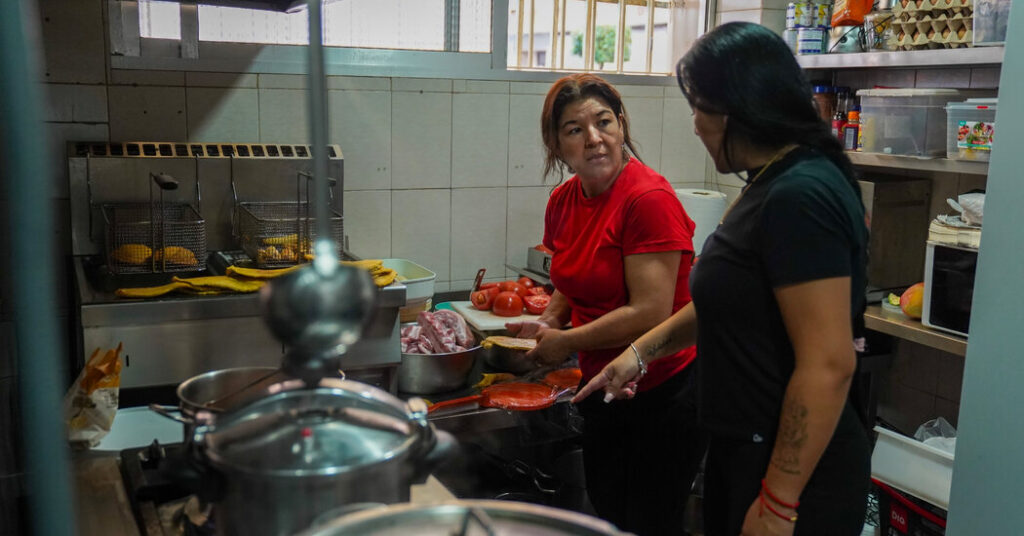
In the Roots of My Town restaurant on Spain’s eastern coast, Luz Fanny Arce Campiño, 53, stirred a rich stew and described how her adopted European home had eclipsed the United States as the most desired destination for friends and family back in her Colombian hometown.
After having arrived in Madrid by plane and becoming “another illegal immigrant” by overstaying a visa, Ms. Campiño said, she established residency in the small town of Paiporta, got work in her brother’s restaurant and was saved by “guardian angels” who rescued her during disastrous floods last year. Now the government has granted her legal status and a pathway to Spanish citizenship.
“I’m happy,” she said.
Unlike the United States and some European neighbors defined by tough immigration stances, Spain’s left-wing government has projected an image of itself as the West’s new melting pot. It has embraced immigrants, especially Latin Americans who speak Spain’s language, share its religion and understand its culture. Even activists who say that warm welcome doesn’t extend to many Africans acknowledge that Spain is an outlier on a continent closing its doors.
The government says it has been motivated in part by progressive values and a memory of Spanish emigration to Latin America, especially during the dictatorship of Francisco Franco. But its embrace of migrants, the government says, also reflects the reality of shrinking birthrates and a dearth of homegrown workers to support vast welfare benefits.
Spain’s more than three million foreign-born workers — with more than a million arriving since Prime Minister Pedro Sánchez took power in 2018 — have helped make the country, by some measures, the fastest growing major economy in the Eurozone.
“Either you open up and grow,” Mr. Sánchez said in a recent interview with The New York Times. “Or you close off and shrink.”
Migration activists argue there is still plenty of distance between Mr. Sánchez’s soaring rhetoric and the reality on the ground.
Many Latin Americans complain of a lingering and snobby colonial gaze. And though the government recognizes it has a rare ability, envied by some of Europe’s hard-right leaders, to attract a population that can more easily assimilate, activists say the government is slow-walking a petition in Parliament to declare an amnesty and grant legal status to an estimated 500,000 undocumented immigrants, mostly Latin Americans.
Critics also accuse the government of a glaring double standard. Many Latin Americans arrive by plane on tourist visas, overstay and expect to find a path toward legalization. They often do. Many Africans, by contrast, arrive by boat and without papers, and find border controls, closed doors or a purgatory of bureaucracy.
Mr. Sánchez rejects the critique, saying in The Times interview that the government is not incentivizing one group over another.
His government has separately pointed out that a large percentage of the country’s legal immigrants come from Morocco and says that it is the anti-migrant, anti-Muslim and growing Vox party that prefers Latin Americans to Africans.
Elma Saiz, Spain’s minister of Inclusion, Social Security and Migration, added in a recent interview that all the anti-immigrant noise on the right amounted to a desperate distraction from what was a clear success story.
“Spain is a beacon,” she said.
Cecilia Estrada Villaseñor, an immigration researcher in Spain who herself came from Mexico, agrees. “For Latin Americans, Spain didn’t exist,” she said. “It was Europe, across an ocean.” But as the United States became less appealing, with the Trump administration cracking down, “people are starting to look to Spain as the country.”
For Spain, letting in immigrants has myriad advantages.
Although the country still has an unemployment rate of more than 10 percent, the worst in the European Union, joblessness is half of what it was a decade ago, and supporters of immigration say new arrivals are filling low-paying or physically demanding jobs that Spaniards are reluctant to take in restaurants, as nannies or as farm and construction workers.
Without immigrants, Ms. Saiz said, Spain “would come to a standstill.”
There is also a political motivation to treat new immigrants well. Many constitute a potential voter base in a deeply polarized country, and the conservative opposition that includes Vox has vigorously courted Latin Americans, especially those from Venezuela skeptical of their country’s socialist policies.
Carlos Flores, a Vox member of Parliament from Valencia, said he would have no problem with leaders prioritizing certain groups of immigrants because, in his view, a Norwegian retiree, American expat or wealthy Venezuelan pose “zero problems.” He said the same is true of “hard-working immigrants” from Latin America whom he trusted to care for his elderly parents.
He argued, however, that the government’s progressive ideology blinded it to what he considered the cultural incompatibility of migrants from African countries and the security risks he said they could bring.
The government counters that stance, pointing out that crime is down compared to 20 years ago, before the latest wave of immigration. And while immigrants constitute an outsize percentage of people convicted in Spanish courts, experts say that poverty is the main driver, and that the crimes are often nonviolent. Last year, the head of the national police said it was “disinformation” that foreigners were driving up crime.
Still, polls suggest Vox’s message has increasing reach.
On Valencia’s annual Moors and Christians festival day — reflecting the centuries-long Arab caliphate in much of Spain and then the centuries-long Christian effort to reconquer the peninsula — Ana Mostazo, 40, wore the shirt of the “Christian Warriors of El Cid” association. She watched an A.I. video on her phone of Christian knights reconquering Spanish towns through the Middle Ages and spoke proudly of her immigrant friends from Latin America. They were keeping the economy afloat, she said, but added, “Moroccans are a problem.”
Spain’s government calls such statements misleading. The Interior Ministry says illegal immigration from North Africa to the Canary Islands and other parts of the Spanish coast was down 40 percent this year. Despite that, the country’s conservatives wanted to adopt a fortress-like mentality common in southern European neighbors with right-wing governments, Fernando Grande-Marlaska, Spain’s interior minister, said in an interview.
“They’re saying we should follow policies like Italy and Greece,” he said. “And we’re being more effective than they are.”
He said the government is seeking a balance in promoting the benefits of legal immigration with efforts to combat illegal immigration. He said that the problem with the amnesty petition, supported by the Catholic Church, was that it could act as “a pull factor” for smugglers to bring more migrants.
He also spoke about how Spain had been “advancing border security” into African nations and said Spanish officials were now working in Senegal, Niger and Gambia. He dismissed concerns about Spain’s working with undemocratic African governments to catch illegal migrants — furnishing some with drones and biometric devices — as Eurocentric and patronizing.
Those who do make it in, migrant advocates say, often live in miserable conditions far from the Spanish dream.
After arriving in Spain from Ghana illegally in 2018, Ali Maiga, 31, has lived with other African migrants in a ruined and rat-infested building next to a cemetery. He took courses in driving a forklift but couldn’t get a work contract to obtain a residence permit to allow him to work legally. He has taken off-the-books jobs in a scrapyard to get by. He has seen his friends back home posting about their success there, he said, but “I don’t want to tell them the story here.”
Some Latin Americans also face roadblocks, especially in the current fraught political atmosphere.
Silvana Cabrera, whose grandfather moved from Spain to Bolivia during the Spanish Civil War, now leads an organization seeking to help undocumented migrants get their papers.
Since becoming a democracy, Spain had undertaken nine amnesties by both center-left and center-right governments. The latest push once had support from the pro-business conservative Popular Party, before Vox applied pressure from the right. Ms. Cabrera argued that Mr. Sánchez felt the political pressure, too, and had resisted issuing a decree because “he’s scared to lose power.”
But many immigrants, especially those from Latin America, tell a happier story.
Ms. Campiño, the cook, said Spain has not only given her a community and work, but Spaniards also literally saved her life. During last year’s deadly floods, she clung to a tree in the raging waters until a Spanish man made a rope of clothes and pulled her to safety. A Spanish woman she now calls her “abuelita” gave her shelter in an upstairs apartment. Because of her terrifying experience, her application for legalization was fast-tracked.
Now, she says, she can’t wait until she obtains a Spanish passport. She plans to use it to go to the United States, but only to see her son and grandchild. “Then,” she said, “I will come back and live here.”
José Bautista contributed reporting from Madrid and Valencia.
Jason Horowitz is the Madrid bureau chief for The Times, covering Spain, Portugal and the way people live throughout Europe.
The post Spain Sees Itself as a Beacon for Immigrants. So Do Many Latin Americans. appeared first on New York Times.