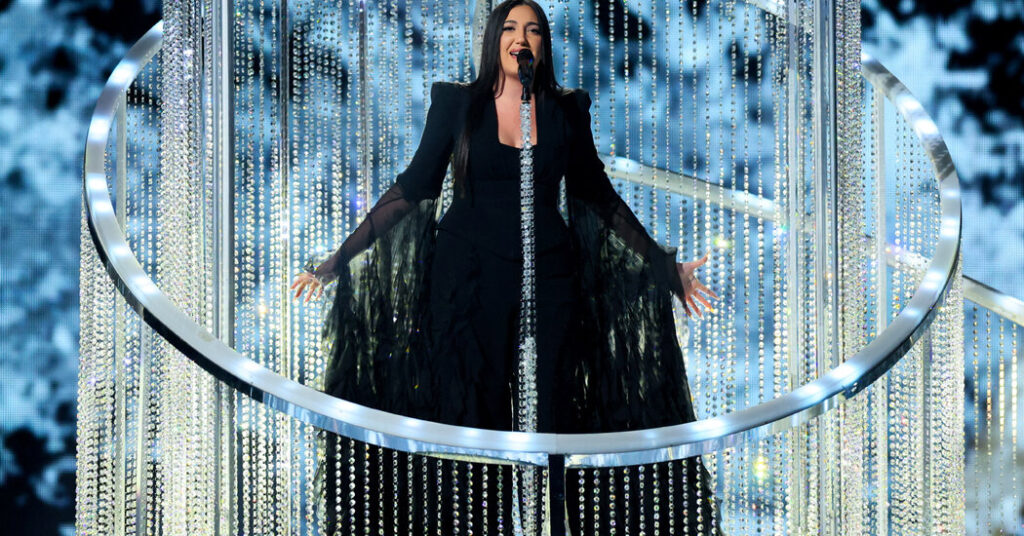
Since Israel’s military began its incursion into Gaza after the Hamas-led attacks two years ago, many Eurovision fans have agonized over Israel’s presence in the contest. As the humanitarian crisis in Gaza deepened, several member countries said Israel should no longer take part in the musical event.
On Thursday, after a European Broadcasting Union meeting in which Israel’s participation in the contest was left unchanged, RTVE, the public broadcaster that organizes Spain’s participation, said in a news release that the country was boycotting next year’s event, which will be held in Vienna in May.
The broadcaster said it decided to withdraw after it asked for a vote on Israel’s suspension that was not approved. The Netherlands, Slovenia and Ireland also confirmed they were pulling out.
RTÉ, Ireland’s national broadcaster, said in a statement that participating in Eurovision alongside Israel was “unconscionable given the appalling loss of lives in Gaza and the humanitarian crisis there.” Taco Zimmerman, chief executive of AVROTROS, the public broadcaster that organizes the Netherlands participation, said in a statement that “culture unites, but not at all costs.”
Despite being outside Europe, Israel has long been allowed to compete in Eurovision because KAN, its public broadcaster, is a member of the European Broadcasting Union. Since first entering in 1973, Israel has become one of the competition’s powerhouses, having won four times.
KAN said in a statement that it would take part in next year’s Eurovision. According to a transcript of Thursday’s meeting supplied by the broadcaster, Golan Yochpaz, the company’s chief executive, criticized those trying to get Israel thrown out.
“The attempt to remove KAN from the contest can only be understood as a cultural boycott,” he said, adding, “A boycott may begin today — with Israel — but no one knows where it will end or who else it may harm.”
“Is this what we truly want this contest to be remembered for on its 70th anniversary?” he added.
The boycotts plunge the world’s most-watched singing competition into crisis, with questions about whether fans from those nations will continue to watch.
Several of the boycotting nations have played pivotal roles in Eurovision’s 69-year history. Spain is such a large financial contributor to the competition that its entry automatically qualifies for the final each year; Ireland has won the high-camp event seven times — a tally matched only by Sweden — and the Netherlands has won five times.
At Thursday’s meeting, held in Switzerland, public service broadcasters from across Europe approved changes to the singing competition’s rules to try to prevent governments, including Israel’s, from influencing Eurovision’s voting system. But they did not vote on Israel’s participation, as some member broadcasters had called for.
In September, the broadcasting union had promised such a vote in an attempt to resolve the Eurovision tensions, but then postponed it after Israel and Hamas agreed to a cease-fire.
For years, Eurovision fans who support Palestinian rights have expressed concern at Israel’s involvement in the contest. In 2019, Hatari, a techno-punk band representing Iceland at that year’s event in Tel Aviv, unfurled a scarf that read “Palestine” during the show’s live telecast.
Such complaints grew louder after Israel began its military campaign in Gaza in October 2023. And they surged again in this year’s contest after Israel’s prime minister, Benjamin Netanyahu, and his government’s official social media channels repeatedly urged followers to vote for Israel’s act — an unusual step for a national government.
The Israeli entrant, Yuval Raphael, a survivor of the Hamas-led attacks, came in second after securing the largest public vote.
Alex Marshall is a Times reporter covering European culture. He is based in London.
The post Spain, Ireland and Others Boycott Eurovision Over Israel’s Participation appeared first on New York Times.