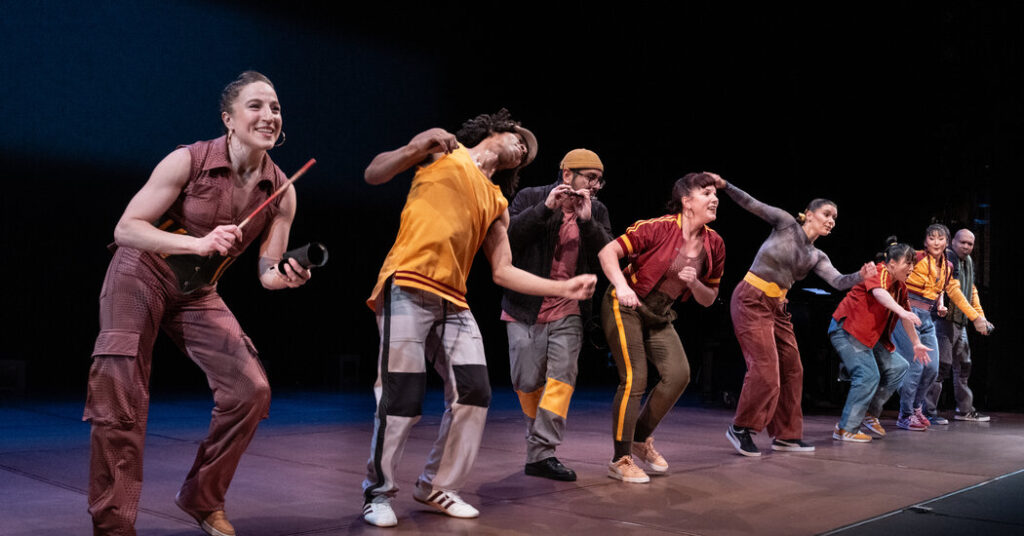
Two dancers sit in silence on boxes. One leans onto the other, then they switch roles. After a few exchanges like this, they bump each other — a move humorously accentuated by the pluck of a bassist who has suddenly appeared onstage. The bassist (Eduardo Belo) brings the lifeblood of music to their dance and also joins it, at one point walking under a bridge made by the dancers’ arms.
This is the start of “Shadow Cities,” a work that Ephrat Asherie Dance is debuting at the Joyce Theater this week. It encapsulates much of the hour that follows. Theatricalized club and street dance by Asherie’s adept group meets live music by the eminent Afro-Latin jazz pianist and composer Arturo O’Farrill. The result is … cute.
Asherie is a B-girl who came up in New York’s underground club scene and for years has been honoring that culture while adapting it to theatrical contexts. She often uses live jazz, sometimes by her pianist brother, Ehud. O’Farrill is the rare top-shelf jazz musician to collaborate consistently with dancers. He’s familiar to Joyce audiences for his work with the tap dancer Ayodele Casel.
A collaboration between these two artists sounded promising, but the show is patchy. A program note describes “Shadow Cities” as a “reflection on the beauty, vastness and joy of the in-between,” and the work does achieve moments of beauty and joy. But it’s also in-between in a more frustrating sense: without the improvisational heat of the club and without the structural clarity and sustained imaginative power possible with choreography.
In the best section, Asherie and three other female dancers take the stage in silence. They begin a simple stepping pattern, with slow, swinging arms. Their footsteps have a muted sound, a hush that combines with the swinging motion for a lulling, lullaby effect. When O’Farrill adds his piano and Larry Bustamante his flute, they accelerate the Latin sidestepping without losing the sweetness.
The quality is soon lost, though, in the choreography’s loose weave. Too much of it is organized like a street party. “Shadow Cities” is the kind of show in which the musicians move among the dancers and the dancers play cowbells and shakers; even the boxes turn out to be drumlike cajons. Whenever the music locks into a groove, be it Afro-Cuban or funky, the dance does, too, pleasurably. But in between these bits, it’s diffuse.
Thematically, it’s vague: shadows and silhouettes in the lighting, boxes as suitcases, hands-up gestures. Perhaps it was the letterman stripes and Charlie Brown yellow in David Dalrymple’s costumes or an occasional Vince Guaraldi feel in O’Farrill’s music, but the show put me in mind of a Peanuts holiday special.
Some of that feeling emanates from Asherie, who, along with being a supple and musically sensitive dancer, is a performer who unfailingly radiates niceness. She and the six other dancers shine in spots — Manon Bal mixing florid arm motions from waacking with salsa footwork; Val Ho perfectly combining floppiness with sharp punctation in her locking.
O’Farrill is on another level, though. A muscular pianist, he doesn’t just cover the whole keyboard; he handles the strings under the lid. When he takes the music into avant-garde areas, Asherie’s choreography struggles to follow. O’Farrill’s solo interludes are the highlights of “Shadow Cities,” and it is both a cop-out and a gift that the show ends with him, making John Coltrane’s “Naima” his own. Nothing in-between about that. It’s just great.
Ephrat Asherie Dance
Through Sunday at the Joyce Theater, Manhattan; joyce.org.
The post Review: When Club Dance Bumps Into Latin Jazz appeared first on New York Times.