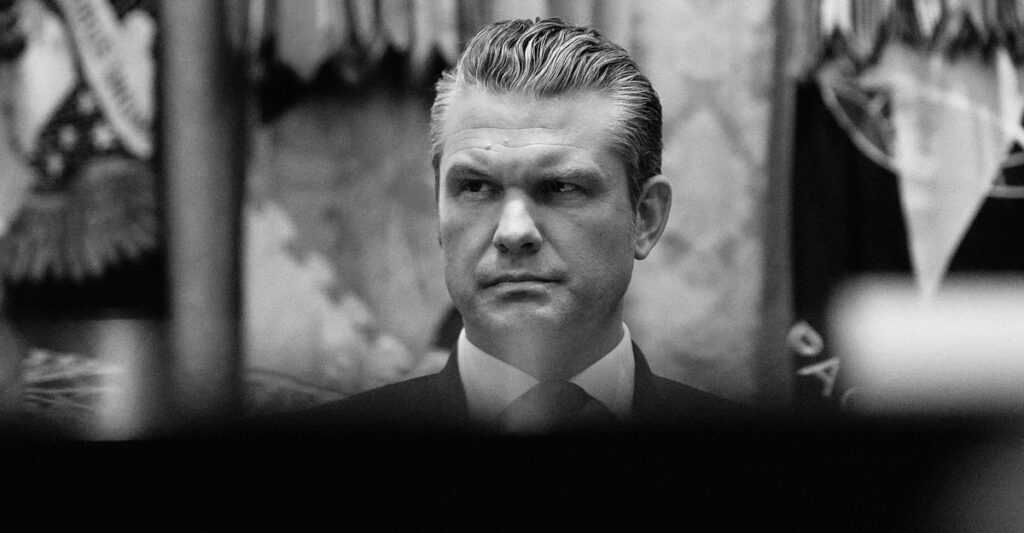
The report from the Pentagon’s Inspector General’s investigation into “Signalgate,” Secretary of Defense Pete Hegseth’s transmission of the details of a U.S. military option in Yemen to a group on Signal—including, by mistake, the editor in chief of The Atlantic, Jeffrey Goldberg—have now been released to the American public. Its conclusions are unequivocal and brutal: Pete Hegseth endangered the success of a U.S. military operation and put the lives of American military personnel at risk.
The secretary of defense has responded to this stark judgment by resorting to weaselly dodges and sending his public affairs people out to claim that he has been “totally exonerated.” This is nonsense.
Originally, before the report was cleared for public release, the lines about Hegseth’s transgressions were classified as secret and unreleasable to foreign nationals—probably because public knowledge of Hegseth’s actions would be so damaging to the reputation and security of the United States:
The Secretary’s transmission of nonpublic operational information over Signal to an uncleared journalist and others 2 to 4 hours before planned strikes using his personal cell phone exposed sensitive DoD information. Using a personal cell phone to conduct official business and send nonpublic DoD information through Signal risks potential compromise of sensitive DoD information, which could cause harm to DoD personnel and mission objectives.
If Pete Hegseth were anyone else but the secretary—and if he didn’t have top cover from President Donald Trump—he’d be in a world of trouble. According to the report, he violated Defense Department regulations, refused to cooperate with investigators, and waved away the significant dangers he created while trying to preen like a tough guy in a group chat.
[Read: Pentagon Report: Hegseth risked endangering troops with his Signal messages]
Americans might expect leadership from the Pentagon’s top civilian, but that is too much to ask of someone like Hegseth, whose responses are the worst kind of bureaucratic ass-covering. The report notes that when investigators asked to speak to him, he declined. I was a Defense Department employee and held a security clearance for decades. I have been interviewed in DOD IG investigations—thankfully, never as a target—and it is the duty of a government employee to cooperate with such inquiries. When investigators asked to see Hegseth’s phone, he refused. When he was asked for a full transcript of his Signal chat, he again demurred, according to investigators, “because it was not a DoD-created record,” thus forcing them to rely on “The Atlantic’s version of the Signal group chat.”
The only response Hegseth gave to the IG team was a snippy letter, included in the report, in which the secretary claimed that he had the right to do what he did, that he did not reveal any classified information, and that his predecessor, Lloyd Austin, kept a personal cell phone with him. (No Trump appointee can ever answer anything without a “whatabout.”) Hegseth’s answer was what might be expected from some lawyered-up paper-pusher, not from a man responsible for the nation’s secrets, its military plans, its nuclear arms, and the lives of thousands of American men and women in uniform.
But even taken on their own terms, Hegseth’s excuses don’t stand up. The report makes clear that the information Hegseth transmitted in the group chats came from Central Command and was classified. Rather than admit that he sent out secret information—again, data that could imperil American lives if revealed—Hegseth claimed that he used his authority to declassify the material he released. This information is secret, he was told. I declare it no longer secret, he responded. Problem solved.
Well, not exactly. The IG report agreed that Hegseth did, in fact, have the right to declassify the material, but it then noted that the information was no less damaging just because Hegseth had decided it was no longer classified. Hegseth also claimed that he used only information that would be “readily apparent to any observer in the area” and contained no classified strike details. The IG wasn’t buying that one, either:
Although the Secretary wrote in his July 25 statement to the DoD OIG that “there were no details that would endanger our troops or the mission,” if this information had fallen into the hands of U.S. adversaries, Houthi forces might have been able to counter U.S. forces or reposition personnel and assets to avoid planned U.S. strikes. Even though these events did not ultimately occur, the Secretary’s actions created a risk to operational security that could have resulted in failed U.S. mission objectives and potential harm to U.S. pilots
One problem here is that Hegseth is claiming he declassified the details before the strike—a move that makes no sense. (As CENTCOM told investigators, “following an operation, the command sometimes declassifies specific operational details, such as photographs or mission-related information, but that this is not typically done before an operation is complete.”) His subsequent assertion that his messages contained no secrets appears to be an attempt to evade legal responsibility for releasing the information in the first place.
[Tom Nichols: Pete Hegseth needs to go—now]
Neither Congress nor anyone else should accept such obviously deceptive evasions. Instead of showing leadership and accepting responsibility for a mistake that could have been a lethal blunder, instead of stepping forward and admitting his error, instead of cooperating and helping to improve Pentagon security, Hegseth hid behind his desk from investigators and said that he had the legal right to do something stupid and dangerous, as if that made his actions any less stupid or dangerous.
Hegseth’s responses are nothing more than sniveling from a man who is supposed to be a model for an organization built on bravery and competence. The secretary had a good teacher: Trump. When caught with boxes of classified information in his bathroom, Trump claimed he had the ability to declassify materials just by “thinking about it.” When Justice Department officials asked him to cooperate and return the materials, he told them to pound sand. Like Trump, Hegseth has adopted the I can do anything I want mantra, a selfish and child-like rejection of the U.S. military’s core beliefs of discipline, honor, and personal responsibility.
Pete Hegseth risked American lives. He should be removed from his office; in a better government, he would have to deal with legal charges. (Other senior U.S. leaders have faced charges for far less serious breaches.) Such possibilities may seem irrelevant now that he faces even more severe accusations of being a murderer or war criminal, but the Trump administration as a general principle views any acknowledgements of responsibility from its people or its leader as a surrender to the president’s political enemies. Hegseth remains in a position he has dishonored because he does not have the decency to resign—and Trump, so far, does not have the decency to fire him.
The post Pete Hegseth’s Weak Excuses appeared first on The Atlantic.