This article is part of Overlooked, a series of obituaries about remarkable people whose deaths, beginning in 1851, went unreported in The Times.
For about 15 years, Dorothy Wise proclaimed that she was the women’s national champion in pool. Her reasoning was simple: In a world where pool rooms were thick with cigar smoke and ruled by men, there were no women for her to compete against.
“I always said I would challenge any woman in the United States, or in the world, for that matter, to a 14.1 match, to see who was the best,” she told Billiards Digest magazine in 1981, referring to a game known as straight pool, “and I never got any takers.”
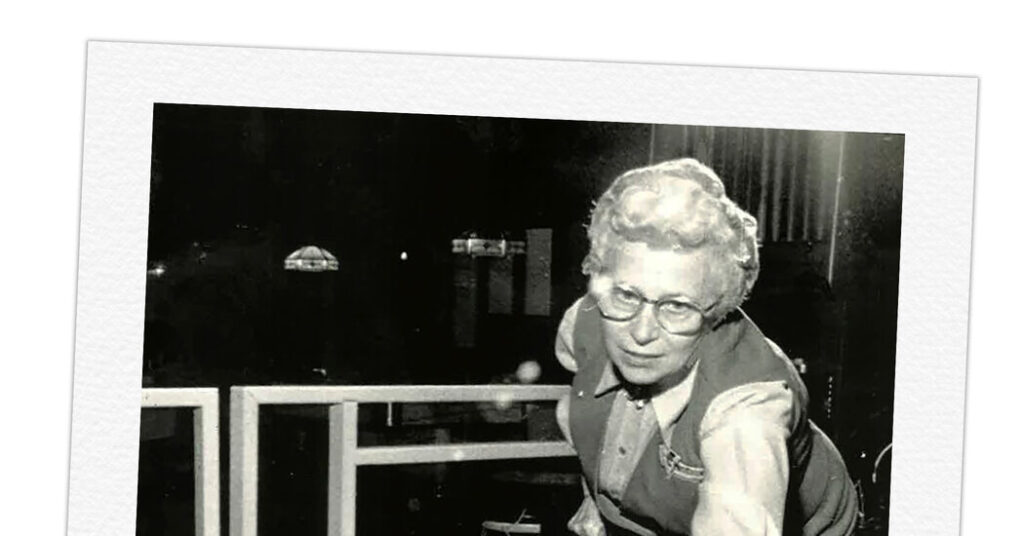
Wise eventually became an official champion when she won the first national tournament for women, held by the Billiards Congress of America, in 1967. By then, she was 52, and her hair had gone gray. “The grandmother of pool,” the news media labeled her.
“She looks like she could bake a cherry pie, crochet a nice Afghan, babysit your kids or be the terror of the church in the weekly bingo game,” The Akron Beacon Journal wrote at the time, adding, “Dorothy, however, is the acknowledged female counterpart of Willie Mosconi” — widely considered to be one of the greatest players of all time.
Wise embraced the “grandmother” nickname, using it to promote what she called “the family image of the game.” She didn’t swear, smoke, drink or gamble, and she urged that women and children learn the sport.
“Children should be started when they are tall enough to reach the table,” she told The Salt Lake Tribune in 1973. “You can play it all your life. It’s good physical and mental exercise. When you get into the finer points, it’s a lot like chess.”
She secured the women’s championship title five years in a row, until 1972, when she was beaten by a rising star, 13-year-old Jean Balukas. Wise didn’t even make the finals.
“Maybe I was defeated before I even went. I don’t know,” she said in an interview at the time. “I had this terrible cold. I wasn’t up to par.”
Dorothy Eleanor Maxfield was born on Dec. 13, 1914, in Spokane, Wash., one of eight children of Eva (Cole) and Charles Maxfield. Her father’s jobs included bootlegger. Dorothy was athletic as a child, playing croquet and baseball, and skiing.
When she was 19, she married Jarvis B. Gilbert, who went by Jack and worked for the Great Northern Railway. They had two daughters, Lorraine and Lenore. The marriage ended in divorce after seven years, and Dorothy became estranged from her children, who were 3 and 5 at the time, said Larry Lenz, Lenore’s husband.
She married Jimmy Wise, who owned several billiards halls around the country, and settled in Redwood City, Calif. Her new husband taught her to play pool when she was about 30, and she was hooked. She practiced “from morning to night,” she said, arriving at pool halls in her gold and white Thunderbird with the custom plate “CUE TIP” and pulling out her 21-oz Willie Hoppe cue — now considered a collector’s item.
“I was playing four, five, six hours a day with him looking over my shoulder all the time,” she said of her husband in an interview with Billiards Digest magazine. “Of course, there were times when we’d clash. In fact, I think I quit the game about 110 times. About 30 minutes was my longest retirement, though. Then I’d come back.”
Her greatest skill was a soft touch with the cue ball, making it glide on the felt, each shot deliberate yet effortless, said Billie Billing, a former president of the Women’s Professional Billiard Alliance (now Association), who first watched Wise play when Wise was 60.
“When I saw her cue ball, it was like floating on water,” Billing said in an interview. “It was so graceful.”
Because there were no tournaments for women, Wise entered men’s tournaments, including the Redwood City Open, which she won in 1953 and ’54. But she quit after her male competitors kept complaining about her participation and even threatening her.
Once, an opponent growled: “Come outside. If I can’t beat you at billiards, I’ll beat you in a wrestling match,” she told The Redwood City Tribune in 1969.
Mike Shamos, the curator of the Billiard Archive, a Pittsburgh-based nonprofit group that preserves the history of the game, said women across the country who played pool in the 1950s were poorly regarded by their male peers. “There was tremendous prejudice at the time against any women who went into a pool hall,” he said in an interview. “Dorothy blew through that.”
She insisted that she had a place in the game — and that everyone else did, too.
“I got so sick and tired of hearing people say, ‘What’s a nice lady like you doing in a place like this?’” she told Billiards Digest, adding, “It hurt me that they would say that because, to me, billiards is one of the finest games that was ever invented.”
When the first national tournament for women was held, in a hotel ballroom in St. Louis, it felt momentous. The room was alive with the glare of cameras, the chatter of spectators and the clacking of billiard balls. Even so, Wise bristled at the inequities: Only 12 participants were permitted to enter the women’s bracket, compared with 48 in the men’s tournament, and the prize was $500 for women and $5,000 for men.
Her triumph was shadowed by the death of her husband the next year. “He saw me win the first U.S. Open for women before he died,” she told The Los Angeles Times in 1971. “Jimmy said it was the thrill of his life.”
She went on to win four more years in a row, often crediting her wins to her husband’s tutelage. “He figured he could make a champion out of me,” she told Mort Luby Jr., a former publisher of Billiards Digest, in a video interview in 1981, “and he did.”
For years, she toured the country, demonstrating trick shots and earning sponsorships from cue manufacturers; Fischer, a maker of pool tables; and the sporting goods company Spalding.
Wise was the first woman inducted into the Billiards Congress of America’s hall of fame, in 1981. She had been nominated for the W.P.B.A.’s hall of fame in 1976, the year the organization was founded.
By then, however, she had fallen out of the sport and had never heard of the W.P.B.A. So, in 1979, Billing organized a banquet dinner to induct Wise and presented her with a plaque.
“I thought it was really important, because she was still on this planet, not only for her to get the plaque,” Billing said, “but so that people around her would say to her, ‘You’re great, you’re inspirational.’” (A trophy Wise won in 1969 is in the collections of the Smithsonian National Museum of American History in Washington.)
Wise died of dementia on April 12, 1995, in a rehabilitation facility in Spokane. She was 80.
After retiring from pool, she found a best friend in Michelina Russo, a spiritualist who was six years her senior; the two had met in church. Wise became an adoptive mother to a grandson of Russo’s, Moon Botelho.
Together, Wise and Russo frequented bars in San Francisco, where the music spilled into the streets.
“They made a decision: Because they were done with men, they were going to go ahead and enjoy their lives,” Botelho said in a phone interview.
The women bought a house in Kansas City, Mo., and moved in together. One thing Wise never left behind, though, was her love for the game of pool. She and Russo opened the roof to add a third floor to the house and installed a billiards table there.
Amisha Padnani is an obituaries editor and the creator of Overlooked, a series that tells the stories of remarkable people whose deaths were not originally reported by The Times.
The post Overlooked No More: Dorothy Wise, the ‘Grandmother of Pool’ Who Defied the Odds appeared first on New York Times.