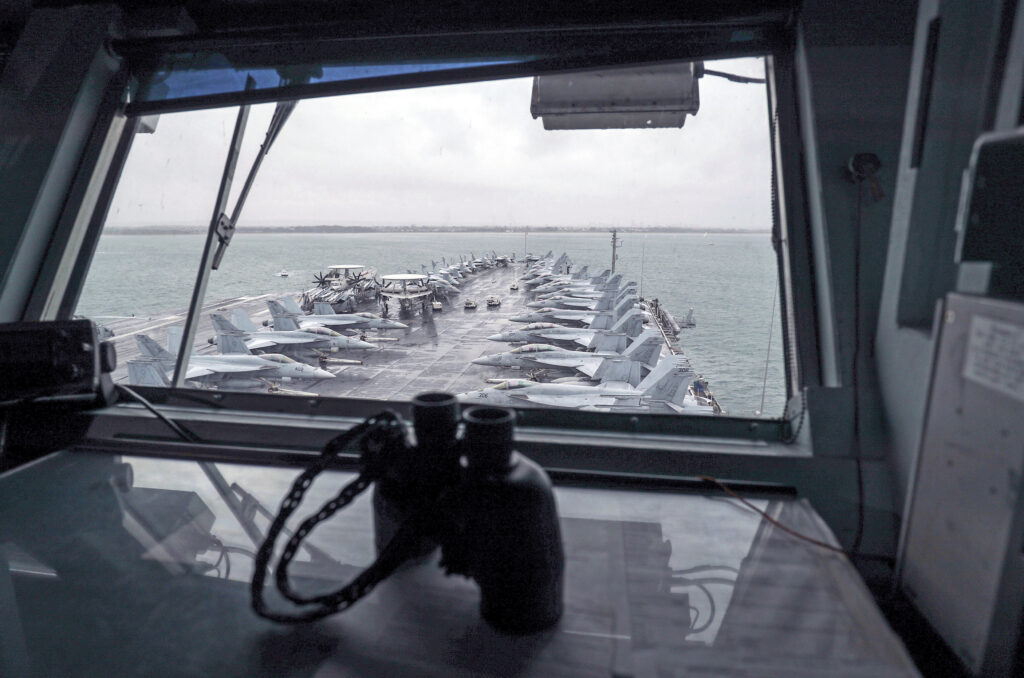
The U.S. Navy on Thursday released its findings from four investigations scrutinizing the significant challenges encountered by one of its aircraft carrier groups over nine months in the Middle East, where several major accidents occurred as the ships battled Yemeni militants.
The Truman carrier group departed its home port in Norfolk in September 2024 — and by the time it returned in May, the carrier itself had collided with a merchant vessel; its cruiser had shot down one of its fighter jets, another warplane was lost when it slid overboard as the carrier performed an evasive maneuver to dodge an incoming missile; and a third jet was lost when an arresting cable failed as the pilot attempted to land.
In three of the four incidents, investigators determined, either poor training, improper procedures or crew fatigue played significant roles. And while no service members died, those incidents could have led to multiple fatalities, the Navy found.
The Navy has taken disciplinary action in those incidents, Vice Chief of Naval Operations Adm. James Kilby said in a statement, and will continue “to assess our tactics, training, and procedures across all echelons to ensure we learn from these incidents.”
Investigators concluded the fourth incident — in which a parked F/A-18 Super Hornet slid off the Truman’s hangar bay as the ship attempted to evade incoming fire from Houthi fighters in Yemen — could not have been foreseen. And they praised the sailors involved who put their own lives at risk to try to prevent the fighter from going overboard, the documents say. But investigators determined the incident may have been preventable if those in Truman’s control room had communicated to the hangar bay that the ship was about to take evasive maneuvers.
The Truman spent 52 consecutive days conducting strikes against the Houthis, who, armed with a vast arsenal of Iranian-supplied weapons, waged a months-long campaign targeting commercial and military ships transiting the Red Sea. The Houthi attacks, which the group said it had undertaken in solidarity with besieged Palestinians in the Gaza Strip, all but stopped the flow of shipping through the vital waterway, prompting the Biden administration at first — and later the Trump administration — to take military action.
As the sustained U.S.-led bombing campaign targeted missile launch sites and weapons storage facilities in Yemen, the Truman and its accompanying warships regularly took incoming fire from missiles and one-way attack drones. The pace of operations exhausted the crews, who, investigators determined, frequently went with only a few hours sleep in between long duty shifts.
The investigations released Thursday also revealed that some of the ships’ critical systems and personnel were not thoroughly prepared for undertaking a combat mission.
In the case of the failed arresting wire, for example, Navy maintainers and inspectors both failed to see the device was worn down. Crucially, though, they also failed to identify that a pin in the system that descending jets hook on to when landing on the carrier’s deck was malfunctioning and lacking proper parts. When the system failed, the landing jet could neither stop nor pull up, forcing the pilot to eject as the aircraft crashed into the water.
“While combat and operations tempo had a role, the erosion of standards occurred well before,” the Navy found in that accident, concluding “the operating environment simply became an excuse for standards to erode further.”
The friendly-fire incident occurred Dec. 21, seven days after the Truman strike group entered the Red Sea. At the time of that mishap, the carrier’s air wing had launched strikes against positions in Yemen, and the Houthis responded by launching anti-ship cruise missiles and one-way attack drones back that the Truman’s protective cruiser, the USS Gettysburg, spent “several hours” shooting down, investigators found. The airspace became saturated with U.S. warplanes and incoming threats.
Navy investigators determined that the Gettysburg was not in optimal condition for such a fight, the documents say. Its systems for identifying friend or foe were breaking down on average 11 times a day, the report says. It’s secure communications system was experiencing frequent connectivity losses. Key sensors were found to be deficient, too, the Navy found, creating “an increased risk of fratricide.”
The ship’s watch standers, insufficiently trained and facing extreme fatigue, were another liability, investigators determined. Just before midnight, despite having an incomplete picture of the battlespace due to the deficient sensors, the Gettysburg fired at what the crew thought were more incoming anti-ship cruise missiles that instead were actually two Super Hornets returning to the carrier, the report says.
The crew ejected safely from the jet that was shot down. The second jet landed safely.
In February, when the Truman collided with the merchant vessel Besiktas, the carrier group had been deployed for five months. The ship’s crews told investigators they were getting as little as two to four hours of sleep between watches, describing the ship’s culture as “just get it done.”
In that incident, as the Truman was approaching the Suez Canal, it did not cut speed despite other maritime traffic in the area, the report says. Investigators found that inexperienced and tired watch standers, and what they called a “culture of procedural non-compliance,” made a dangerous situation worse. There were plenty of opportunities to avoid the accident, they determined.
Instead, as the Truman closed in on the Besiktas, deck officers who were worried about the Truman’s speed did not voice their concerns to any of the ship’s senior officers, investigators found.
The Truman sustained almost $700,000 damage because of the collision, but no one was killed on either ship. Had the point of impact been 100 feet forward, though, the Besiktas would have been struck in a berthing area for up to 120 sailors, the Navy found.
The post Navy deployment marred by friendly fire, lost jets, collision at sea appeared first on Washington Post.