There’s an adage floating around social media about grief that posits it is love in another form, accumulating as a knot in the chest, a lump in the throat, tears in the eyes. “Grief is just love with no place to go,” the saying ends. But if you’re Jennifer Packer, it goes on canvas, made known through the brushstrokes of one of this generation’s most gifted painters.
Packer writes, in an artist’s statement for her solo exhibition at Sikkema Malloy Jenkins gallery in New York, that she has been preoccupied with trying to rebuild her practice in the wake of enormous devastation and loss. The show of 21 new paintings and drawings, titled “Dead Letter,” is her response to the unexpected death of her partner, the poet April Freely in July 2021.
Parker reminds visitors that the show cannot encapsulate the dynamisms of a person or the sanctity of the relationship. “This show is not an attempt to render this literally,” she writes. “I do not believe the work can properly contain this.” If we hold onto that thought while we absorb the show, then it is also possible to see the work as an exercise in mining one of the great existential questions of humanity — what happens when we die?
Packer’s artist statement also includes a quote by Freely, which reads, “this is an impossible communication, but that’s the only kind we want.” The line comes from her 2014 essay in the Kenyon Review about the Golden Record aboard the Voyager probes launched into space in 1977 — with sounds and images of Earth — still traveling through the farthest reaches of space with messages from humankind.
A dead letter can be many things, including a law or agreement that has lost its force or authority, or a letter that cannot be delivered to the addressee and is returned to the sender. Packer’s show toys with the idea of both — communication that cannot reach its intended recipient and the laws that govern the gossamer separation between life and what comes after. Freely’s essay is an enthusiastic curiosity about the limits of our understanding, and Packer’s show can be read as its own phonograph, sent out into the void, perhaps in search of Freely herself.
One stunning work set as the centerpiece of this conversation between worlds is titled, “At the Edges of Longing Is an Impossible Communication (Dead Letter).” It features a monastic-like figure standing before a periodic table of the elements, suggesting the limits of scientific knowledge. At the bottom, a row of playing cards line the bottom like an elaborate embroidery. Cards, like a Ouija board, are often used in divination practices called cartomancy. Packer’s artistic ancestors make themselves known in the work, including Kerry James Marshall, who often incorporates numbers and symbols into his large-scale paintings. And yet the enigmatic collage also reminds you, the viewer, of how unknowable art — or truly anything in life — really is. All we have are the responses that emerge within us.
The Packer show is spread out across three rooms. You might miss the third if you aren’t paying attention; it contains the most vulnerable work in the show, which is also one of the smallest. In this farthest recess of the gallery, installed behind the doorway, is a tiny portrait of Neely. The show is so rich, so satiating, that one might forget to pay “Lil Buddha, the Alchemist” due respect. At 10 inches tall, the painting features an ocher figure in a large, cloak-like garment, standing erect, surrounded by a spectrum of yellows and gold that summons a cosmic aura that touches on the holy. There even appear to be ringed planes, or perhaps U.F.O.s. The figure, despite having no discernible features, appears with such commanding presence that it can only be Freely herself.
Are those of us still here any more present than those of us who have departed? Packer’s paintings reach into the void within which all life — and the afterlife — exists. Grief is hard to see clearly. Packer’s brushstrokes intimate a kind of channeling, a liminal space between knowing and unknowing. Only our bodies disappear when they pass beyond the earthly plane, but our broader culture does not contain uniform ways to acknowledge or honor those spectral realms. The artist’s show felt like an exploration of the practices of grief, how to hold space for it, how to speak about it, but most important, how to try and feel the unwieldiness of it.
Packer’s process is one of subtraction. What’s not there is as important as what is there, and close examination of the work shows removal, often by scraping or blotting. (In a 2021 interview with Amber Jamilla Musser, she explained, “Most of the paintings are made through an undoing.”) Packer also works deftly and expertly with the blur. By technique, this could mean using turpentine to literally blur colors and linework (“Warp, Weft” is a masterly example of this); in her practice, she may be deploying the theories of the poet and critic Fred Moten, who describes the blur as a political aesthetic that operates against legibility and simplicity, and insists on multiple meanings.
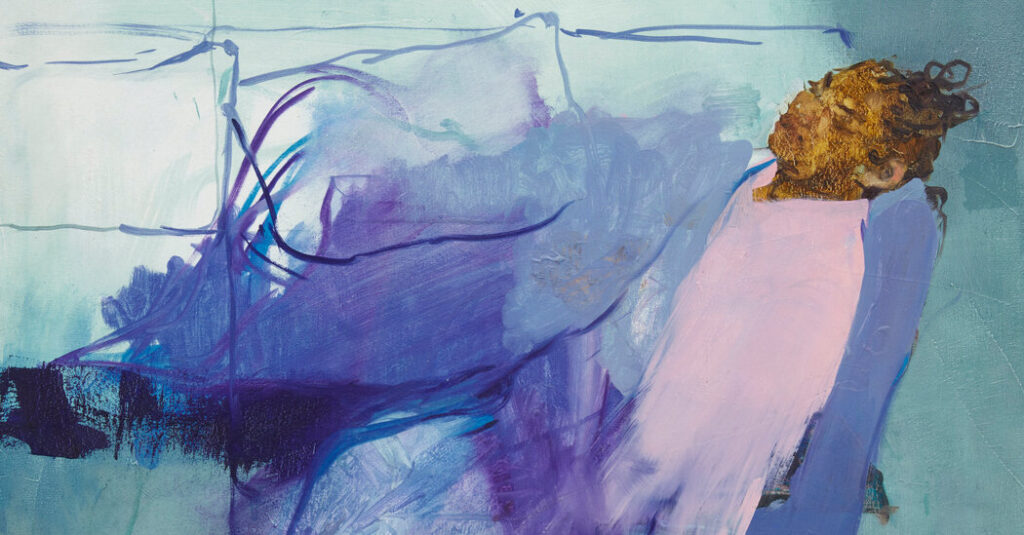
Erasure is a fraught topic for Black people, and especially Black artists, who are often expected to express the encumbrances of systemic neglect and its wake upon a diaspora of experience through a handful of work, but Packer’s method slyly refuses that. In “Melt,” a gorgeous portrait of a young woman in repose on a blue sofa, the angle of her head resting on the arm suggests that she is napping, but the tautness of her eyebrows and the meandering of the pink of her shirt into the lavenders and aquamarines of the sofa and wall evoke a fraught dream, a hallucination — or something weightier.
Packer declines to elaborate. What the viewer’s mind grasps onto reveals more about their own bias than the artist’s intentions. In another work, “Activity, The Pause,” two figures blend into each other. A cat naps on one figure’s chest. The angling of their heads suggests someone reading to someone who is ill. The entire painting is shot through with blazing sunset colors: Red, hot pink, oranges and yellows, save for the electric teal blue pillow.
Is Packer’s intention to draw the eye to the pillow itself, which brought to mind a casket pillow? But is that logical, or is the assumption of suffering a bias toward Black figuration in paintings? Studying Packer’s paintings, I was reminded of “[siccer],” a recent performance by the New York choreographer Will Rawls, an eccentric and riotous exploration of the color green as a proxy for the pressures, sorrows, expectations of being Black (also sometimes called the blues) — a refusal of genre as much as an attempt to push the edges of it. This is also Packer’s terrain.
In 2022, she mounted what was then her biggest show at the Whitney Museum, “The Eye Is Not Satisfied With Seeing.” The title, from Ecclesiastes 1:8, refers to insatiable desire. The hunger for more. (The passage in the Bible begins “all things are wearisome.”) That futility of enoughness is still present here, thrumming through each brushstroke, each peel of paint stripped away. Packer allows the desire for more to be uncomfortable, coaxing viewers to redefine their expectations of art, and also perhaps, Black artists and their subjects.
Throughout the gallery, there are paintings of bouquets, seen more and more at contemporary art shows. (The work of William Villalongo and Jordan Casteel come to mind, as does the recently opened Faith Ringgold show at the new Jack Shainman location in TriBeCa.) Here, Packer’s florals are rendered in the same bleary brushstrokes as the rest of her linework, making them seem like apparitions of the natural world instead of pulled from it.
The show itself can be seen as a memento mori, a reminder of mortality and the act of sublimation. The Dutch used still life paintings, or vanitas, as a warning against worldly indulgence, a reminder that materialism is futile after death. And yet Packer pushes beyond admonishment into something deeper, the intimate promise of the end, perhaps sharpening one’s relationship to aliveness in the process.
In 2020, millions of people died (and are still dying) from Covid, and our nation has never formally acknowledged the pain of that. There are genocides happening concurrently. The grief inside of us has no place to go. Packer lets us know it is alive, whether or not we bear witness to it. She offers a way to reach deeply into it, perhaps even release it.
Jennifer Packer: Dead Letter
Through Dec. 13, Sikkema Malloy Jenkins, 530 West 22nd Street; Chelsea; 212-929-2262; smjny.com.
The post Jennifer Packer: Art at the Cosmic Edges of Longing appeared first on New York Times.