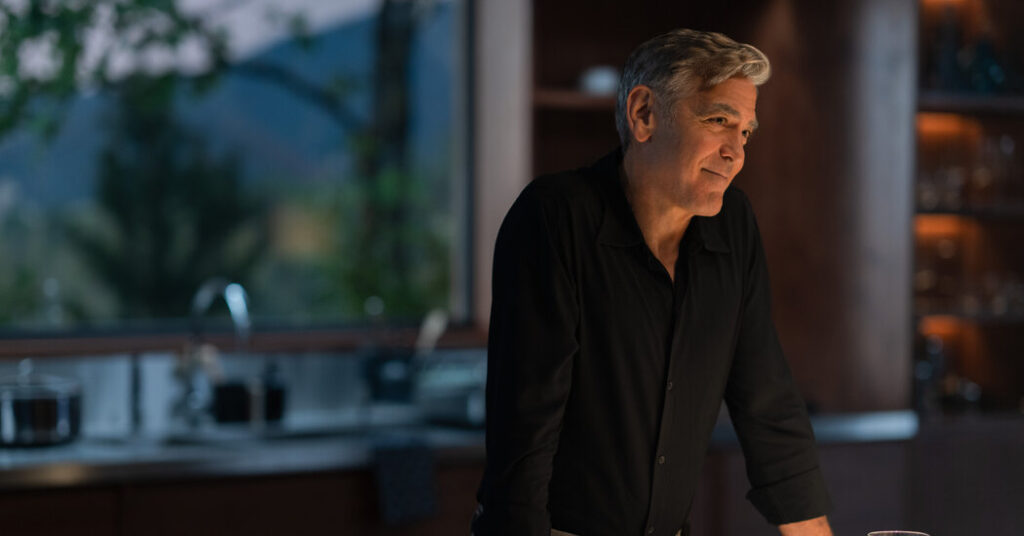
The audience best suited to appreciate Noah Baumbach’s “Jay Kelly” might be the man who stars in it, and who seems to be its reason to exist: George Clooney. (His name’s resemblance to his character’s is surely no coincidence.) Jay appears to be an alternate universe version of Clooney: Both have been called heirs to Clark Gable, both are admirers of Paul Newman, both might be the last of the old-school glamorous movie stars, charmers with a megawatt smile.
But at this point in his life, Clooney is, at least by reputation, a loyal man, one who has many friends, an accomplished wife, small children on whom he is said to dote and an established reputation as an activist and humanitarian. Jay, on the other hand, is a man with a dream life and an empty soul: His entire identity is just being the guy people love from the movies. His successful single-minded pursuit of stardom has cost him relationships with his partners, his daughters and most of his friends. Now, the person closest to him in the world is Ron (Adam Sandler), his manager, who genuinely loves him — not as much as he loves his own wife (Greta Gerwig) and children, but pretty close. To Jay, Ron’s a friend, but the kind who takes 15 percent of his income.
“Jay Kelly” is a peculiar movie, slipping in and out of registers, seeming to work on multiple levels at once. It feels personal not just to Clooney but to Baumbach, who wrote the screenplay with Emily Mortimer. (Baumbach makes a cameo in one scene, to gently comic effect.) The film is about what it means to be famous, but it is also about what a life in show business takes out of you: all the running around catering to someone’s whims, the strange fakery, but also the occasional realization that what you made can be meaningful in ways you never expected. People live alongside the movies, after all; a good film, or even just an enjoyable one, takes on a life bigger than its running time.
“Jay Kelly” is a story about a fictional star, but it’s also a wistfully lighthearted lament for an era of the movies that’s fading away, the kind in which a single movie star like Kelly or Clooney would open a movie on his popularity alone. You can tell, because it starts on a soundstage where a movie shoot is about to wrap, and Baumbach takes in the bustle with one continuous sweeping shot. It’s the first moment that feels like it’s paying homage to some movie, or maybe a bunch; you can’t help but think a little of Robert Altman’s “The Player,” at least.
That’s where we meet Jay, and from there we follow him through a very strange few days in his life. He discovers that his mentor Peter Schneider (Jim Broadbent) has died, and on his way out of the funeral, he runs into an old friend and acting school classmate (Billy Crudup). That meeting proves fateful in ways he couldn’t have imagined, especially after he decides to decamp for Europe to see if he can spend a little time with his younger daughter (Grace Edwards) during her last summer before college. Of course, Jay can’t go anywhere without a whole entourage in tow, from his hairdresser (Mortimer) to his publicist (Laura Dern) to the ever-faithful Ron, who has to scramble to set up a lifetime tribute to Jay at an Italian film festival after Jay initially declined it.
These episodes bring up in Jay certain memories he’s pushed down, recollections of his days as a young actor (played in flashbacks by Charlie Rowe), youthful love affairs, conversations with his older daughter (Riley Keough) that he wishes he’d handled differently. He’s remembering who he is, in a sense: Our identities are the sum of our memories. Jay is headed to Italy and so is Ron, who has sacrificed a fair amount of his own happiness for Jay over the years. For both, they’re moving toward a revelation.
Certain sections of “Jay Kelly” seem perplexingly out of joint with the rest of the movie, especially a long middle sequence on a train through Europe. They make more sense as tributes to certain kinds of movies (especially because most of the passengers in one particular French train carriage are played by a series of recognizable European actors in their own right). Jay is reliving his life as a series of choices as well as a series of movie moments: “All my memories are movies,” he recalls saying to Peter in one flashback.
And indeed, while each reminiscence comes to him with the feeling of a different genre, each of his experiences in the present takes on the conventions of a genre, too. It’s like Jay Kelly has been Jay Kelly for so long that he doesn’t know how else to experience the world but as an actor playing a part.
Inevitably, the results do not quite cohere narratively or tonally. But the film still has a strange, old-fashioned charm. You can’t really imagine anyone other than Clooney playing Jay, but Sandler is equally good; he brings a pathos to Ron, a man who has perhaps loved not wisely but too well. Yet Ron really believes in what Jay does, that he brings happiness to the people who love his films, and love him in them. The role of the Hollywood manager has almost always been played as a kind of pecuniary crank, but this guy is a good guy, a family man, an artist in his own right, and Sandler infuses him with the same warmth that you can see sparking inside Jay. Somehow it’s Ron, not Jay, who is the full-fledged human here.
The finale of “Jay Kelly” is both heart-swelling and weirdly dark; I respect Baumbach’s decision to craft an ending with both classic Hollywood overtones and a conflicted lower thrum. I suppose he and Mortimer and Clooney and everyone else involved know that the trade-offs involved in a show business life are not resolvable, any more than other lines of work.
But there might be something particular about a life lived in the limelight. The film’s epigraph quotes Sylvia Plath, but it could be quoting Jay Kelly: “It’s a hell of a responsibility to be yourself,” the text says. “It’s easier to be somebody else or nobody at all.” All of Jay’s memories are movies. But everybody saw those movies. So if our identities are the sum of our memories, then who does that make Jay?
Jay Kelly Rated R for language and discussions of sex. Running time: 2 hours 12 minutes. Watch on Netflix.
Alissa Wilkinson is a Times movie critic. She’s been writing about movies since 2005.
The post ‘Jay Kelly’ Review: All His Memories Are Movies appeared first on New York Times.