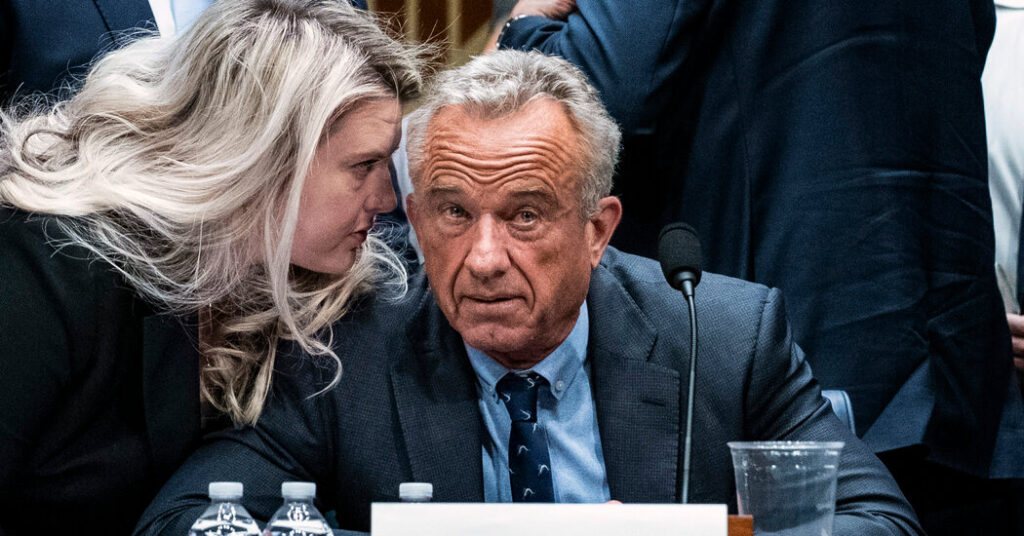
Throughout his two-decade crusade against vaccines, Robert F. Kennedy Jr. viewed the federal government’s Vaccine Safety Datalink as a kind of holy grail. With millions of confidential patient records, the database, he believed, held the potential to prove whether vaccines cause autism.
After he became President Trump’s health secretary, Mr. Kennedy demanded access to the data, and assigned an old ally to examine it. But the scientists who managed it were standing in his way, worried that the data could be used improperly. Frustrated, Mr. Kennedy sent Hannah Anderson, one of his top advisers, to the Centers for Disease Control and Prevention in Atlanta.
“She said, ‘I can’t leave town until you figure out how we’re going to do this,’” recalled Dr. Daniel Jernigan, who oversaw the database and has since left the C.D.C. In the end, Ms. Anderson got the data.
Mr. Kennedy took over the Department of Health and Human Services in February after assuring skeptical senators weighing his confirmation that, despite 20 years of hostility toward the country’s long-established vaccine system, he would do nothing that “makes it difficult or discourages people from taking vaccines.” He sought to present a more unifying agenda, vowing to target ultraprocessed foods and minimize toxic exposures as part of a broader mission to “reverse the chronic disease epidemic and put the nation back on the road to good health.”
But an examination of Mr. Kennedy’s tenure atop the nation’s massive health agency shows how, in ways not previously known, he has methodically laid the groundwork to overhaul American vaccine policy, following a blueprint he laid out in books, speeches and podcast appearances during his years as the leader of a movement attacking the system he now oversees. He has walled himself off from the government scientists and other civil servants he distrusts while elevating longtime allies to help carry out his vaccine agenda.
Mr. Kennedy has denied misleading senators about his intentions. He said in an interview that it should be no surprise that he brought in people he can trust, including parents who believe their children were injured by vaccines.
“I don’t want to perpetuate a system that everybody knows is broken,” he said, adding, “I need people in there who are highly motivated to challenge the inertia, challenge the orthodoxies, because the biggest threat to the system is inertia, because it will just continue this terrible sick care system where everyone is sicker. You need to disrupt it.”
Mr. Kennedy’s efforts will be on full display Thursday and Friday when those advisers — handpicked by the health secretary after he fired the old group — meet to reconsider the suite of vaccines given to young children.
Unraveling the vaccine schedule would mark a radical and, experts say, dangerous shift. Public health officials warn that if Mr. Kennedy succeeds, measles and other infectious diseases will come roaring back, jeopardizing the health of all American children. Six medical organizations have taken Mr. Kennedy to court, accusing him of “a clear pattern of hostility toward established scientific processes” that has resulted in chaos throughout the health care system.
The federal government does not mandate vaccination; that is up to states. But the C.D.C.’s recommendations provide a guide to state lawmakers and parents, and help dictate which vaccines insurance companies will cover. As secretary, Mr. Kennedy controls billions of dollars in vaccine funding for low-income children. He has already threatened to withhold money from states that do not allow parents to opt out of vaccine requirements.
His ultimate power is the bully pulpit. He can shake confidence in vaccination, or reinforce it.
This account is based on interviews with more than two dozen people, including current and former government scientists, activists and allies of Mr. Kennedy. The Times also reviewed internal emails and interviewed the health secretary twice.
While much of Mr. Kennedy’s work has been out in the open, the review shed light on what he has done behind the scenes.
When a child died of measles in Texas just two weeks after Mr. Kennedy took over, longtime C.D.C. infectious disease experts sought unsuccessfully to brief him. Instead, Mr. Kennedy consulted a doctor he met through the leader of the nonprofit he founded, promoting his alternative treatments while downplaying vaccination.
When Mr. Kennedy wanted to learn about vaccines for malaria, he turned to a doctor, Meryl Nass, who had worked with him on a petition in May 2021 asking the government to withdraw Covid vaccines from the market in the thick of the pandemic. She advised him against investing in malaria vaccines, she said, arguing that the money was better spent on other means of prevention.
And he has enlisted a hero of his movement — William Thompson, a career C.D.C. scientist who questioned the validity of a 2004 study that concluded the measles vaccine was not linked to autism.
Dr. Thompson’s claims were rejected by the C.D.C., but he remained at the agency under government whistle-blower protections, working quietly in its Division of Viral Hepatitis until Mr. Kennedy arrived and began consulting him about vaccines and autism, according to emails reviewed by The Times.
Mr. Kennedy is “particularly interested in having us examine isolated autism cases” from decades-old data, Dr. Thompson wrote in a June 17 email. When staff members noted the challenge of resurfacing the records, Dr. Thompson persisted: “Again, this is a high priority for Secretary Kennedy.”
Mr. Kennedy said in a recent interview that he personally directed the C.D.C. to abandon its official position that vaccines do not cause autism. Within the past week, he has installed critics of Covid vaccines as the No. 2 official at C.D.C., and as chairman of the panel of vaccine advisers.
But he rejected the idea that vaccines have been his main focus. He noted that he has prodded food manufacturers to abandon artificial dyes and pushed infant formula manufacturers to use less sugar. He leaned on the insurance industry to streamline its “prior authorization” process for medical procedures. He persuaded Mr. Trump to launch a sweeping crackdown on televised drug advertisements, and worked with the president on plans to lower drug prices.
“What I do with vaccines is a very, very small part of my job,” Mr. Kennedy said in the interview.
Yet his vaccine agenda, which is highly divisive, is having an impact.
Coronavirus vaccines became harder to get after he announced new guidelines on social media in May, sidestepping the usual scientific review process for what he called a “common sense” change. The vaccines are now approved for people older than 65 and those with underlying medical conditions.
Mr. Kennedy canceled a nearly $600 million contract with Moderna, the Covid-19 vaccine manufacturer that was working on an mRNA vaccine against bird flu for humans. He also cut nearly $500 million in grants and contracts to develop mRNA vaccines. Mr. Kennedy says the technology is flawed. His critics say the cuts will diminish a promising new method to deliver vaccines and cancer treatments.
For the first time since the C.D.C.’s founding nearly 80 years ago, states are no longer listening to its advice. Democratic-led states have formed their own coalitions to issue vaccine recommendations.
The partisan gap over vaccines is widening, according to a recent survey by Pew Research Center. Ninety-two percent of Democrats say the benefits of the measles, mumps and rubella vaccine outweigh the risks. But just 78 percent of Republicans feel that way, down from 91 percent a decade ago.
The pace of change on vaccines has stunned experts. “We had an idea about what might happen,” Dr. Jernigan said, “but we really had no idea how quickly he was going to move.”
First Test: Measles
As two days of grilling came to a close at Mr. Kennedy’s January confirmation hearings, a senator pleaded with him to acknowledge that vaccines did not cause autism. A new study, Mr. Kennedy shot back, “shows the opposite.”
The study, associated with vaccine skeptics, had been faulted as biased and flawed. His comments were a sign that, despite his assurances to senators that he would protect vaccines, Mr. Kennedy would remain true to the views that had come to define his life’s work.
The scion of a Democratic dynasty, Mr. Kennedy spent the first part of his career as an environmental lawyer, and worked to eliminate mercury from waterways. But in the early 2000s, a small group of mothers of children with autism, the so-called “mercury moms,” persuaded him to look into thimerosal, a mercury-based preservative in vaccines, transforming him from liberal icon to a hero of vaccine opponents.
As chairman of Children’s Health Defense, the nonprofit he ran until he launched a bid for the presidency in 2023, Mr. Kennedy tried to build a case that vaccines were more hazardous, and infectious diseases less dangerous, than most people believed.
“Measles outbreaks,” Mr. Kennedy wrote in 2021 in an e-book published by his nonprofit, “have been fabricated to create fear that in turn forces government officials to ‘do something.’”
Two weeks after senators voted narrowly to confirm him, Mr. Kennedy had his own measles outbreak to confront.
The disease was spreading in the tiny West Texas city of Seminole, home to a close-knit community of Mennonite Christians who shun vaccination. An unvaccinated six-year-old girl became the first person on American soil in a decade to die from measles.
Two top officials — Dr. Debra Houry, the C.D.C.’s chief medical officer, and Dr. Demetre Daskalakis, the agency’s top infectious disease expert — each said that they had appealed to Mr. Kennedy’s staff to allow them to brief the secretary on the crisis brewing in Texas. But the briefing, they said, never happened.
The C.D.C. scientists did not know, at the time, that Brian Hooker, a biochemical engineer and chief scientific officer of Mr. Kennedy’s old nonprofit, was already on the ground in Texas talking to Dr. Ben Edwards, who has a wellness practice in Lubbock.
Dr. Edwards told Dr. Hooker he had been having success treating measles patients with a steroid inhaler and antibiotics — a combination he had used against Covid-19. He also talked about Vitamin A, which can prevent complications in hospitalized measles patients, and mentioned cod liver oil, rich in the vitamin.
“You have to talk to Bobby,” Dr. Hooker remembered telling Dr. Edwards, referring to Mr. Kennedy. “Bobby needs to know about that.”
Dr. Hooker connected them. But he said he was not advising Mr. Kennedy, adding that the health secretary had “good people” working for him.
Dr. Houry, the C.D.C. chief medical officer, said Mr. Kennedy’s top aides demanded that she update the agency’s website to reflect Dr. Edwards’s advice. She agreed to mention Vitamin A, but not the steroid-antibiotic combination treatment, saying there was no evidence.
While the evidence is lacking, Dr. Edwards said, the treatment was better than nothing: “This is clinical decision making on the front line in the moment.”
Mr. Kennedy publicly promoted Dr. Edwards’s recommendations. He also sent C.D.C. epidemiologists who typically respond to outbreaks to the area, and ordered the shipment of 2,000 measles vaccines — even as he insisted, in a Fox News opinion piece, that “the decision to vaccinate is a personal one.”
Health secretaries have routinely promoted vaccines, especially during outbreaks. Mr. Kennedy views his job differently.
“My role is to get people healthy,” he said, adding that it made no sense to promote measles shots to a vaccine-hesitant community, the Mennonites. “For them, my approach is: If people are not going to take the vaccine, then you need to be able to treat them. Nobody should die of measles.”
In Seminole, a local wellness emporium quickly stocked bottles of cod liver oil in kid-friendly flavors like strawberry and bubble gum. Dr. Edwards opened a pop-up clinic next door, treating patients even after he was infected with measles himself, doing so, he said later, because patients were already infected and were “not going to seek care anywhere else.”
The clinic irked Dr. Leila Myrick, a local physician. “It was infuriating,” she said, “because we have our hospital right here.”
Even more frustrating for Dr. Myrick and other mainstream doctors was the way Mr. Kennedy contradicted Texas health officials and downplayed the danger of measles. State health authorities said the first death was from measles and a second death in a school-aged child was from “measles pulmonary failure.” Mr. Kennedy, reflecting the assessment of a close ally, reached a different conclusion.
“One of the little girls had strep,” Mr. Kennedy told the talk show host Dr. Phil McGraw at the time. “She had bacteria in her blood. That’s really what killed her.”
Escalating Tensions
At the C.D.C., Mr. Kennedy’s longtime allies grew in influence, putting them on a collision course with career government scientists.
Mr. Kennedy did not get his pick for C.D.C. director. Republicans were unable to muster the votes to confirm Dr. David Weldon, a former congressman from Florida who has long criticized C.D.C. vaccine policy.
Before his confirmation fell through, Dr. Weldon said, he had arranged for a former aide, Stuart Burns, to work at the C.D.C. Mr. Kennedy has since managed to assemble more stalwart allies from his past vaccine crusades, and put them in the health department and its various agencies, including the C.D.C.
When asked during a Senate hearing in September to name scientists inside the C.D.C. who have briefed him, the secretary mentioned only one: Dr. Thompson, the C.D.C. whistle-blower.
This spring, emails show, Dr. Thompson was deeply involved in trying to obtain data for autism research. Mr. Kennedy himself was focused on the effort, as was his chief of staff at the time, Heather Flick Melanson.
“We appreciate all he does to help with important, timely projects,” Ms. Melanson wrote. “He’s been great.”
Mr. Kennedy also hired Mark Blaxill, a businessman and longtime advocate for parents of children with autism, who has argued that the C.D.C. is committing fraud by concealing a connection between vaccines and autism. He was assigned to work with the new committee of vaccine advisers that will discuss this week whether the schedule of vaccines given to infants and toddlers should be revised.
“They’ve never looked at the whole schedule, which is the thing that is most likely the biggest culprit,” Mr. Blaxill said last year in an interview with Children’s Health Defense. He did not respond to requests for comment.
When the new panel convened for the first time in June, the agenda included thimerosal, the mercury-based vaccine preservative that Mr. Kennedy and many in his movement had long viewed as a potential cause of autism. It had been removed from nearly all childhood vaccines, but not flu vaccines, in the early 2000s — not for safety reasons, officials said at the time, but to assuage parents’ concerns.
Lyn Redwood, a nurse practitioner who helped interest Mr. Kennedy in vaccine safety two decades earlier and later became president of his nonprofit, was the featured speaker. After Mr. Kennedy became secretary, he hired her as a special government employee.
In preparation for the session, Dr. Daskalakis, the C.D.C.’s top infectious disease expert, said he asked agency scientists to assess the benefits and risks of thimerosal.
Their 17-page report showed that while thimerosal in vaccines given to pregnant women had fallen steadily, autism rates were still rising, suggesting that the preservative was not to blame.
The C.D.C. posted the report on its website the night before the meeting. But during the meeting, it suddenly disappeared. An explanation came from Dr. Robert Malone, a close ally of Mr. Kennedy’s and staunch opponent of Covid vaccines who now sits on the committee.
“My understanding,” Dr. Malone said, “is that article was not authorized by the office of the secretary, and has been removed.”
Mr. Kennedy said in the interview that he was not aware of the document.
In the end, the vaccine advisers called for pregnant women and children to avoid flu vaccines with thimerosal — a recommendation that mainstream scientists said was not rooted in evidence. It was a victory for the health secretary and his supporters.
But it also brought simmering tension between Mr. Kennedy’s team and career C.D.C. leaders closer to a boiling point. Dr. Jernigan, Dr. Daskalakis and Dr. Houry were called into the offices of agency lawyers to explain how the document was created and posted. It had been circulated to scientists and political officials, they explained, who had raised no objections.
It proved a fragile truce.
The Holy Grail: Vaccine Data
Over 31 years at the C.D.C., Dr. Jernigan had led the response to dozens of disease crises around the globe. He set up testing when a deadly bird flu was killing vendors from Bangladeshi bird markets in 2012, and responded as the Ebola virus ripped through a maternity hospital in Sierra Leone in 2015.
None of that, he said, had prepared him for the uncomfortable assignment he would face in the spring of 2025: opening up the Vaccine Safety Datalink to David Geier, the man Mr. Kennedy chose to examine decades-old medical records.
The database is a collection of health system and hospital records that contain confidential health information for millions of children. Two decades ago, the hospitals imposed strict rules granting access only to researchers whose study protocols they had approved. The move was a response, in part, to breaches in study protocols in 2004 by Mr. Geier and his father, who had used the data to claim that thimerosal was linked to autism.
The research has been widely discredited.
Mr. Geier was charged and fined $10,000 by the Maryland medical board in 2012 for acting as a doctor without a license alongside his father, who was operating a string of facilities giving experimental treatments to children with autism.
Nonetheless, in his 2023 book, “Vax-Unvax: Let the Science Speak,” Mr. Kennedy frequently cited the Geiers’ research involving the Vaccine Safety Datalink. He has fiercely defended them.
And Mr. Kennedy has repeatedly claimed, without evidence, that the C.D.C. has tinkered with the data to skew vaccine research.
“There’s been a lot of monkey business with the V.S.D.,” Mr. Kennedy asserted at a Senate hearing in May.
Under pressure from Mr. Kennedy’s office to open up the database to Mr. Geier once again, Dr. Jernigan wanted assurances that the data would be used ethically, and for scientifically sound reasons, and that releasing it was legal. But a department lawyer overruled him.
“We were told that David is working as a quote, direct agent of the secretary,” Dr. Jernigan said. “The secretary has full access to anything in the department, and anything that David wants is the same as if the secretary is asking for it.”
Mr. Kennedy sent Ms. Anderson, then his chief policy officer, to Atlanta in July. Mr. Geier turned up at the headquarters of the C.D.C. a few days later. When Mr. Geier left Atlanta, he took with him a laptop loaded with millions of data points from vaccinations — much of it personally identifying. But the data is more than two decades old.
Neither Mr. Geier nor Ms. Anderson responded to requests for comment.
Dr. Jernigan sensed that his job was on the line. In August, his suspicions were confirmed. Mr. Kennedy demanded that Susan Monarez, the C.D.C. director, who had been on the job for less than a month, fire career officials responsible for vaccine policy and accept policy changes without question. She refused, she said, and was fired. The next day, Dr. Jernigan, Dr. Houry and Dr. Daskalakis resigned.
Mr. Kennedy vowed in the interview to get the more recent data, saying, “It shouldn’t be this difficult.” He said he was determined to pour money into vaccine safety studies that have never been done.
He remains convinced that vaccines, along with ultraprocessed foods and environmental toxins, have fueled an increase in asthma, allergies, autism and other neurodevelopmental disorders that have been on the rise in recent decades — when the number of childhood immunizations rose.
There is no scientific proof. But Mr. Kennedy is on a mission to change that.
“Vaccines,” he said, “must be a culprit, because they became ubiquitous along that timeline.”
Apoorva Mandavilli contributed reporting.
Sheryl Gay Stolberg covers health policy for The Times from Washington. A former congressional and White House correspondent, she focuses on the intersection of health policy and politics.
The post Inside Kennedy’s Methodical Quest to Shake Up America’s Vaccine System appeared first on New York Times.