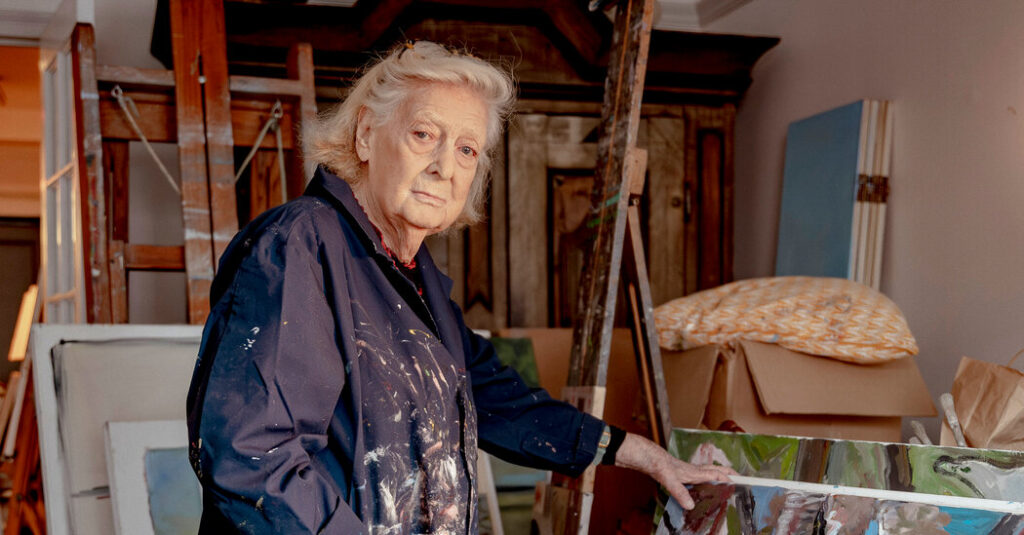
Sitting among a boisterous crowd of friends and family at the Hirschl & Adler Galleries on Madison Avenue in Manhattan, Cornelia Foss presided over the opening of the latest exhibition of her long career. Dressed in all black with a dark blue scarf, Ms. Foss confided that she felt “shaky.”
It was understandable. Ms. Foss is 94, and though she has been exhibiting since 1959 and is represented in several major American museums, this was her most high profile gallery show in a very long time.
But the opening of the exhibit, titled “Little Red,” was less a retrospective than a reintroduction. Ms. Foss has always been in the company of famous artists — she is the widow of the avant-garde composer Lukas Foss, as well as the muse of a number of poets and painters and the former lover of the pianist Glenn Gould.
But she has not been well known as an artist in her own right, and certainly not for work like this. For nearly her whole career, she painted portraits and Long Island landscapes and seascapes — works The New York Times has called “graceful, mature, modest.”
The canvases unveiled that night, however, showed something new.
These paintings vibrated with unnerving, even chaotic energy, set in an uncanny world that was equal parts nightmare and fable. The buoyant mood at the opening — visitors streamed by to congratulate Ms. Foss or pose for pictures — contrasted sharply with the ominous motif in the paintings: a wolf stalking the smudged red cape and white stockings of a small girl through forest and field.
That night in the gallery, only Ms. Foss knew where it came from, and what it meant.
Ms. Foss’s Park Avenue apartment is crowded with relics that reflect a life lived near the center of high culture. A long paintbrush poking out of a vase belonged to the Abstract Expressionist Willem de Kooning, who admired Ms. Foss’s work. Among the dozens of paintings and photographs crowding the walls is a pencil portrait of Ms. Foss’s husband by the artist Larry Rivers.
Then there’s the picture of Mr. Foss playing a piano duet with his lifelong friend Leonard Bernstein. It was taken at the Tanglewood Music Festival, and tellingly, Ms. Foss and Felicia Bernstein are turning pages for the maestros. But if this suggests that Ms. Foss was more a friend of great artists than an artist herself, her early career promised otherwise.
She made her debut in 1959, at the prestigious Ferus Gallery in Los Angeles, an early launchpad for Andy Warhol and Ed Ruscha.
Newly married, Cornelia and Lukas Foss moved from Italy to Los Angeles in 1953. They had met at the American Academy in Rome, and Mr. Foss had been appointed head of the composition program at U.C.L.A., succeeding the composer Arnold Schoenberg. Ms. Foss also had a full schedule, studying painting at the Kann Art Institute while raising a young son, Christopher, who was born in 1957, and socializing with the likes of Igor and Vera Stravinsky and Aldous Huxley.
Ms. Foss was then making bold figurative paintings, including some evocative of the medieval “dance of death.” But that theme and early momentum literally went up in smoke when the Foss residence — and many of her artworks — burned in the Bel Air fire of 1961, effectively rendering the family homeless. Ms. Foss was pregnant with her daughter, Eliza, at the time.
As the only child of a Jewish mother from a prominent German banking family and a father descended from a long line of Lutheran ministers, Ms. Foss had already fled one disaster, when she and her mother abandoned Berlin in 1939 and escaped to America. Her father had secured an academic posting, and the family eventually settled in Bloomington, Ind.
Now she would have to start over yet again. The Fosses moved to New York City.
Thanks to his musical connections, Mr. Foss had many friends in New York, but Ms. Foss knew almost no one besides her parents, who moved to the city when her father began teaching at Columbia in 1956.
But eventually Ms. Foss became enmeshed in a rarefied social world, and her homes on the Upper East Side and later in Bridgehampton, on Long Island, became meeting places for a cultural elite. Regular guests over the years included the composers Aaron Copland and John Cage, the poets W.H. Auden and James Schuyler, and socialites like Christophe de Menil and Alexandra Schlesinger. Christopher Foss even remembers Mick Jagger making an appearance at one of his parents’ parties.
Ms. Foss is not shy about dishing out gossip on the formidable members of the circle she socialized and occasionally slept with. She speaks about her friends and affairs (and her friends’ affairs) with a cosmopolitan nonchalance. And for the record, she hates the word “muse”; something like “confidante” or “intimate” would be closer to the truth.
She has even collected these anecdotes and aperçus in a 350-page unpublished memoir, a copy of which, annotated in her spidery script, she keeps in a dark green bag from Zitomer, the high-end pharmacy on the Upper East Side. A few highlights: Stravinsky’s habit of asking Ms. Foss to cover for him while he took nips from his pocket flask, a sudden marriage proposal from the painter Philip Guston (whom she barely knew), the beat poet Gregory Corso spending a month trying to detox from heroin in her attic when the Fosses moved to Buffalo.
The family relocated there in 1963, when Mr. Foss became music director of the Buffalo Philharmonic Orchestra. Life was good upstate, not least because Ms. Foss could hire a nanny to free up time for painting.
But there was also the strong pull of Glenn Gould, the eccentric Canadian pianist.
Ms. Foss met Mr. Gould in the early 1960s, after a concert in Los Angeles. “There was something — the concentrated look that he had,” she recalled. “I just fell in love with him.” It was around the same time that she discovered her husband had been unfaithful.
The relationship with Mr. Gould evolved through long phone calls and occasional encounters into a full-blown romance, which, Ms. Foss noted, was satisfying physically and intellectually. In 1968, Ms. Foss decided to move with her children to Toronto to live near him, leaving her husband in Buffalo.
Mr. Gould was notoriously difficult — he once sued a man for patting him on the back — yet in Toronto, he doted on the Foss children.
But Mr. Gould’s well-documented paranoia worsened, as did his prescription drug abuse.
Most troublingly, Ms. Foss said, “Glenn didn’t want me to paint.”
Though she stresses Mr. Gould’s kindness, Ms. Foss now regrets spending four and a half years in Toronto.
“That’s a long time,” she said. “I wasn’t being me.”
In 1972, Ms. Foss and her children moved back to New York City for good.
She found a therapist and a studio. And though her marriage to Mr. Foss eventually recovered, it remained complicated. He was constantly traveling for his busy performance calendar, and like many in their bohemian milieu, both continued to have affairs.
Though she might have seemed like an art world insider, Ms. Foss never felt like one. Following her first summers on Long Island, she was drawn to paint the landscape, preferring a traditional realism to more fashionable styles like Abstract Expressionism and Minimalism.
But her sense of displacement went deeper, to her itinerant childhood, particularly her earliest years in Rome, where her father worked as an archaeologist. “Wherever I was, I was a totally different person,” Ms. Foss recalled in her living room. “When I was in Italy, I was a German. When I was in Germany, I was something else, because I’d been living in Italy all the time. When I was in America, I was a European,” Ms. Foss said.
“I was different. I had a secret, and my painting was part of that.”
Many of the people she encountered in New York, she said, “took it for granted that I didn’t do anything.” Even fellow Long Island landscape painters like Jane Freilicher and Jane Wilson kept their distance. “As far as painting was concerned,” Ms. Foss said, “I was a secret painter.”
Ms. Foss did not hide her dramatic childhood escape from Nazi Germany. But, already feeling like something of an artistic outsider, she left her difficult memories out of her work. “They were there,” she said, “as if I had hidden my good jewelry in a place.”
In 1937, after her father, the distinguished classical archaeologist Otto Brendel, was fired from his position at the German Archaeological Institute in Rome because of his “non-Aryan” wife, the family returned to Berlin. For their own safety, Ms. Foss’s parents did not tell their daughter about the Jewish half of her family. But she could tell something terrible was brewing.
Her father left Berlin to search for an academic position abroad and eventually sent word that he had been appointed to a chair at Washington University in St. Louis. Her mother then navigated a Kafkaesque bureaucracy to secure an exit visa, but the ordeal was far from over.
It was September 1939, and Ms. Foss recalled racing with her mother to the train station with only the bags they could carry. They would travel to Antwerp, where they would take the S.S. Volendam to New York City. But at the Belgian border, the train stopped and they were ordered out of the carriage.
Soldiers with snarling dogs approached them, and an 8-year-old Cornelia was separated from her mother, led away and strip-searched by a “dreadful” nurse. “I wasn’t afraid so much as I was angry and furious,” Ms. Foss said. “How dare she?” Satisfied the child was not carrying any contraband, they let her go right as the train was leaving.
As Ms. Foss recalled, still obviously haunted by the memory, she spotted her mother standing on the platform between two cars, and ran as fast as she could to reach her just in time.
“That was the worst moment of my life, probably,” Ms. Foss said, with a startling matter-of-factness. “Except when Lukas died,” she added.
After her husband died in 2009, Ms. Foss stopped painting for two years. She moved out of the Fifth Avenue home they had shared for decades, settling in the Upper East Side apartment she has lived in ever since. When she started making art again, something was different.
She still painted landscapes, but she also began making portraits of the many people she had known, including Mr. Gould. She also turned to more politically charged themes that recalled the work that was lost in the California fire, making and exhibiting paintings of the innocent victims of American drone strikes, and one of ashen figures of Jews emerging from green foliage as they await their slaughter. In 2016, she made her first two paintings of Little Red Riding Hood and the Wolf, which became a series she calls her “Little Reds.”
It was as if the past had begun to invade her landscapes.
“Little Red” has been extended until Dec. 12, and includes a helpful “Cornelia in Context” section that shows work by her contemporaries — among them Ms. Freilicher and Ms. Wilson — as well as Fairfield Porter, one of Ms. Foss’s greatest influences.
But the 12 paintings in the main gallery, most made in the last year, stand alone. They form a kind of narrative of her life: Little Red escaping through the woods of Nazi Germany and then traveling through a warmer scene that recalls Italy, before finally locking eyes with the wolf as it appears in an inset portrait, with a Long Island seascape in the background. Little Red’s hair, like the young Cornelia’s, is flaxen blond.
“She’s safe,” Ms. Foss said of the little girl. “And she’s angry.”
The post In Her 90s, a Painter Finally Confronts Her Nazi Trauma appeared first on New York Times.