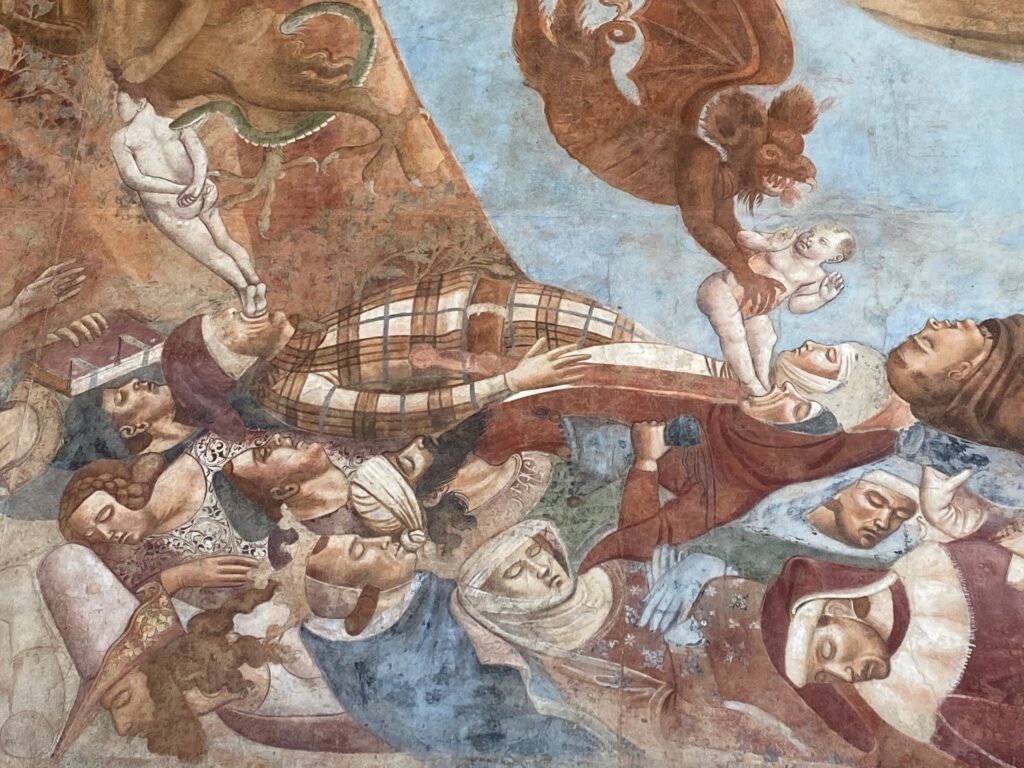
For centuries, the prevailing explanation of how the Black Death entered medieval Europe was a simple narrative of biological warfare. During a siege of Caffa, a Genoa-controlled port city on the Crimean Peninsula, a Mongol army catapulted plague-infested bodies over the city walls, according to a historical account. It was a simple narrative, with a clear villain.
But a new study published Thursday adds to a body of evidence that upends that grisly origin story, suggesting that a perfect storm of volcanic eruptions, crop failure, famine and medieval globalization converged in the mid-1300s to unleash the Black Death across Europe.
The paper in the journal Communications Earth & Environment is the latest in a wave of recent scientific and historical evidence that is rewriting our understanding of the bubonic plague pandemic that tore across medieval Europe, killing more than half of the people it infected, more than half a millennium ago.
The plague is transmitted by insects that feed on blood, such as fleas, and usually cycles through rodent populations — but has jumped into humans, sparking three deadly pandemics that killed millions.
Martin Bauch, a medieval historian at the Leibniz Institute for the History and Culture of Eastern Europe and Ulf Büntgen, an environmental systems scientist who studies tree rings to understand the past climate at the University of Cambridge, teamed up to reexamine data from ice cores, unusual tree rings and historical records to reconstruct a different narrative rooted in a chain of interconnected environmental and societal events.
In broad strokes, they found a volcanic eruption, or a series of them around the year 1345 spewed sulfur into the atmosphere. This triggered a climate downturn, with cool summers and rainy growing seasons afflicting large parts of the Mediterranean and Western Europe. Crop failures followed, along with a famine across large swaths of medieval Europe. The Italian maritime republics of Genoa and Venice had been in a war with the Mongols of the Golden Horde, but agreed to lift the embargo to import grain to feed starving people.
Around the autumn of 1347, grain imports began to resume. On the ships that brought much-needed food were stowaways: the plague pathogen.
“As I was reading it, this is the next puzzle piece,” said Hannah Barker, an associate professor of history at Arizona State University who uncovered the plague-grain trade connection and was not involved in the study. “We had good information on the historical side, on the grain trade. The next question is: why 1347, why not 1353, why not 1342 — what was it that was special about that year? It is several causes coming together.”
Blue tree rings, famine and fleas
The study of the Black Death had already been revolutionized by the study of ancient DNA. The bacterium that causes plague, Yersinia pestis, has been recovered from ancient remains and studied. The ancestor to the pathogen that causes the Black Death can be traced to the Bronze Age in central Eurasia and the foothills of the Tien Shan mountains in what is today Kyrgyzstan. Scholars also agreed the pathogen came to Europe from the Black Sea. But how?
Bauch had long been intrigued by the period from 1345 to 1347 because those years stood out, meteorologically. There were historical reports of extreme precipitation and severe flooding in Italy that ravaged the harvest and washed away fields.
Bauch studies historical chronicles, letters, treaties. But he connected with Büntgen who was also interested in those years, with a focus on the ancient climate record.
Ice cores record the effects of volcanic eruptions: when sulfur is ejected into the atmosphere and is then deposited as sulfate aerosols. They became interested in one such eruption, or series of eruptions, that occurred around the year 1345. Historical accounts from this time also reported unusually foggy and hazy skies and unexpected lunar eclipses, which may have occurred when the moon is veiled by volcanic ash and gas.
Studies of the growth rings in trees from the Spanish Pyrenees Mountains showed an odd aberration in those years — blue rings. These occur when the growth conditions are not favorable. What was extremely rare was to see consecutive blue growth rings between 1345 and 1347. That suggested a climate downturn in southern Europe. A famine spread across much of Spain, France, north and central Italy, Egypt and the eastern Mediterranean.
Then, medieval geopolitics entered the story: war and famine.
“You have explicit orders to Venetian officials: Buy grain at any cost and send all the ships to go get it, and fill them with grain. We need them very urgently,” Bauch said.
But it turns out, as Bauch’s study suggested, that the plague was a stowaway.
Science, history, archaeology collide
The plague field now encompasses people with different expertise, from those who study the Yersinia pestis pathogen itself, historians who pore over records, archaeologists who uncover new remains and others.
Maria Spyrou, who specializes in studying pathogen genomics and infectious-disease history at the University of Tübingen, said in an email that the new study is an interesting reconstruction of the detailed historical events that could have sparked the Black Death in Europe. She noted that it is in line with her own studies, which traced the evolution of the plague pathogen that caused the Black Death to Eurasia.
That leaves one of the hottest questions in the history of the plague wide open.
“What is still unclear, however, is the mechanisms by which Yersinia pestis spread from central Asia to the Black Sea prior to 1345,” Spyrou said.
The gradually unraveling history of the Black Death may also contain a warning for the future. It illustrates how climate change, coupled with globalization could seed other pandemics.
“It’s the scientific information that kind of broke the dam,” Barker said. “The DNA first, and now the climate research, is causing historians to ask new questions. And once we start asking new questions, we find new information, we look in places that nobody was looking before. Things are changing really fast.”
The post How volcanoes upend the story of what sparked the Black Death appeared first on Washington Post.