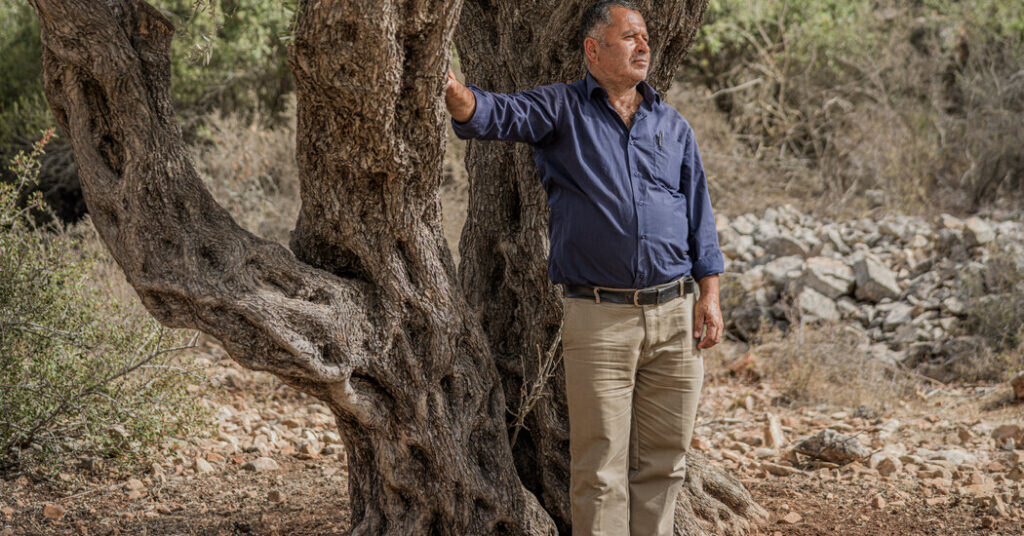
For two decades, Muhammad Abdulrahman, 58, lived with his wife and his beehives on a remote hillside in the Israeli-occupied West Bank.
But in May, Israeli settlers set up camp about 200 yards away and took control of the road leading to Mr. Abdulrahman’s home, blocking him from returning, he said. Israeli soldiers then evicted him and his wife, Suha Abdulrahman, the couple said.
The Israeli military said that Mr. Abdulrahman left voluntarily, but he said that he has still been unable to return home. Last month, a video shared by an Israeli lawmaker on social media showed his house had been turned into a space for religious study by the settlers.
“All my memories are in that home,” Mr. Abdulrahman said by phone last month from his brother’s house in the nearby town of Betunia, where he is now staying. “They are not only stealing our land but also trying to cut the roots that connect us to it.”
The Abdulrahmans were among the first Palestinians affected by an Israeli government decision in May to redraw the map of the West Bank by turning more Palestinian areas into Jewish settlements.
In the most extensive expansion in decades, the government approved 22 villages and neighborhoods for settlements across the territory, including one called Beit Horon North, near where Mr. Abdulrahman and his wife lived, west of the Palestinian city of Ramallah. It was part of a broader and decades-long push by Israel to entrench its control over the West Bank.
That process has become more aggressive since 2022, when Prime Minister Benjamin Netanyahu returned to office, and the outbreak of the war in Gaza, which was ignited by the Hamas-led attacks on Israel in October 2023. There has been a surge of settler violence in the West Bank, which Israeli police have largely failed to address. Israel has also conducted extensive military operations, which it has said were aimed at combating militants, that have uprooted entire neighborhoods in Palestinian cities. Historians and researchers say that has led to the largest wave of Palestinian displacement in the West Bank in a half-century.
Most of the international community sees the creation of a Palestinian state that includes the West Bank as key to ending the Israeli-Palestinian conflict. Since capturing the territory in 1967, however, Israel has expanded its presence there through settlement building,even in densely populated Palestinian areas.
The government intended to accelerate that process with its decision in May to expand the settlements, according to Israel Ganz, a head of a local settler council who helped promote the plan. The Palestinian Authority, which administers large parts of the West Bank, is also racing to claim territory before Israel does.
“Say there are 500 acres of land the state of Israel doesn’t want to lose — it puts a village there,” Mr. Ganz said. “That doesn’t mean a 500-acre city will be built, but once you’re there, no one else can be.”
The United Nations and the International Court of Justice say that all Israeli settlements in the occupied West Bank area violate international law. Israel rejects that.
Some of the 22 settlements approved in May already existed but they had been deemed illegal under Israeli law. The recent decision meant that these were authorized retroactively. Others are planned for the northern edge of the West Bank, in a region where no officially recognized settlements have existed since Israel dismantled them in 2005.
In August, the Israeli government approved a major settlement project, known as E1, that would effectively split the West Bank in two, making it harder for Palestinians to establish a contiguous state there.
In recent months, members of the Israeli government have also repeatedly threatened to annex parts of the West Bank.
‘This is our land, and I make the rules here’
Over the past year, settlers have built a record number of outposts — small encampments often made of prefabricated homes — according to an Israeli military official who spoke on the condition of anonymity to share sensitive information.
More than 40 were built in the past six months alone, according to Hagit Ofran who monitors the West Bank for Settlement Watch, a project run by the Israeli advocacy group Peace Now.
The government’s plan for the 22 settlements “aims to curb Palestinian urban growth and link Israeli-populated areas,” according to Mr. Ganz, who helped select some of the sites. “Beit Horon North, for instance, will stop Ramallah from spreading,” he added.
When we visited Beit Horon North in July, Israeli settlers appeared to be in control of the area.
“This is our land, and I make the rules here,” said Elkana Shahar, a young settler who was wearing a sleeveless shirt with a peace sign. He and a few other boys had been left on a hot morning to watch over a scattering of belongings in the shade of an awning — a worn sofa, a refrigerator, a fan and bookshelves. The settlers had also poured concrete in preparation for permanent construction.
When we approached, one of the settlers drew what appeared to be a handgun that they later said was a pepper-spray pistol.
“Did you get approval to be here?” Mr. Shahar asked. He demanded that we leave, saying that it was private property.
On the same road, two other young Israeli settlers were seen breaking into a recently built Palestinian home that had been abandoned. The gate to the yard was broken, and the back window had been shattered.
Many settlements grow out of such outposts. A spokesman for the Israeli Civil Administration, a military unit that manages civilian affairs in the West Bank, said that building the Beit Horon North settlement required further legal and planning procedures. The outpost that we visited there was not part of the government-authorized settlement, and was illegal, they said, but that taking any action against it was “subject to the approval of the political echelon.”
Under the Oslo Accords, signed in the 1990s, both Israelis and Palestinians committed to not take any steps that would change the status of the West Bank. But successive Israeli governments largely ignored dozens of unauthorized Jewish outposts in the region — and the military has often discretely provided their security — ushering in a period of large-scale settlement expansion.
Some remote areas, like the one where Mr. Abdulrahman lived, were not part of that expansion until this year.
“We thought no one paid attention to our patch of land,” said Mr. Adulrahman. He and his wife lived in an old two-room house built from large, uneven stones, surrounded by pine trees and an olive grove. No other homes were within earshot.
Mr. Abdulrahman said he was ready to fight for his home, and he had filed a complaint with the Israeli police and the Israeli Civil Administration. The police did not respond to a request for comment.
It was not the time for emotions, Mr. Abdulrahman said. “It’s time to put Israel’s claim that it’s a rule of law country to the test.”
Rawan Sheikh Ahmad contributed reporting from Haifa, Israel, and Sanjana Varghese from London.
Natan Odenheimer is a Times reporter in Jerusalem, covering Israeli and Palestinian affairs.
The post How Israel’s Settlement Surge in the West Bank Is Displacing Palestinians appeared first on New York Times.