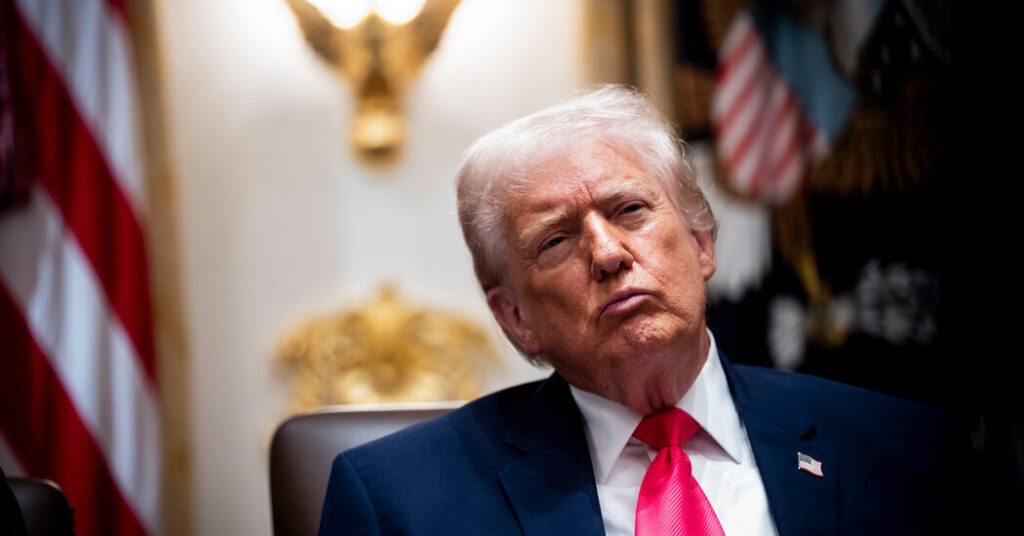
Just two weeks ago, President Trump set a Thanksgiving deadline for Ukraine to agree to a peace treaty with Russia, putting on the table a proposal with elements that could have been drafted by the Kremlin.
Now, it seems clear he will have to wait — maybe weeks, maybe past the fourth anniversary of Russia’s invasion of Ukraine in late February.
A Ukrainian delegation is expected to meet on Thursday with Mr. Trump’s negotiators, keeping alive hope for some progress. But President Vladimir V. Putin signaled yet again this week that he was not budging from his hard-line demands, leaving Mr. Trump’s envoys with no breakthrough to show for their five-hour meeting with the Russian leader in Moscow on Tuesday.
That leaves Mr. Trump with a difficult but familiar set of choices. Does he pressure Ukraine to make even more concessions — as he attempted two weeks ago — even if that means endangering the country’s sovereignty? Does he eventually walk away, as he has suggested at some moments that he might, even if that admits failure in an effort to end a war that he had promised to solve in 24 hours?
Or does he reverse course and restore wide-ranging American military aid to Ukraine, after declaring that Europe, not the United States, would have to bear the financial burden of arming the country?
“It does take two to tango,” Mr. Trump told reporters on Wednesday, acknowledging the difficulty of getting Russia and Ukraine to a deal.
“I don’t know what the Kremlin is doing,” Mr. Trump said when asked for an update on Tuesday’s meeting, which included his envoy, Steve Witkoff, and his son-in-law, Jared Kushner. “I can tell you that they had a reasonably good meeting with President Putin. We’re going to find out.”
It was a very different tone than the one he used at his August meeting with Mr. Putin in Anchorage, Alaska, where he confidently predicted that the leaders of Russia and Ukraine would sit down together and hammer out an understanding, with Mr. Trump as their mediator and guide.
All year, Mr. Trump has set deadlines and claimed that a peace deal might be nigh, only to be frustrated by a Russian president who has stuck, unwaveringly, to his far-reaching goals for Ukrainian territory and sovereignty.
But while many observers expected Mr. Trump to eventually lose interest in trying to stop the war, he has only redoubled his efforts in recent weeks, apparently convinced that Ukraine’s grinding battlefield setbacks and the mounting costs to Moscow of a sustained conflict would drive both sides toward a deal.
American officials have argued that in their effort to get proposals on paper, and in front of Mr. Putin and President Volodymyr Zelensky of Ukraine, there have been more negotiations in the past few weeks than in the past three years.
For now, it appears that those negotiations are continuing. The United States has invited Ukrainian officials to visit “in the near future” for more peace talks, Andrii Sybiha, Ukraine’s foreign minister, said on Wednesday. A White House official said Mr. Witkoff and Mr. Kushner would meet the Ukrainian delegation on Thursday in Miami.
Ukraine has sought to show Mr. Trump that it is ready to keep talking, even though many Ukrainians are convinced that Mr. Putin has no interest in reaching a negotiated end to the war.
“Activity is at its maximum to bring this war to an end,” Mr. Zelensky said in his evening address on Wednesday. “And from our side, from Ukraine’s state, there will be no obstacles or delays.”
Mr. Putin, on the other hand, has not been eager to rush into an agreement, maintaining his strategy of going along with talks while being unwilling to make substantive concessions.
The biggest sticking points appear unchanged despite the diplomatic sprint of recent weeks, which began last month with the leak of a 28-point U.S. plan for ending the war that was widely criticized as being too favorable to Russia.
Russia, Mr. Putin suggested last week, not only wants Ukraine to cede land that Kyiv still controls, but also to have the United States legally recognize Russia’s conquests.
“No compromise option has yet been found” on the territorial issue, Mr. Putin’s foreign policy adviser, Yuri Ushakov, told reporters past midnight on Wednesday in Moscow. “The work will continue.”
Mr. Ushakov was speaking after Mr. Putin spent about five hours meeting with Mr. Witkoff and Mr. Kushner. He said that Russia had agreed to some parts of a four-part U.S. proposal to end the war, but that Mr. Putin “made no secret of our critical and even negative attitude” toward other parts.
Mr. Putin’s reaction to the revised American proposal was unsurprising. When the original, 28-point text leaked two weeks ago, taking Europeans by surprise, U.S. negotiators were forced to rewrite it, excising the sections that most undercut Ukraine’s future security.
Predictably, that made it unacceptable to Mr. Putin, whose goals, Secretary of State Marco Rubio said on Tuesday night, remained the same: to undercut the Ukrainian state.
“Putin a couple of weeks ago said: It may take long — we are going to achieve our objectives; it may cost more and take longer than we want it to, but we will get it done,” Mr. Rubio told Sean Hannity of Fox News in an interview after the marathon negotiating session in Moscow.
“I actually think that’s their mentality,” he continued. “And what we’re trying to see: Is it possible to end the war in a way that protects Ukraine’s future that both sides could agree to? That’s what we’re trying to find out, and I think we’ve made some progress. But we’re not there yet.”
While Mr. Trump said on Wednesday that Mr. Kushner and Mr. Witkoff had the impression that the Kremlin would “like to make a deal,” Mr. Rubio suggested he was not so sure. He told Mr. Hannity that he could not put a “confidence level” on reaching an accord, “because ultimately the decisions have to be made, in the case of Russia, by Putin alone, not his advisers.”
Tuesday’s five-hour session was the sixth, and longest, meeting between Mr. Witkoff and Mr. Putin in Russia this year. For the first time, the two were joined by Mr. Kushner, who played central roles in negotiating the Gaza cease-fire in October and the Abraham Accords, the deals that normalized relations between Israel and some Arab countries in Mr. Trump’s first term.
But already, officials say, the negotiation on the war is taking a different form than the Gaza agreement, reflecting the very different nature of the conflict.
People familiar with the discussions say there are now four separate elements being negotiated in parallel. One concerns issues related to Ukraine’s sovereignty, like limits on the future size of its peacetime army and on the range of its missiles. The others cover territory, economic cooperation and broader European security issues.
Mr. Zelensky said that his aides would brief European officials in Brussels on Wednesday on the talks, “and they will also discuss the European component of the necessary security architecture.” He made it clear that beyond negotiating over territory, Ukraine’s goal was to make sure that any peace deal included guarantees of Western support to deter a new Russian invasion in the future.
“The most important thing is Europe’s effective involvement in our defense, and also in guaranteeing security after this war,” Mr. Zelensky said.
But even as the talks appeared set to continue, there was widespread skepticism in Europe and in Washington about the chances that they would end in agreement.
Jennifer Kavanagh, a military analyst at Defense Priorities, a bipartisan research center that promotes a restrained global role for the United States, said that Mr. Putin was unlikely to compromise given his apparent conviction that Russia’s battlefield leverage was increasing.
“Any deal that ends the war is going to be painful and unfair,” she said. “It still seems like we’re a long way from a set of terms that meets Russia’s minimum acceptable criteria and that is palatable enough to Ukraine that the United States can convince Kyiv to accept it.”
Zolan Kanno-Youngs contributed reporting from Washington.
David E. Sanger covers the Trump administration and a range of national security issues. He has been a Times journalist for more than four decades and has written four books on foreign policy and national security challenges.
The post His Deadline for a Peace Deal Blown, Trump Faces Choices on Russia-Ukraine Talks appeared first on New York Times.