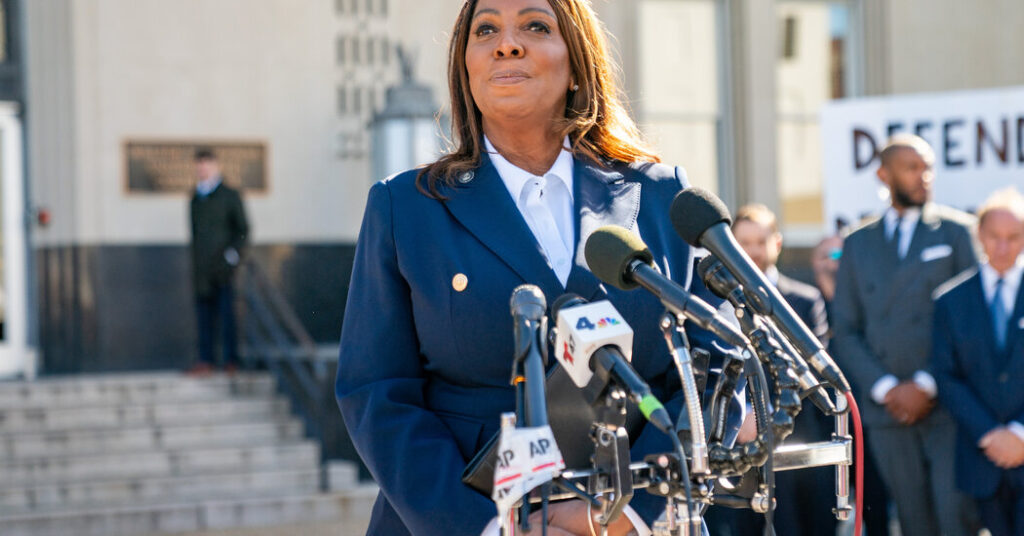
A grand jury in Norfolk, Va., declined on Thursday to re-indict Letitia James, New York’s attorney general, rejecting efforts to revive a criminal case that had been sought by President Trump, according to people familiar with the matter.
The unsuccessful attempt to revive the case against Ms. James does not necessarily end the administration’s efforts to put her on trial, even after a federal judge dismissed an earlier indictment last month in ruling that the prosecutor who brought the case was unlawfully appointed by Mr. Trump and Attorney General Pam Bondi.
Nothing in the law prevents the Justice Department from trying a third time to indict her.
The Justice Department declined to comment. Ms. James has long been in the president’s crosshairs, largely because of her yearslong civil case against Mr. Trump, accusing him of exaggerating his net worth by billions of dollars. The Virginia case is not the only one his Justice Department has opened into Ms. James.
On Thursday, even as a federal grand jury in Virginia voted down a new indictment, lawyers representing Ms. James’s office appeared before a federal judge in New York, where the Justice Department is pursuing a separate civil rights investigation into her work as the state’s top lawyer.
That judge expressed skepticism during the hearing that the interim U.S. attorney overseeing that case was lawfully appointed by the administration — an issue that is becoming increasingly difficult for the president’s quest to use the Justice Department to seek revenge against his perceived foes.
In September, Mr. Trump forced out his own choice for U.S. attorney in the Eastern District of Virginia, Erik S. Siebert, after Mr. Siebert concluded the evidence did not support criminal charges against Ms. James or another of Mr. Trump’s frequent targets, the former F.B.I. director James B. Comey.
The president installed Lindsey Halligan, a White House aide with no prosecutorial experience, in Mr. Siebert’s place. Days after her appointment, Ms. Halligan secured a grand jury indictment against Mr. Comey and, weeks later, against Ms. James.
Ms. James, who sued Mr. Trump in 2022 on allegations of widespread business fraud, was indicted on charges of lying to financial institutions to secure better terms for a mortgage on a home in Virginia.
Judge Cameron McGowan Currie ruled in late November that Ms. Halligan’s interim appointment was invalid, because such appointments were meant to last no more than 120 days, a period exceeded by the previous interim appointee, Mr. Siebert. And because Ms. Halligan was the sole prosecutor who had secured charges against Mr. Comey and Ms. James, Judge Currie ruled, the indictments had to be thrown out. She did not weigh in on the evidence against Ms. James, which career prosecutors in the Eastern District of Virginia had viewed skeptically.
Ms. Bondi quickly vowed to appeal that decision.
Federal judges have repeatedly ruled against Mr. Trump’s use of interim appointments to skirt the Senate confirmation process required for U.S. attorneys.
A three-judge panel for the Court of Appeals for the Third Circuit in Philadelphia ruled on Dec. 1 that the Trump administration’s extended use of an interim U.S. attorney appointment in New Jersey was also unlawful and invalid. That ruling came in response to the fight over Alina Habba, a former personal lawyer for Mr. Trump who was the leading federal prosecutor in New Jersey.
Aishvarya Kavi and Jonah E. Bromwich contributed reporting.
Devlin Barrett covers the Justice Department and the F.B.I. for The Times.
The post Grand Jury Said to Decline to Re-Indict Letitia James appeared first on New York Times.