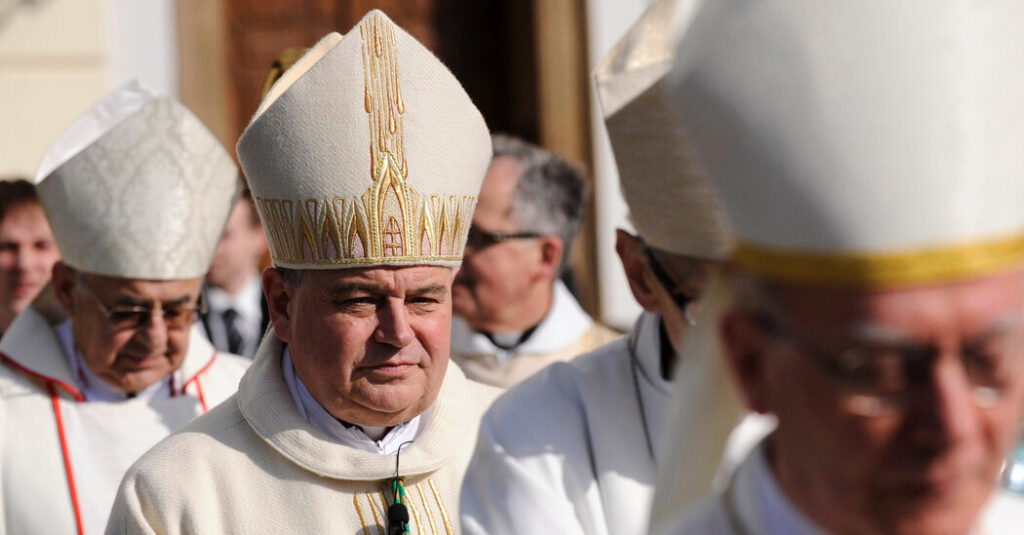
Cardinal Dominik Duka, a Czech prelate who helped keep the Roman Catholic faith alive in his country over decades of Communist rule through secret Masses, underground publications and close collaboration with secular dissidents, even during more than a year in prison, died on Nov. 4 in Prague. He was 82.
The Archbishopric of Prague, which he led from 2010 to 2022, announced the death. It did not provide a cause or specific place.
Cardinal Duka spent much of his early life under one of the most anti-religious governments in Communist Europe. Czechoslovakia imprisoned, tortured and executed Catholic leaders; required priests to register with the state; and tightly surveilled Masses for the slightest hint of anti-government sentiment.
Cardinal Duka was ordained in 1970 and quietly joined the Dominican order. After officials revoked his registration in 1975 for criticizing the government, he worked in a car factory while continuing to tend to his flock in secret. He published reams of samizdat — underground books and essays — that circulated among Czechoslovakia’s small but vibrant Catholic community.
After he was jailed for his activities in 1981, he celebrated Mass in prison, under the disguise of a chess club. He also grew close to a fellow inmate, the dissident playwright Vaclav Havel, who in 1989 led the country’s bloodless Velvet Revolution against the government and later served as Czech president.
When Mr. Havel died in 2011, Cardinal Duka presided over the liturgy at his funeral.
By then, he had long since emerged from the shadows to help rebuild the church in Eastern and Central Europe.
Despite the Czech Republic’s status as one of Europe’s most atheistic countries, Cardinal Duka held significant influence among its political leadership, maintaining strong connections with figures like Mr. Havel and Milos Zeman, the president of the Czech Republic from 2013 to 2023.
He worked closely with the Czech government over the redistribution of property that the Communists had expropriated from the church, eventually winning back billions of dollars in restitution.
He was named the bishop of Hradec Kralove, a city east of Prague, in 1998 and became the archbishop of Prague in 2010. Pope Benedict XVI elevated him to cardinal in 2012.
In that last role, he pressed the church to adopt or maintain conservative positions on issues like abortion, same-sex marriage and migration. In contrast to many other Catholic leaders, he said immigration was threatening to overwhelm European societies and should be controlled more strictly.
“With the regulation,” he said, “we take into account not only the well-being of the afflicted, but we also necessarily protect the population of the host countries. Throughout the history of mankind, unregulated migration invariably brought violence, wars and an economic, cultural and social downfall.”
At the same time, Cardinal Duka was rarely doctrinaire about enforcing his views at the parish level. He also urged the church to work harder to connect with modern society, especially younger people who might not immediately identify with their Catholic roots.
“The church should respond more readily to the questions of today’s world,” he said upon his elevation to archbishop. “Religious questions and answers must be put and answered in a comprehensible language and correspond to a higher level of people’s education, and so that young people can recognize themselves in these reports.”
Especially after he retired in 2022, he became more outspoken about hot-button cultural issues, even when doing so courted controversy.
In 2023 he sparked an uproar with a post to social media claiming that in the face of “efforts to legalize marriage for all” and the impact on religious communities during the war in Ukraine, Jews and Catholics today “face the same pressure as they did under Nazism.”
A year later, he compared the opening ceremony of the 2024 Olympic Games in Paris, which featured an outré interpretation of the Last Supper, with the 1936 Games in Berlin, held under the Nazi regime — arguing that both events saw the Games subverted by a political agenda.
In September, he led a requiem Mass for Charlie Kirk, the conservative activist, calling him an “honest and courageous man.” Cardinal Duka added that he had not heard of Mr. Kirk before his assassination.
Jaroslav Vaclav Duka was born on April 26, 1943, in Hradec Kralove. His father, Frantisek, was a soldier in the Government Army, which fought under the Germans. He deserted his unit in Italy and joined the Czech forces in exile, eventually serving with the Royal Air Force in Britain.
Like many Czech soldiers who fought with the Allies, Frantisek did not receive a hero’s welcome when he returned. Instead, the new Communist government, fearing Western influence, put him in prison, where he remained for most of his son’s childhood.
Cardinal Duka and his sister, Eva, were raised by their mother, Anezka Dukova. He does not leave any immediate survivors.
Following high school, he went to work in a factory and trained as a locksmith. He began his theological training in 1965 and joined the Dominicans in 1972, taking Dominik as his religious name.
He offered to resign from the College of Cardinals in 2018, when he turned 75, the mandatory retirement age. Pope Francis kept him on for another two years, an indication of how, despite political differences, Cardinal Duka was admired by many of his more liberal colleagues.
That sentiment was echoed by Pope Francis’s successor, Leo XIV.
“I remember with admiration his courage during the time of persecution, when, deprived of his freedom, he did not falter in his adherence to Christ and to the church,” the pope said in a statement following Cardinal Duka’s death. “With a father’s heart he guided the people of God, promoting reconciliation, religious freedom and dialogue between faith and society.”
Clay Risen is a Times reporter on the Obituaries desk.
The post Dominik Duka, Czech Cardinal Jailed Under Communism, Dies at 82 appeared first on New York Times.