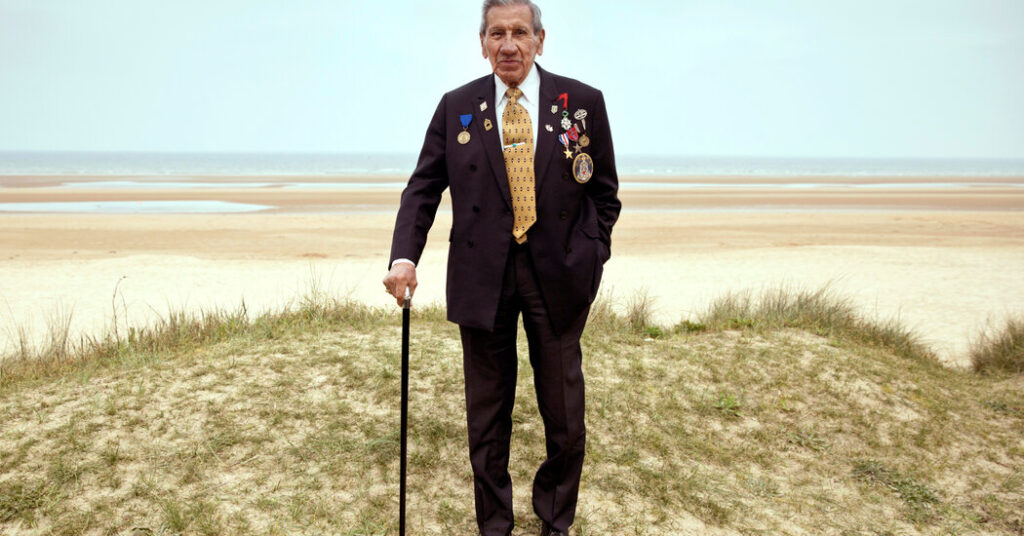
Charles Norman Shay, who as a 19-year-old medic on D-Day repeatedly saved soldiers from drowning off Omaha Beach, turning them on their backs, dragging them ashore and binding their wounds, died on Wednesday at his home in Thue et Mue, France, near the site of the Normandy invasion. He was 101.
His death was announced by a group that supports the Charles N. Shay Indian Memorial, a monument on Omaha Beach to Native American soldiers who landed there on June 6, 1944.
Mr. Shay, a member of the Penobscot Nation of Maine, was one of about 175 Native Americans among the 34,000 Allied troops who came ashore on that beach, into the teeth of some of the bloodiest fighting of D-Day in the opening act of the liberation of France during World War II.
Mr. Shay was awarded the Silver Star for saving soldiers who had been cut down by heavy German machine-gun fire after disembarking from their landing craft into the waves. In 2007, he received France’s Legion of Honor for his actions that day.
“I saw there were many wounded men who were floundering in the water, who could not help themselves, and I knew that if nobody went to help them, they were doomed to die,” Mr. Shay recalled in a 2010 interview for the Library of Congress.
He continued: “I proceeded to get as many men as I could out of the water by turning them over on their backs and grabbing them under their shoulders. I don’t know where my strength came from, but they say once the adrenaline starts flowing in your body you can do unbelievable feats.”
An Army private with the First Infantry Division, known as the Big Red One, Mr. Shay was drafted in 1943 and assigned to the medic corps. He continued in that role as American forces suffered heavy casualties while battling to drive German occupiers out of France.
Mr. Shay participated in the Battle of Hürtgen Forest and the Battle of the Bulge. In March 1945, he and his squadron were captured by the Germans near Auel, Germany. For several weeks, he was held as a prisoner of war at Stalag VI-G, until Americans liberated the camp in April 1945, en route to forcing Germany’s surrender in May.
As a Native American, Mr. Shay found few opportunities for work on returning to the United States. In the fall of 1945, wearing his Army uniform with his decorations, including the Silver Star, he was turned away when he tried to vote in an election in Maine. (The state did not grant Native Americans the right to vote in federal elections until 1954, and in state and local elections until 1967.)
“I tried to cope with the situation of not having enough work or not being able to help support my mother and father,” he said last year. “Well, there was just no chance for young American Indian boys to gain proper labor and earn a good job.”
He re-enlisted in the Army and was stationed in Vienna as a medic with a military police unit. During the Korean War, he saw combat and earned the Bronze Star. He retired with the rank of master sergeant in 1952.
Charles Norman Shay was born on June 27, 1924, in Bristol, Conn., one of nine children of Leo Shay and Florence (Nicolar) Shay, a noted Penobscot basket maker. In 1923 the couple had moved to Connecticut from the Penobscot reservation on Indian Island in Maine, in search of better jobs.
The family traced its ancestry to a 17th-century French officer, Jean-Vincent d’Abbadie de Saint-Castin (for whom the town of Castine, Maine, is named), and one of his wives, a daughter of the Penobscot chief Madockawando.
Charles earned a certificate as a machinist in 1942 before being drafted.
In 1950, while stationed in Vienna, he married Lilli Bellarth, a native of that city, and the couple lived there for many years. In 2003, they moved to the Penobscot Indian Island Reservation, near Old Town, Maine, north of Bangor, where Mr. Shay, by then a tribal elder, promoted the culture and history of the Penobscot.
He was instrumental in the reprinting of “The Life and Traditions of the Red Man,” a book written by his grandfather Joseph Nicolar in 1893. He also lobbied successfully for a Maine law making June 21 Native American Veterans Day.
Mr. Shay’s wife died in 2003. He is survived by a son, Jonny Shay, and a grandson.
Mr. Shay returned to Omaha Beach for the first time in 2007. “When I looked across the beaches all those years later,” he told Portland Monthly magazine in 2017, “I could still hear the screams and cries of the wounded and dying begging for help. I did what I could to relieve their pain and misery.”
From 2018 until his death, Mr. Shay lived in northwestern France, in the home of a caretaker, Marie-Pascale Legrand, not far from the beaches where the World War II invasion took place. Ms. Legrand, who met Mr. Shay at a commemoration ceremony in Normandy in 2016, said in an interview that he had been lonely living in Maine and was not getting adequate health care. After visiting him there, she invited him to move to Normandy.
For several years, Mr. Shay performed a sage-burning ceremony overlooking Omaha Beach in honor of the dead. He was one of a very few American veterans able to attend D-Day commemorations in Normandy in 2020 and 2021, during the Covid-19 pandemic.
A total of 4,414 Allied troops were killed during landings on five beaches in Normandy on D-Day, including 2,501 Americans. Allied commanders considered pulling back forces from Omaha Beach at one point because the German resistance was so fierce. By the end of that first day, Mr. Shay fell into an exhausted sleep above the sand.
“When I woke up in the morning, it was like I was sleeping in a graveyard because there were dead Americans and Germans surrounding me,” he recalled. “I stayed there for not very long, and I continued on my way.”
Trip Gabriel is a Times reporter on the Obituaries desk.
The post Charles Norman Shay, Tribal Elder and World War II Hero, Dies at 101 appeared first on New York Times.