The emailed plea was urgent and direct: “Rahmanullah needs help.”
The warning came nearly two years before Rahmanullah Lakanwal would be named as a suspect in the gunning down of two National Guard troops near the White House on the eve of Thanksgiving. It was enshrined in writing by a volunteer helping to give Mr. Lakanwal a fresh start in America who had become convinced he was unraveling.
He had tried to make a go of life in the coastal city of Bellingham, Wash., after he and his family were evacuated from Afghanistan by the U.S. military in August 2021. In Afghanistan, he had fought in a C.I.A.-trained paramilitary unit. In the United States, he did temporary jobs, took his five sons to a local mosque and hosted visitors for tea in an apartment decorated in traditional Afghan style, with floor pillows and red rugs.
But by early 2023, he started to show signs of depression and erratic behavior, according to accounts from a volunteer in northwest Washington who worked with his family.
In the months after, he sequestered himself inside his darkened bedroom, refused to answer his phone, and even failed to bathe or dress his sons when his wife left to take short breaks from him. He dropped out of the English classes he was supposed to take, did not seek work and stopped paying rent. His family received an eviction notice.
“Rahmanullah has not been functional as a person, father and provider since March of last year,” the volunteer wrote in a January 2024 email for a friend to send to a nonprofit group working with immigrants. “His behavior has changed greatly.”
Occasionally, Mr. Lakanwal did emerge from “dark isolation,” only to disappear onto the open road, taking seemingly aimless drives hundreds of miles away to Chicago and Phoenix and Indianapolis in “reckless travel,” the volunteer wrote. He posted photos from the car on Instagram.
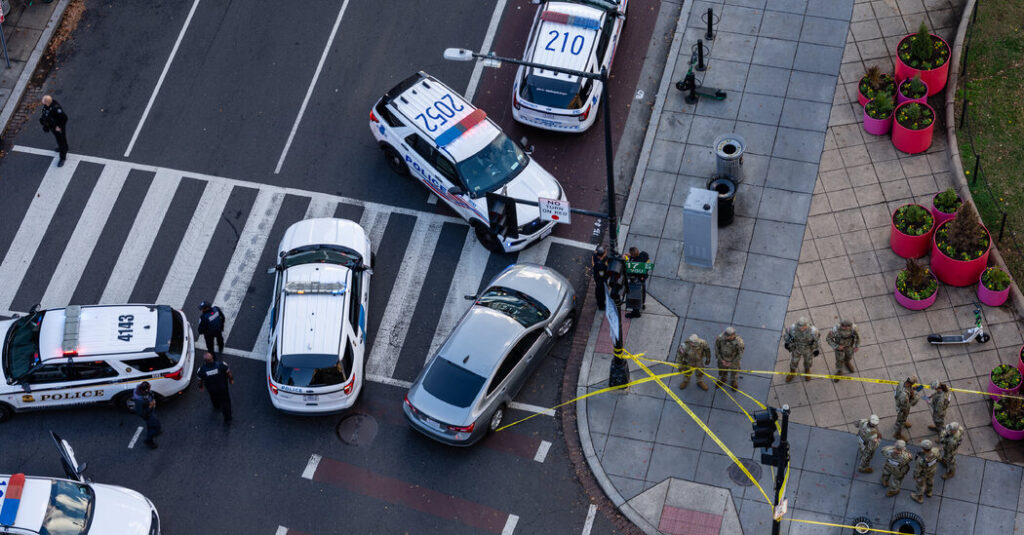
Last week, Mr. Lakanwal went on one last road trip, the authorities say, driving cross-country to Washington, D.C., where he is accused of shooting two West Virginia Guard members, one fatally. Mr. Lakanwal, 29, has pleaded not guilty to the charges.
Investigators are still trying to understand why Mr. Lakanwal spiraled downward — whether he was haunted by his involvement with a violent Afghan paramilitary group, as a childhood friend told The New York Times, or if he was succumbing to the isolation, poverty and untreated mental traumas that trail many Afghans from their war-ravaged homeland, or something else entirely.
Prosecutors called the shootings a betrayal by a man who had benefited from America’s generosity.
Regardless of motivation, the attack has had global reverberations, as America’s failed wars violently returned just steps from the White House.
The shootings unnerved Afghan immigrant communities from Washington, D.C., to Washington State, and prompted President Trump to order a sweeping new immigration crackdown against Afghans and many others from around the world.
This account of Mr. Lakanwal’s troubled life in Afghanistan and the United States is based on interviews with the volunteer who knew him, friends in his homeland, former comrades, residents of Bellingham and workers from refugee resettlement groups, as well as emails from the volunteer obtained by The Times. Most people interviewed agreed to talk only on the condition of anonymity because of safety concerns.
The volunteer said in an interview that Mr. Lakanwal was a singular case and worried her in a way no other Afghan refugee did.
In Mr. Lakwanal’s adoptive hometown, Bellingham, a liberal city of 97,000 near the Canadian border, church groups and volunteers who once embraced the wave of new Afghan arrivals have taken down web pages detailing their efforts and deleted online fund-raising sites as anger over the attack has intensified.
Bellingham’s small Muslim community of roughly 20 families from the Middle East and South Asia, including a half-dozen Afghan ones, has also been jolted, said a local Muslim leader who sometimes saw Mr. Lakanwal at Friday prayers.
Even well before this disruption, many of the Afghans in Bellingham had wanted to move to suburbs south of Seattle, where they thought they would feel less isolated since there is a robust Afghan community there, the volunteer wrote in an email. (The Associated Press first reported some details from her emails.)
Mr. Lakanwal grew up in a tiny wheat-farming village near the eastern Afghan city of Khost, one of four brothers and four sisters. He was 5 years old when the Americans invaded after the Sept. 11, 2001, attacks, opening a grinding 20-year war against the Taliban that changed the lives of all Afghans.
A brother of Mr. Lakanwal joined one of several Zero Units, the informal name for American-allied Afghan paramilitary groups paid by the C.I.A. and tasked with carrying out bloody missions that ultimately did little to change the course of the conflict. Mr. Lakanwal followed his brother, leaving his village for the southern province of Kandahar, the Taliban’s heartland.
A friend who asked to be identified only as Muhammad said that Mr. Lakanwal had joined the 03 Unit to earn money for his family and get medical training, rather than for any ideological reason.
When Mr. Lakanwal returned home on breaks, the friendly, once-outgoing young man who enjoyed picnics with friends had been replaced by a withdrawn man who had to be coaxed to go outside, Muhammad said.
“He didn’t go out with us much, and he didn’t want us to ask about his situation,” Muhammad said. “He had changed a lot.”
Not long before the Taliban took over, Mr. Lakanwal and his brothers bought an empty piece of land next to their family home, but never built anything, Muhammad said.
Muhammad said Mr. Lakanwal told others in his village that he had been shaken by seeing so many bodies and bloodshed in his role with the 03 Unit. Human Rights Watch accused the Zero Units of carrying out extrajudicial killings, disappearances and attacks on medical providers.
There were signs that Mr. Lakanwal’s role gave him some measure of power, however small, in the chaotic landscape of war.
Muhammad said that Mr. Lakanwal and some friends were once stopped at a checkpoint as they drove to a wedding, and officers searching Mr. Lakanwal found a pistol. Mr. Lakanwal did not tell his friends why he had the gun, but he made a phone call, and the gun was quickly returned, Muhammad said.
As the war dragged on and U.S. and NATO forces withdrew, the Zero Units found themselves working around the clock.
When the Taliban started to seize Afghanistan’s provincial capitals in August 2021, Mr. Lakanwal’s unit rushed to try to push back Taliban forces encircling Kandahar city before falling back to Kabul, the last bastion of the American-backed government.
With too few American forces defending the airport in Kabul, the American command asked the unit to help secure the perimeter, a former senior Afghan commander said. In return, the fighters would be evacuated to the United States, fulfilling what many American officials have described as a moral obligation to save Afghans who risked their lives to work with Americans.
Mr. Lakanwal and his family arrived in the United States in September 2021 through Operation Allies Welcome, which allowed Afghan nationals to enter the United States on two-year grants of parole. The Afghans were expected to apply for other means to stay in the country, namely a Special Immigrant Visa or asylum. About 190,000 Afghans have settled in the United States since the fall of Kabul.
Former intelligence officials have said that members of the Zero Units underwent a rigorous vetting process in Afghanistan, including the collection of biometric data when they joined and while they were in the unit. And Afghans in the United States undergo more rounds of intensive checks during the immigration process.
The Lakanwal family arrived in Bellingham around January 2022 with resettlement help from World Relief, a Christian aid group. With his parole status, Mr. Lakanwal had authorization to work, with the expectation that he and his family would apply for a more permanent status, said Shawn VanDiver, the founder of AfghanEvac, a group that helps resettle Afghans in the United States.
Mr. Lakanwal was granted formal asylum this April, under the Trump administration. When asked if U.S. officials reviewing the asylum case were aware of Mr. Lakanwal’s mental state or other possible concerns, the Department of Homeland Security did not give a direct answer.
Tricia McLaughlin, the spokeswoman, said in a statement that the Biden administration had granted parole to Mr. Lakanwal, and that a 2023 settlement in a legal case involving Afghan refugees bound immigration officials “to adjudicate his asylum claim on an expedited basis.”
The family lived in 2022 in a three-bedroom bungalow-style rental house in Bellingham that they had fashioned in the manner of a traditional Afghan home.
The living room was decorated with Afghan and Persian rugs and pillows that Mr. Lakanwal’s wife had made with a donated sewing machine. The family sat on the carpeted floor while Western visitors sometimes sat in a love seat. When male visitors came over, Mr. Lakanwal’s wife would serve tea, dried fruit and nuts before retreating to a bedroom.
The volunteer began to work with the family in September 2022.
She would meet Mr. Lakanwal and other Afghan men at various homes to talk about how to fill out immigration and financial paperwork and how to apply for jobs. Mr. Lakanwal and the other men did not speak with the volunteer about what they had done during the war. They would say merely that they came from a “security background,” she said.
For job applications, the men and the volunteer concluded that the Afghans could declare “gate security” or “perimeter security” as a skill set.
The Lakanwal family’s school-age sons went to public school. At home, they played soccer in the driveway. Mr. Lakanwal would laugh and joke with his sons in the living room, the volunteer said.
She talked to him through Pashto-speaking interpreters because he did not speak English. For a time, he seemed outgoing and boisterous, someone who “lit up a room” when other Afghan men were around, but he had started to change by March 2023, she said.
He quit a job and rarely left his darkened bedroom, and he refused to see visitors.
The volunteer said it was unclear what exactly triggered the change, but sensed part of it was his frustrations with the uncertainty of America’s immigration process, the volunteer said.
His family feared being deported to Afghanistan as his application for a Special Immigrant Visa dragged on. A lawyer advised him to apply for asylum as well, which he eventually did. At some point, the family renewed their two-year parole status. Mr. VanDiver said.
One colleague from the 03 Unit said the members have a WhatsApp group chat where their commanders try to help the men with problems and communicate with American advisers, but Mr. Lakanwal was not active in the group.
In January 2024, increasingly concerned about Mr. Lakanwal’s behavior and the family’s imminent eviction, the volunteer sent two emails on his deterioration to a friend who also worked with Afghan refugees. The volunteer said the friend sent one of the emails to a nonprofit group, the U.S. Committee for Refugees and Immigrants.
“I personally believe that Rahmanullah is suffering from both PTSD from his work with the U.S. military in Afghanistan, and that he is possibly manic depressive, mostly depressive, based on his behaviors,” the volunteer wrote, adding that he was off on “a manic trip” cross-country that very week. His absence gave his wife and boys “a period of relative stability.”
After returning from an earlier drive to Chicago, he had demanded that his wife divorce him, the volunteer wrote.
In March 2024, a program officer from the group traveled with colleagues to Bellingham to meet with Afghans. The officer said in an interview that he made the trip after the organization was told about the struggles of Afghan families broadly in Bellingham; he said he did not recall if he received an email specifically about Mr. Lakanwal. Many of the men he met were dealing with mental-health issues and poverty and feeling discouraged by a lack of job opportunities. The program officer said he did not meet with Mr. Lakanwal.
The U.S. Committee for Refugees and Immigrants did not respond to a request for comment.
In mid-2024, the family moved to a rent-subsidized three-bedroom apartment. After the U.S. government granted them asylum this April, they had a path to permanent residency. The volunteer continued to stop by the house during working visits with the community, sometimes dropping off used bicycles for the boys. But she rarely saw Mr. Lakanwal.
The volunteer said she last spoke to him on a visit this September. He came out of his room and said hello, one of his few words of English.
Hamed Aleaziz contributed reporting from Washington. Alain Delaquérière contributed research.
Edward Wong reports on global affairs, U.S. foreign policy and the State Department for The Times.
The post A Volunteer’s Dire Warnings About the National Guard Shooting Suspect appeared first on New York Times.