Ben Braverman was recently speeding across the Golden Gate Bridge while explaining, in rapid-fire patter, why venture capital investors like him needed to move fast. The artificial intelligence boom had changed everything, he said. Companies were getting started faster, finding customers faster, scaling up faster. The numbers were gobsmacking. Investors had to hustle to keep up.
That’s why he was ferrying across the San Francisco Bay with Filip Aronshtein, the 25-year-old founder of Dirac, a start-up that uses A.I. to automate work for industrial companies. They were headed to Club Evexia, a luxury fitness center in Mill Valley, Calif. That’s where Mr. Braverman planned to persuade the founder to take money from his firm, Saga Ventures, in between rounds of bench presses. A weight-lifting meeting was the only time Mr. Braverman could get with Mr. Aronshtein, and he was eager to take it.
“Speed is the name of the game,” Mr. Braverman said.
Across Silicon Valley, investors have been doing anything they can to get into the hottest A.I. start-ups. One venture capital firm flew the 22-year-old founders of Mercor, an A.I. company valued at $10 billion, on a private jet to Las Vegas to race Ferraris. Another gave college students money to start companies rather than do internships. Others are acting as if they work for young start-up founders, making customer introductions and recruiting employees. All of them are moving at a breakneck pace.
That has led to some eye-popping funding rounds. Safe Superintelligence, a start-up that was created last year to try to build A.I. that is smarter than humans, raised $2 billion at a valuation of $32 billion this year. Sierra, which was founded in 2023 and lets companies build A.I. agents, gathered $350 million and was valued at $10 billion. Cursor, an A.I. coding start-up, raised money three times this year and saw its valuation leap more than tenfold to $27 billion.
Funding for A.I. start-ups has overtaken all other categories, with 64 percent of venture funding — or roughly $161 billion — flowing into such deals in the first nine months of the year, according to PitchBook, which tracks start-ups. Large fund-raising rounds by Anthropic, OpenAI and Elon Musk’s xAI are driving the shift.
Investors argue that the A.I. opportunity is so enormous and that potential winners will be so successful that deal prices, especially when the companies are just starting out, do not matter. What matters is getting into the best start-ups, they said. If A.I. has boosted the valuations of Nvidia, Microsoft and Alphabet into the trillions, perhaps several more trillion-dollar companies are getting started today.
“Everyone feels like the next decade of winners are being decided in the next 18 to 24 months, and that’s creating this real intensity,” said Smit Patel, who advises A.I. founders and investors on fund-raising. “People are trading some discipline for speed because speed is the only strategy.”
The mania has helped stoke worries about a bubble in A.I. investment, particularly on data centers for A.I. computing. Tech has long been an industry of booms and busts, and sentiment can change quickly.
But investors justify their deal making by pointing to the rapid revenue growth of many A.I. companies. Cursor’s monthly revenue hit an annualized rate of $1 billion this year, a tenfold increase since the end of last year, a company spokesman said. (Fast-growing software companies often extrapolate their latest monthly revenue to a full year.)
OpenAI expects to hit annualized monthly revenue of $20 billion this year, according to Sam Altman, its chief executive. And Anthropic, which makes the Claude chatbot, said its annualized revenue had grown to $7 billion in October, from $1 billion at the start of the year. On social media, investors post breathlessly about smaller start-ups that need only 10 days, not even a month, to go from zero revenue to an annualized rate of $2 million.
Mr. Braverman said he had observed that growth in start-ups he invested in. “It breaks all the rules for what you think can happen,” he said.
(The New York Times has sued OpenAI and its partner, Microsoft, over copyright infringement. Both companies have denied wrongdoing.)
Vibecode, a start-up that uses A.I. to let people build apps, set out to raise $3 million last spring. It had not released its app, but investors were so eager that the company garnered $15 million in offers in a week. Vibecode wound up amassing $9 million at double the valuation it initially sought. In August, two months after releasing its app, it rocketed to $1 million in annualized monthly revenue.
Ansh Nanda, a Vibecode co-founder, said he had heard from several dozen investors since then. He marveled at the opportunities that Silicon Valley has enabled, where 24-year-olds like him could be given millions of dollars to chase their dreams.
“I want to build something that has a massive impact on the world,” he said.
To land deals, venture capitalists have adapted their strategies. Katie Jacobs Stanton, an investor at Moxxie Ventures, said she had sought out entrepreneurs in countries including Canada, France and Israel. Some teams she backed in those places are now moving to San Francisco.
Ms. Jacobs Stanton said she was also trying to find founders before they went through accelerator programs and saw their valuations rise. And like everyone else, she is moving fast.
“Founders will remark, ‘Hey, sorry, the round went really fast in three days,’” she said. “The market is rewarding speed.”
Gaurav Jain at Afore Capital has adjusted his investment criteria. He previously sought out great founders with great ideas. Now, he said, he is willing to back great founders with not-so-great ideas — or no ideas at all. The strategy is risky, but Mr. Jain’s firm helps entrepreneurs develop their ideas.
“We cannot wait for the companies to have an idea and take off, because then it’s too late,” he said.
Afore is also giving college students $25,000 to $50,000 to take a “gap semester” and start a company instead of doing an internship. The program has funded roughly 30 companies since it started this year; most of the founders have dropped out of college because their ventures took off, Mr. Jain said.
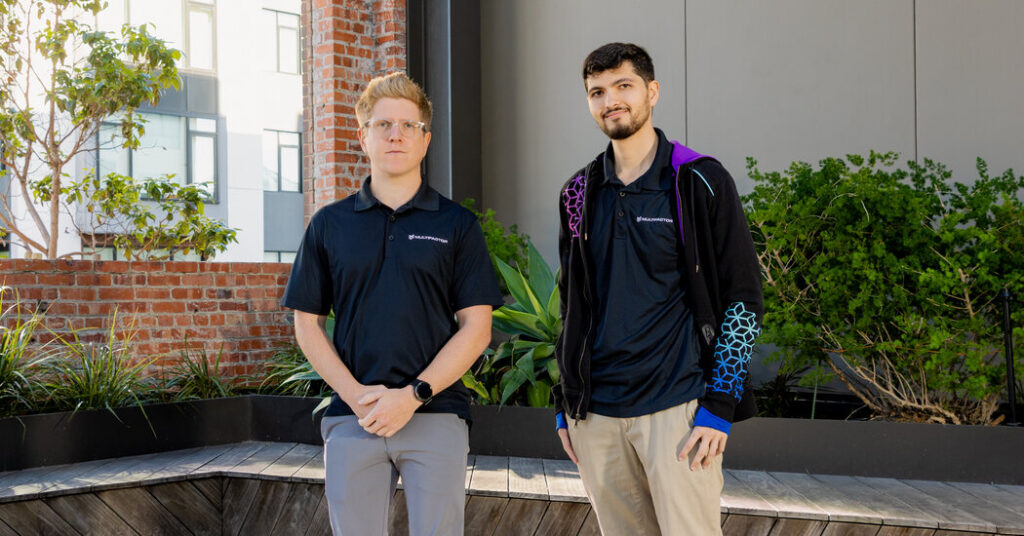
On Wednesday, the founders of Multifactor, a start-up building security systems that let humans and A.I. agents share accounts, took the stage at a “demo day” held by Y Combinator, a start-up accelerator program. But Multifactor was not trying to woo any investors in the room, because it had already secured funding.
Vivek Nair, 24, a former officer in the Central Intelligence Agency, said he and his Multifactor co-founder, Colin Roberts, a 31-year-old former scientist with the National Aeronautics and Space Administration, had spent the end of November fielding interest from more than 250 investors. Many of them wanted more than a 30-minute Zoom call with them and suggested rock climbing, hikes, gym sessions, sporting events and hot yoga. Some sent unsolicited offers. Others sent branded cookies.
Mr. Nair and Mr. Roberts wanted $10 million to $12 million, but got $45 million in offers at valuations as high as $120 million. On top of the money, the investors pitched their expertise and connections, Mr. Nair said.
After a week of nonstop meetings, Multifactor chose Abhishek Sharma at Nexus Ventures to lead the funding. Mr. Sharma said he had known within 15 minutes that he wanted to invest and had scheduled a second meeting within 24 hours. Multifactor raised $15 million led by Nexus, valuing the company at $100 million.
Even so, Mr. Nair continued to hear from investors, whom he has directed to other start-ups. He approached his demo day pitch as a moment to show off the most ambitious vision for Multifactor’s technology.
“I have no need to impress anyone at demo day,” Mr. Nair said. The investors “I care most about are already on the team.”
Cade Metz contributed reporting.
Erin Griffith covers tech companies, start-ups and the culture of Silicon Valley from San Francisco.
The post A.I. Deal Making Is Getting Faster and Faster appeared first on New York Times.