Just three days after President Trump pardoned a former Honduran president who had been serving 45 years for narcotics trafficking, another former politician from the Central American nation stood before a judge for sentencing in a drug case.
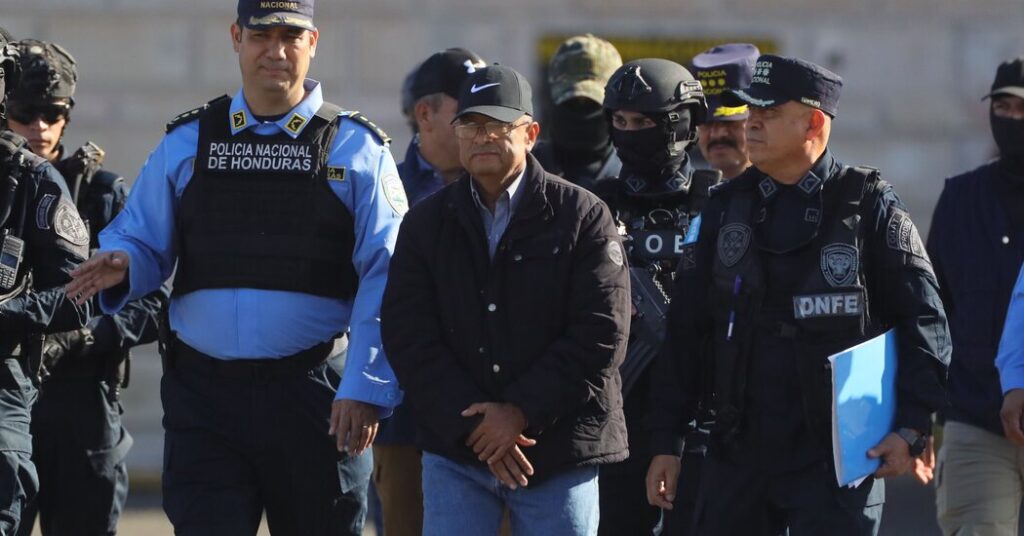
The defendant in Manhattan federal court on Thursday was Midence Oqueli Martinez Turcios, a former congressman who last year pleaded guilty to conspiring to send cocaine to the United States.
At the hearing, Mr. Martinez’s lawyer invoked the pardon given to the former president, Juan Orlando Hernández, as she argued for leniency, but the judge made it clear Mr. Trump’s pardon had nothing to do with the case before him. He sentenced Mr. Martinez to nearly 22 years in prison.
“It’s my job to apply the law,” the judge, Lewis A. Kaplan of Federal District Court, said. He noted that the president of the United States had been given the absolute ability to pardon people “regardless of the facts and the law.”
“I do my job,” the judge continued. “He has the powers entrusted to him, which have no legal constraint of which I’m aware. That’s all I can say about it.”
The sentence highlighted decades of lawlessness brought on by drug lords and corrupt politicians in Honduras, who helped make country one of the Western Hemisphere’s poorest and most deadly. Mr. Trump claimed the nation’s former leader, Mr. Hernández, had no culpability for the devastation, despite a trial last year that showed he helped orchestrate a trafficking conspiracy that sent hundreds of tons of cocaine into the United States.
But courtroom colloquy about the pardon showed how it might arise in other drug cases as lawyers may argue that their less-powerful clients should get breaks as well.
Mr. Martinez, who is in his mid-60s, was deeply implicated in the cocaine trade, but there is no evidence he has the same kind of political pull as Mr. Hernández. His sentence means he could stay in prison into his 80s.
The drug trade has plunged Honduras into misery; it is one of the world’s most dangerous places. More than half the nation lives below the poverty threshold, according to the World Bank. Hondurans have endured soaring inflation and cost of living since the pandemic, to go along with threats of extortion they have long faced from organized crime groups.
Mr. Martinez worked with a drug trafficking organization known as Los Cachiros, Manhattan federal prosecutors said in a letter to Judge Kaplan recommending a sentence of at least 30 years.
Mr. Martinez led heavily armed teams as they transported cocaine from clandestine airstrips in Honduras toward the Guatemalan border on their way to the United States, said the prosecutors, from the U.S. attorney’s office for the Southern District of New York.
Beyond his narcotics trafficking, money laundering and “participation in the rotting cycle of corruption that engulfed Honduras while he was in power,” Mr. Martinez also killed, kidnapped and tortured, prosecutors said.
In 2006, they said, the Cachiros bribed a Honduran politician to name Mr. Martinez minister of security, a post that would have placed him in charge of the military and intelligence police. When Mr. Martinez learned he had been passed over, he ordered the murder of the politician who had failed to deliver, the prosecutors wrote.
Mr. Martinez’s lawyer, Kristen M. Santillo, had said in a sentencing memo to the judge that her client had been raised in poverty and served in the Honduran military before pursuing a career in politics. Regrettably, she wrote, “Mr. Martinez succumbed to the pervasive culture of political corruption in Honduras.”
She recommended a term of 12 years for her client, arguing that his role in the drug trafficking activity had been minor. She argued that the judge should avoid disparities in sentences. Alluding to the pardon, she said in court that people who were the most powerful, who had the most money, “they are going to go home.”
Since 2017, at least a dozen Honduran drug lords and public officials have been convicted at trial in New York on narcotics trafficking and weapons charges. Mr. Martinez was indicted in 2018, arrested by Honduran authorities in 2022 and extradited to the United States the following year.
Like Mr. Hernández, Mr. Martinez was a member of Honduras’s conservative National Party. But corruption in the country cut across party lines, said Dana Frank, a professor of history at the University of California, Santa Cruz, who studies Honduran politics.
The cases involving Honduran public officials began with the cooperation of two brothers who led the Cachiros. One, Devis Leonel Rivera Maradiaga, has admitted to orchestrating the deaths of 78 people.
Mr. Martinez is a relative of the brothers, prosecutors said. In 2006, when he learned he would not become minister of security, prosecutors said, Mr. Martinez drove with Mr. Rivera to the house of the politician the Cachiros had bribed and spotted him lying on a hammock outside.
“Call the hit men so they can kill him,” Mr. Martinez told Mr. Rivera.
They did just that, prosecutors said.
Benjamin Weiser is a Times reporter covering the federal courts and U.S. attorney’s office in Manhattan, and the justice system more broadly.
The post 2 Cocaine Cases. 2 Honduran Politicians. Only One Faces Years in Prison. appeared first on New York Times.