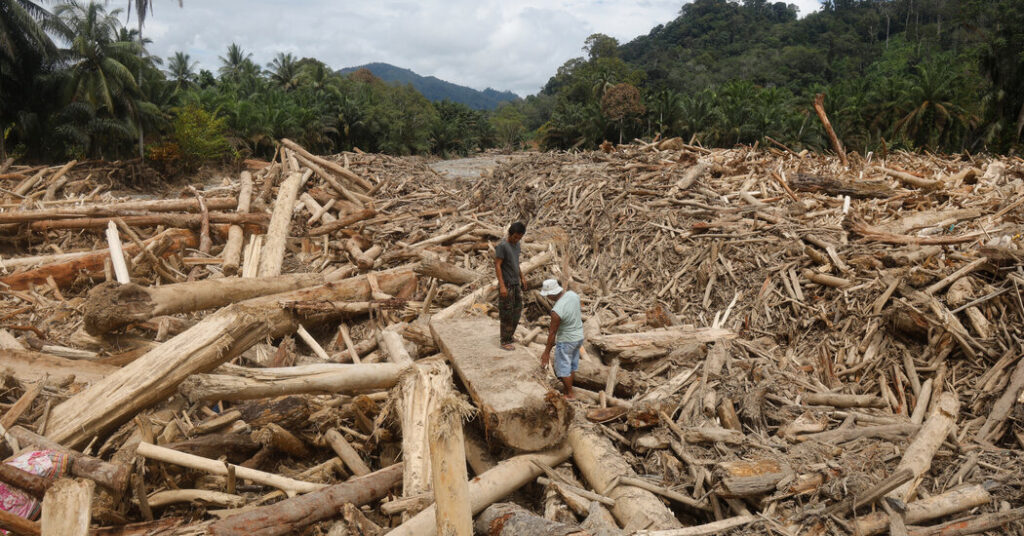
It poured for three straight days last week on the northern tip of the island of Sumatra in Indonesia. One area in Aceh Province got 16 inches of rain in a day. Ensuing floods wiped out four villages. Farther south, the deluge brought an unexpected danger: log after log of timber.
Untold numbers of logs and other debris crashed into residential areas in North Sumatra Province after Cyclone Senyar made landfall in Indonesia on Wednesday.
“Everywhere you look — left and right along the road — there are piles of timber,” said Sarma Hutajulu, a voluntary rescue worker who was helping clear debris in Tukka District. “Those are what smashed into people’s homes.”
The storm battered northwest Indonesia, before moving on to Malaysia and Thailand, unleashing days of heavy rain that triggered flash floods and landslides that have killed at least 800 people. The vast majority of casualties were in Indonesia, where hundreds are still missing. Hundreds of thousands of others have been displaced.
Experts said the catastrophic nature of the storm was compounded by decades of deforestation. Large sections of Sumatra’s natural forest have been razed in recent decades and converted into palm oil plantations, pulpwood farms and gold mines. Logs from some of those operations became floating battering rams after the storm hit.
“I saw it myself in the field, there were so many logs being carried away,” Walden Sitanggang, a pastor and an environmental activist, said from North Sumatra. “Logs don’t just fall from the sky — they must have come from logging activities upstream.”
On Wednesday, Indonesia’s environment minister, Hanif Faisol Nurofiq, acknowledged that the disaster “cannot be attributed solely to natural causes.” He told Parliament that since 1990, tens of thousands of hectares of forests had disappeared from the provinces of Aceh, West Sumatra and North Sumatra.
Mr. Hanif said that the government will evaluate environmental approvals for all operations in Batang Toru in North Sumatra, and summon the officials of companies that were responsible for the presence of the logs.
Earlier in the week, the head of the Meteorology, Climatology, and Geophysics Agency, Teuku Faisal Fathani, told lawmakers of another problem. His agency had warned local authorities in Sumatra about Senyar eight days before the cyclone formed fully, and then issued subsequent warnings as it bore down. But he said not every regional leader was well prepared.
Alya Galuh Rahmadya Jeanitha, 29, a resident of the city of Lhokseumawe in Aceh, said she did not receive any early warning. The area around her house, she said, started to flood last Tuesday. The next day, after the storm made landfall, water entered her house, and she and her family were forced to flee to higher ground.
In North Sumatra, the relentless downpours gave residents only minutes to react.
Henry Irawan Marpaung, 44, said the floods and the landslides occurred almost simultaneously. He said he only survived by holding on to a pillar in his father-in-law’s house, in Tukka District. “I witnessed two neighbors being swept away by the flash flood,” he said.
Across Sumatra, more than 570,000 people are now displaced from their homes. The floods have damaged many roads and bridges, impeding access to many areas.
“There are still babies there who need diapers, there are still people who haven’t eaten in five days. There’s no clean water,” Afil Maulana, an aid worker, said from northern Aceh on Tuesday. “It’s really bad here.”
Muhammad Abdikaramllah, 32, a resident of Banda Aceh, the capital of Aceh, said floodwaters in his wife’s hometown, Langsa, surged up to 13 feet.
“My family is just surviving with whatever they have,” he said. “Some cook eggs if they have any, and if they have leaves, they boil them.”
Climate experts say heavier rains fell in Indonesia, and more recently Sri Lanka, because warmer oceans load storms with more moisture. This increases the need for improving local drainage, slope grading and evacuation systems.
“The common theme across Indonesia, Sri Lanka, Thailand and Malaysia this season is cascading risk,” said Roxy Mathew Koll of the Indian Institute of Tropical Meteorology by email. “Even moderate cyclones are producing catastrophic rainfall because the ocean is warmer, the atmosphere is wetter, and communities are living close to the edge in terms of land use.”
Research by Andra J. Garner, an expert in tropical cyclones at Rowan University in Glassboro, N.J., has found that as the planet warms, storms tend to strengthen more quickly near many coastlines in Southeast Asia, and then move more slowly once over land.
“That amplifies the hazard, because now you’ve got a storm and all of its impacts, but you have the impacts from that storm lasting for a greater amount of time,” she said. “The longer that you’re exposed to those kinds of hazards, the greater the danger will be.”
Muktita Suhartono contributed reporting from Jakarta.
Sui-Lee Wee is the Southeast Asia bureau chief for The Times, overseeing coverage of 11 countries in the region.
The post Where Floodwaters Turned Piles of Timber Into Floating Battering Rams appeared first on New York Times.