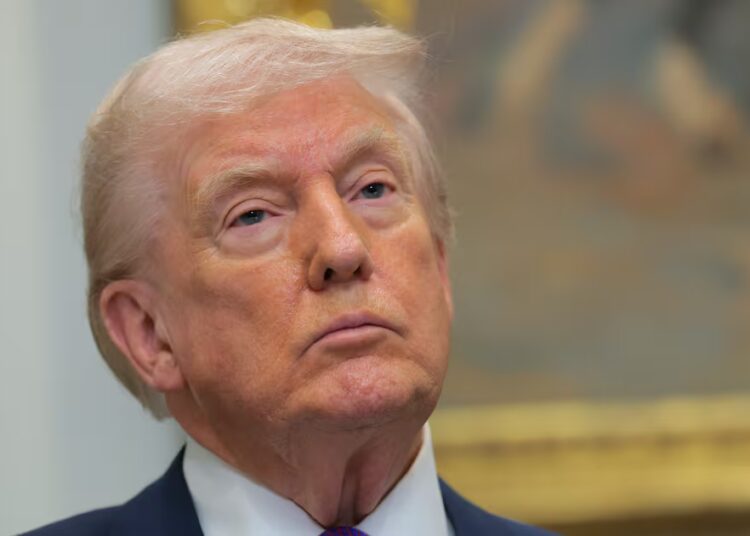
Those of us opposed to MAGA complain plenty about what the Trump administration has done or is doing to the government — drawing on vast administrative resources for deportations, taking stakes in private companies, destabilizing the Federal Reserve. But we’ve missed a core element of President Trump’s appeal. In many cases, he’s effectively freeing the stuck wheels of bureaucracy.
Liberals may not like what he’s doing, but this is what government looks like when it functions — even if it is for brutal, misguided efficiency.
Note the contrast to what came before. President Joe Biden wanted to save the climate and build green infrastructure. For all his good intentions and legislative savvy, his efforts were bogged down in the execution. The $7.5 billion he secured for electric vehicle chargers yielded fewer than 60 new stations by the time he left office. His designs on wind turbines and solar fields were repealed before they were deployed at scale.
Mr. Trump, by comparison, may be doing bad stuff, but he’s doing it fast. Sure, he’s often being dragged into court battles, and perhaps his detractors will win some of those cases. But the new administration still appears much better poised to leave an imprint than the previous administration.
Why do Republicans seem to have a leg up when it comes to getting things done? The problem stems from today’s progressives lacking a clear theory of how public authority is supposed to work.
In some cases, we want government to be robust. We’ve got grand plans for how public bureaucracies should punish corporate polluters and catalyze the clean energy revolution.
In other realms, however, we’re deathly afraid of centralized authority. We’re animated by opposition to the idea that bureaucrats might tell women what to do with their bodies or make a decision that has disparate effects on minorities.
These are both indelibly progressive causes, but they emerge from contradictory impulses. Sometimes we want government to be more powerful; at other times, we want public authority caged.
That is why, for all the horrors of Trump 2.0, it offers an opportunity for progressives to start thinking boldly again about how to conceive of and use public authority for the American people.
The challenge of public authority is not new for the progressive movement. Early in the 20th century, two individuals — Louis Brandeis and his acolyte Felix Frankfurter, who would both serve asSupreme Court justices — embodied a core contradiction.
Reformers working in the mold of Brandeis were nearly as wary of big government authority as they were of monopolistic trusts. Brandeis championed smallness, believing that competition was the most powerful force capable of keeping malefactors in check.
But progressives like Frankfurter, who emerged as one of Franklin Roosevelt’s most influential advisers, took a different view. Far from wanting to take down big institutions, they wanted to expand public authority so that publicly minded experts would emerge to check avaricious private enterprise.
Frankfurter’s group largely won the argument in their time. The Hamiltonian theory of government authority lionized the centralization of power. What would come to be known as the Establishment would wield the discretion to decide big issues. It was this aggressive version of progressivism that animated the New Deal and the Great Society.
The notion that great men should exert authority led to many of progressivism’s great triumphs and to government doing big things — the Tennessee Valley Authority, the Marshall Plan, a range of local public authorities chartered in the spirit of New York and New Jersey’s Port Authority and the Interstate System among them.
But the Establishment eventually revealed itself to be less unimpeachable than its champions purported. Imperious, self-important men like Defense Secretary Robert McNamara sent thousands of troops to die in a quagmire in Southeast Asia. Bosslike mayors like Chicago’s Richard J. Daley segregated cities along racial lines. Robert Moses, the most powerful man in New York from the 1930s to the 1960s, bulldozed neighborhoods in the name of slum clearance and erected highways that, by the mid-1970s, looked poised to suffocate the Big Apple.
In the wake of the 1968 Democratic National Convention, the Vietnam War, Kent State and Watergate, the Establishment was recast as an institution to fear. Having lost their taste for empowering publicly minded experts, reformers rekindled the spirit that had animated Brandeis’s desire to protect the little guy. Politically, progressivism’s new impulse compelled reformers to embrace a new maxim of speaking truth to power. Rather than sanction the Establishment to do more, progressives would work to check institutions prone to abusing their authority. The movement’s turn to diffused rather than centralized public authority turned out to be incredibly successful — at least on its own terms.
But anyone who wonders why the Biden administration struggled to move so much of its agenda need look no further than the reforms progressives themselves have pushed over the past half-century. At every turn, barriers built to prevent the government from doing bad things have prevented it from doing good things as well. It’s much harder to site new green-energy infrastructure when those proposing new plants and transmission lines have to work through public processes, zoning regulations, environmental studies and troves of potential lawsuits. It’s almost impossible to build a network of E.V. chargers when each installation has to meet domestic manufacturing requirements, be sited by a state bureaucracy and then constructed by a contractor that won a complex bidding process.
Progressivism now faces what we might term the Robert Moses problem. We don’t want government to act as Moses did when he carved the Cross Bronx Expressway through powerless working-class communities. But we want it to be much more effective and efficient than it was when Mr. Biden tried to expand broadband to the far corners of the country.
The only path forward is to lean back into centralized public authority. And that’s why the second Trump administration has the potential to slingshot progressivism into a new, brighter future.
Mr. Trump’s actions on deportation, tariffs and the use of military force in the Caribbean are almost certainly abuses of power. But they’re also a break from the public-sector incompetence that has helped erode faith in government to 22 percent, from almost 80 percent in the 1960s.
My argument isn’t that Democrats should ignore the law. Nor am I suggesting that we go back to the Moses era.
But we need to rethink our theory of power. Public authority shouldn’t be so unchecked that government can impose new infrastructure on a community without local residents being able to register their opposition in a meaningful way. Neither should it be that those residents’ parochial concerns always trump the greater good.
To restore their political appeal, Democrats need to articulate a vision of government that balances individual rights with the broader public interest.
The second Trump administration could prove to be a progressive revelation about leadership. The unapologetic manner in which Mr. Trump is pursuing his foul agenda speaks to an infrequently acknowledged element of leadership: Sometimes you have to do things that make you appear the bully. In November 1933, Roosevelt signed an executive order creating the Civil Works Administration, despite his detractors screaming about the specter of socialism; two months later, that single federal agency employed four million Americans.
At the same time, new conservative jurisprudence appears poised to enhance the power of the executive branch. A series of cases at the court suggest that the court’s conservative majority is prepared to give the executive branch more deference. Progressives have railed against this jurisprudence, but if the long-term effect of these rulings is to give the administrative state more discretion to act with greater alacrity, then progressives, once elected, should be able to use it to much the same effect.
The Trump moment should prompt progressives, for the first time since the 1970s, to develop a new holistic theory of how power should be exercised in America. How can progressives develop deliberative systems that envision a middle ground where everyone gets a voice but no one wields a veto?
The basic ingredients are plain. Before government makes any major decision, those affected should have an opportunity to weigh in. Those proposing a change should have to do a reasonable if not exhaustive study of the environmental and other effects. Those who object should have a means to appeal.
But in the end, someone should be empowered to articulate the public interest. Some single entity — some elected official, some appointed bureaucrat, some answerable commission — needs to have the discretion to point the way forward without endless recourse. Someone needs to say when a transmission line can be built despite the fact that it will spoil a scenic view or that a housing project can go up despite its being a drain on the sewer system.
It may be hard to imagine a process that would adequately strike this balance when it comes to siting a new set of wind turbines or clearing right of way for a high-speed train. Thus, some believe certain types of projects should be exempt from any oversight whatsoever. But balanced working models function in other realms. If the F.B.I.’s top counterterrorism official and the special agent in charge of a regional office differ on how that office’s agents should be deployed, the bureau’s director, having heard both sides, will ultimately decide. During surgery, those crowded around the patient might disagree about how to proceed, but a single doctor needs to make the final call.
Somehow progressivism has lost sight of how this dynamic might apply in the realm of public policy. But it can, and the movement’s core responsibility today is to embrace this balance as a theory of power.
Marc J. Dunkelman, a senior fellow at the Searchlight Institute and a fellow at Brown University’s Watson School for International and Public Affairs, is the author of “Why Nothing Works: Who Killed Progress — and How to Bring It Back.”
The Times is committed to publishing a diversity of letters to the editor. We’d like to hear what you think about this or any of our articles. Here are some tips. And here’s our email: [email protected].
Follow the New York Times Opinion section on Facebook, Instagram, TikTok, Bluesky, WhatsApp and Threads.
The post What the Left Could Learn From Trump’s Brutal Efficiency appeared first on New York Times.