Just how many types of neutrinos are there in the universe anyway?
Two papers published on Wednesday in the journal Nature are the latest to count the particles, which flood the universe, have almost no mass and interact antisocially with the rest of the universe. Three types were known, but some physicists believed there might be more.
The authors of each paper have come up with answers that fail to account for additional types of neutrinos and, therefore, match almost exactly what is predicted by physics-as-we-know-it.
For years, physicists have puzzled over a couple of experiments that appeared to observe more of the ghostly particles than what the Standard Model — which encapsulates current knowledge about fundamental particles and forces — predicts.
Other experiments counted fewer neutrinos than expected. Both the appearing and the disappearing of neutrinos seemed to point to hidden interactions involving at least one additional type of neutrino, and this neutrino had to be “sterile” — oblivious to all of the known universe except for the force of gravity.
The new results come from a pair of more recent experiments.
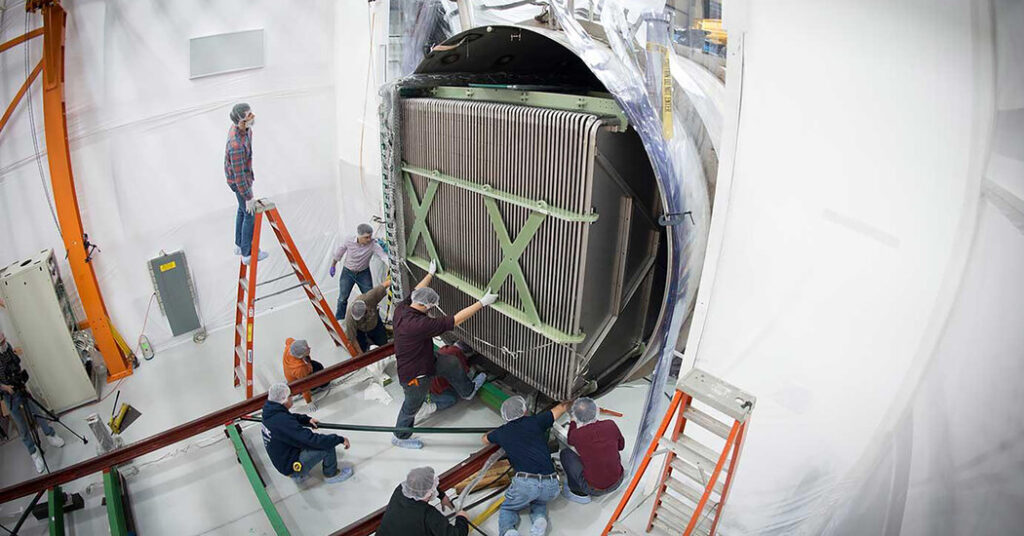
One paper summarizes findings from the MicroBooNE experiment at the Fermi National Accelerator Laboratory outside Chicago. (BooNE, pronounced boon, is a contraction of Booster Neutrino Experiment. “Booster” refers to a 500-foot-wide ring that accelerates protons. “Micro” indicates that its detector is smaller than the one used by its predecessor, MiniBooNE.)
The other paper describes results from the Karlsruhe Tritium Neutrino Experiment, or KATRIN, in Germany that looked for signs of neutrinos in the decay of tritium, a heavy, unstable form of hydrogen.
The results do not rule out the possibility of sterile neutrinos, but they undercut the impetus for speculating that those particles even exist.
“All of them are rejecting the sterile neutrino hypothesis,” said Thierry Lasserre, a physicist at the Max Planck Institute for Nuclear Physics in Germany who coordinated the analysis of data from KATRIN.
And yet the findings from the new experiments are not strong enough to entirely knock down the possibility of sterile neutrinos. There are no obvious flaws in the data or analysis in the earlier experiments.
“With neutrinos, you’re really going into the unknown,” said William Louis, a physicist at the Los Alamos National Laboratory in New Mexico who is a member of the science team for MicroBooNE.
“I think it is a messy picture,” said Dr. Louis, who also worked on MiniBooNE and an experiment at Los Alamos in the 1990s that first discovered a discrepancy that spurred the hypothesis of sterile neutrinos. “In other words, it’s much more complicated than one would have guessed.”
Neutrinos are a hotbed of inquiry for particle physicists.
“It is the second most common particle in the universe — yet, it’s one of the least understood particles,” said Justin Evans, a professor of particle physics at the University of Manchester in England. (Photons are the most common particle in the universe.)
“It’s incredibly hard to detect, incredibly hard to characterize,” Dr. Evans said. He and Matthew Toups of Fermilab serves as the spokesmen for MicroBooNE. “But because it’s so numerous, you absolutely have to understand it in order to understand how the universe evolves,” Dr. Evans said.
Neutrinos could hold the key to solving many of the remaining mysteries not answered by the Standard Model, including why the universe did not completely annihilate itself in the moment after the Big Bang.
Sterile neutrinos, if heavy enough, could account for a sizable fraction of the dark matter that fills the universe but has yet to be identified.
Neutrinos come in three known types, or flavors: electron neutrinos, muon neutrinos and tau neutrinos. (Muons and tau particles are heavier versions of electrons, and each of these negatively charged particles has a corresponding neutrino.)
Neutrinos can change flavor as they travel, a process that can occur only because of the smidgen of mass they carry. But the neutrino transformations reported in the Los Alamos experiment, known as the Liquid Scintillator Neutrino Detector, do not fit the three-flavor model, suggesting the existence of one or more additional flavors of sterile neutrinos.
MiniBooNE, designed to confirm or refute the Los Alamos experiment, sought to count the number of times a muon neutrino turned into an electron neutrino.
The results of MiniBooNE, which collected data from 2002 to 2019, found an excess of electron neutrinos. That roughly agreed with the Los Alamos findings and supported the sterile neutrino idea.
The follow-up experiment, MicroBooNE, used a different detector technology. It also counted electron neutrinos and came up with a number consistent with Standard Model predictions.
The results rule out, with 95 percent certainty, theoretical models that included one type of sterile neutrino, Dr. Toups said.
“This is not particularly surprising, to be honest,” said Matheus Hostert, a physicist at the University of Iowa who was not involved with the new experiments. He said he and other theorists had already started looking for alternative explanations for the Los Alamos and MiniBooNE data.
“Ultimately, there is no simple solution to the MiniBooNE puzzle with new physics,” Dr. Hostert said. “But maybe we don’t get to ask for simple answers in this case.”
Dr. Louis, however, said a modest deficit of electron neutrinos that MicroBooNE observed in one of the two neutrino beams used in the experiment is “very tantalizing.”
That might fit with models with more than one flavor of sterile neutrino, he said. “If you have more than one sterile neutrino, then all bets are off,” Dr. Louis said. “You cannot explain that deficit with no sterile neutrinos.”
The other new results involve the KATRIN experiment, which primarily aims to more precisely narrow the masses of the known neutrinos. But its data can also be used to look for sterile neutrinos. Its findings challenge another neutrino puzzle known as the gallium anomaly.
When an electron neutrino hits an atom of gallium, a silvery metal with a low melting point that is often used in electronics, it combines with a neutron, changing it into a proton. The gallium is thus transmuted into a different element, germanium.
But a series of experiments using pools with tons of liquid gallium consistently measured less germanium than would be predicted by the Standard Model. That deficit could be explained if some of the electron neutrinos were changing into sterile neutrinos that would never interact with the gallium.
Such a sterile neutrino would clearly show up in the KATRIN data, Dr. Lasserre said, and it is not there. The results of the gallium anomaly experiments, performed over several decades in different places, also appear solid, leaving a seeming contradiction.
“I’m sorry to say that we have no explanation,” Dr. Lasserre said. “And this is puzzling.”
More experiments are in progress around the world, probing different aspects of neutrino mysteries.
“I’m hoping that in a few years, things will start to gel, but we’ll see,” Dr. Louis said. “No one knows for sure what the final answer will be.”
Kenneth Chang, a science reporter at The Times, covers NASA and the solar system, and research closer to Earth.
The post What Physics Knows About Ghostly Neutrinos Muddled by New Experiments appeared first on New York Times.