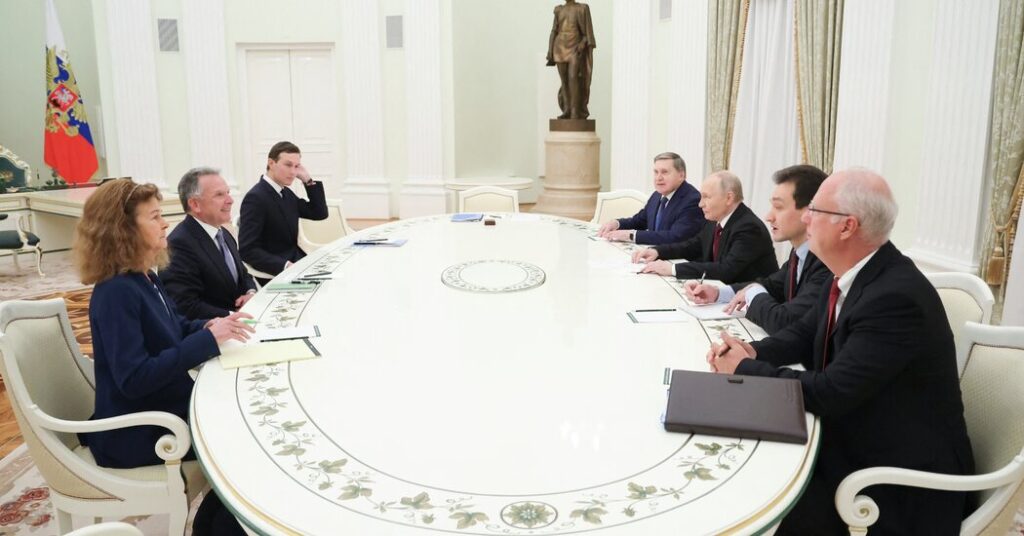
After nearly five hours of talks on Tuesday between U.S. and Russian negotiators about ending the war in Ukraine, no breakthroughs emerged.
According to a Russian negotiator, President Vladimir V. Putin was critical of the proposals. Before the talks, he even said he was willing to go to war with Ukraine’s European allies, which have been working to support Ukraine financially and militarily.
“We are not planning to fight with Europe, but if Europe suddenly starts a war with us, we are ready right now,” Mr. Putin said.
So what could force Russia to end the conflict? Absent serious pressure like stronger sanctions by the Trump administration, it comes down to the economy and the battlefield, analysts say. While there are challenges for Russia on both fronts, neither is dire enough to give the United States significant leverage in the talks, President Trump’s third effort to broker a peace.
“There are points where Putin’s probably feeling under pressure, but none of them have reached any kind of juncture that he feels he has to make a decision or has run out of options,” said Fiona Hill, a senior fellow at the Brookings Institution in Washington who ran Russian and European affairs at the National Security Council during the first Trump administration.
Before Tuesday’s talks, Mr. Putin made a rare visit to a military headquarters, as well as to an economic forum, to make the point that Russia had the economy and the armed forces it needed to continue the war.
The Russian elite is an echo chamber for this claim.
Fyodor Lukyanov, a leading foreign policy commentator, wrote an opinion article in the state-run Rossiyskaya Gazeta newspaper after the most recent U.S. peace proposal emerged. Military force was the main means to achieve Russia’s goals, including “unlocking national economic opportunities,” he wrote.
Earnings from oil and gas that pay for the war have fallen, and new American sanctions against Rosneft, a state company, and Lukoil, the country’s two largest energy producers, were imposed in October.
While the government harvested almost $10 billion in taxes from oil and gas producers in October, according to Finance Ministry figures, that was notably down 27 percent from the same month a year earlier. Sanctions were a contributing factor, amid lower crude oil prices and a stronger ruble.
But Russia still pockets enormous sums from its energy industry, despite Western efforts to corral the shadow fleet of tankers that transport most of the country’s energy exports.
Falling oil revenue is “likely to be a constant toothache that sets into the Russian war effort,” said Clifford Kupchan, chairman of the Eurasia Group, a New York-based political-risk analysis group.
Still, Mr. Kupchan noted, to sharply lower Russia’s income would require much stronger sanctions, including the unlikely prospect of blocking sales to China, Russia’s largest energy customer, or Ukraine’s inflicting significant damage on exports.
A banking crisis might also pressure Mr. Putin, but so far, his adept team of economists has smoothed the war fallout.
Huge government spending on armament production in the first two years of the war sent inflation skyrocketing. To tame it, the Central Bank imposed high interest rates.
The prime rate has come down to 16.5 percent, though some of Russia’s most significant companies are struggling to repay their loans. Russian Railways, a state monopoly, has had particular problems, with over $50 billion in debts as freight numbers have shrunk.
Consumers are also struggling with the high rates, one reason sales of big-ticket items like cars are plummeting. Russia’s largest automaker, the maker of Lada vehicles, AvtoVAZ, said it would shift to a four-day workweek and slash production by 40 percent.
State-run television has allowed for some grumbling about these issues.
Andrei Bezrukov, a professor at Moscow State Institute of International Relations, said on an influential Russian talk show on Sunday that, “sadly, it’s accountants who run the country and its economy” and that they have no long-term strategic plan.
But Russians are unlikely to take to the streets over the economy, noted Konstantin Sonin, a Russian economist a the University of Chicago.
On the military front, Russia has been inching forward, especially in southeastern Donetsk Province. Russia claimed on Monday that it had seized the strategic town of Pokrovsk, but that was contested by both Ukraine and Russian military bloggers.
Gains come at a terrible human cost but that does not seem to affect Russia’s calculations in peace talks.
High payments to soldiers mean the military can recruit 30,000 new soldiers every month, analysts said. Frontline units have dented Ukraine’s advantage in deploying drones by infiltrating small teams to kill the drone operators, military analysts said, but then lack the concentration of troops and tanks needed to seize significant territory.
Still, seemingly fine with a grinding war of attrition, Mr. Putin repeatedly asserts Russia is winning.
“The pace of the offensive has been the same for the past year and will continue that way,” said Dmitri Kuznets, a military analyst for Meduza, an independent Russian news outlet.
Alina Lobzina and Ivan Nechepurenko contributed reporting.
Neil MacFarquhar has been a Times reporter since 1995, writing about a range of topics from war to politics to the arts, both internationally and in the United States.
The post What Could Make Russia Want Peace? appeared first on New York Times.