On the eve of a major expansion, a multibillion-dollar project to upgrade the computer systems of all Department of Veterans Affairs hospitals is beset with problems, according to some medical staff who already use it. Critical patient notes disappear. Prescriptions log the wrong dosages. One nurse said the system incorrectly listed one of her patients as dead.
Mike Faught, a case manager at Mann-Grandstaff VA Medical Center in Spokane, Washington, said he lost access to his patients’ records for two days after a software update in August. “It’s amazing to me that there are still so many problems,” Faught said. “Every time there’s an update, there are unintended consequences.”
The program launched in 2018 to replace the aging computer system used across VA’s health care network, which serves more than 9 million veterans, with an off-the-shelf product that could handle many of the same tasks: organizing important information including appointments, referrals, prescriptions and patient histories.
After the system went live in 2020 at Mann-Grandstaff, doctors and other users began flagging errors that caused delays in treatment and medication mix-ups, and grappling with a system that was routinely offline, according to documents and interviews. As VA expanded to other hospitals and clinics in Washington, Idaho, Oregon and Ohio, the problems followed. In 2023, VA disclosed pursuant to a Freedom of Information Act request that the new records system played a role in more than 4,400 cases of “known harms,” ranging from “minor” to “catastrophic.” VA has subsequently confirmed that those cases included six deaths.
In March, VA announced plans to accelerate the Federal Electronic Health Record Modernization program in 2026 to hospitals and clinics in five more states. Officials say many of the problems have been addressed and they are on track to expand an improved version of the system to 13 additional medical centers and their affiliated clinics next year.
“The system does now work,” VA Deputy Secretary Paul Lawrence said in an interview with The Washington Post and The Spokesman-Review in July. He added that the department will be monitoring the individual medical centers that are preparing for the transition and would not proceed if they are not ready. “Obviously, if they didn’t have the infrastructure ready, we couldn’t go live.”
Yet more than a dozen medical professionals at Mann-Grandstaff and five other VA hospital networks using the new system said in interviews that many problems that have plagued the rollout persist, slowing care and, in some cases, threatening patient safety.
To examine the issue, The Post and The Spokesman-Review also reviewed VA records obtained through FOIA, copies of internal emails, conversations on employee message boards, congressional testimony, and reports from the VA Office of Inspector General and the Government Accountability Office.
VA staff at hospitals and clinics using the new system said they field a steady stream of email alerts from VA tech support about problems.
On July 1, for example, users were notified of “massive degradation issues, freezing issues and delays in reconnecting” after an emergency software patch. On Aug. 29, VA warned that the system was failing to record information about upcoming patient appointments, a problem that had been unresolved for two days. On Sept. 5, doctors and pharmacists were informed that they should not use a tool in the system that verifies appropriate medication dosages, because “users cannot verify which content is correct.” The issue was first reported to VA eight weeks earlier, according to an email.
“It’s alert fatigue,” said one provider at Mann-Grandstaff, who spoke on the condition of anonymity because she was not authorized to speak publicly about her experience. “This is down, that’s down.”
Another nurse who works at Mann-Grandstaff said she keeps a separate spreadsheet of upcoming appointments for her patients, because reminders have abruptly disappeared from the computer system.
“The system is broken,” she said. One of her patients received the wrong dosage of heart medicine when test results from a non-VA doctor were delayed in the system, she said.
Overall, care for veterans deteriorated at the six hospital networks using the new system, according to findings of an internal VA study last year that was obtained by The Post and The Spokesman-Review.
The study found that patients faced longer wait times and providers saw fewer patients. It concluded that the system had a “large negative impact” on VA care, according to a September 2024 presentation of the findings. In primary care, total patient visits fell by 30 to 40 percent and had not recovered at the time of the study.
Technology giant Oracle took over the $10 billion modernization program in 2022 after it purchased Cerner, a niche health IT company that began the work. Oracle declined to answer specific questions but sent a statement in August from Seema Verma, executive vice president and general manager of Oracle Health and Life Sciences. Verma previously served as administrator of the Centers for Medicare and Medicaid Services in the first Trump administration.
“Oracle is proud to be working with VA and the Trump administration to finish the EHR modernization project, so we can collectively deliver the world-class EHR this country’s veterans and the providers who care for them deserve,” Verma said, using the industry acronym for electronic health records.
Officials at Mann-Grandstaff and other VA hospital networks using the new system referred all questions to VA headquarters in Washington.
VA spokesman Pete Kasperowicz said in a statement that the records system is on track to improve care.
“Once complete, EHR will revolutionize the way VA works with the Department of War and Veterans to deliver care by improving customer service and convenience for our patients,” he said. Problems with the records program were the fault of the Biden administration and the vast majority of cases identified by VA as harms were minor, he added.
“Biden political appointees’ mismanagement of VA’s electronic health record modernization effort resulted in a program that was nearly dormant for almost two years,” Kasperowicz said. “The Trump administration won’t repeat those same mistakes and is already moving quickly to accelerate deployment of the system and bring the project to completion as early as 2031.”
Asked about the frequent alerts sent to staff, Kasperowicz called them “routine.”
“None of the incidents you cite had any effect on patient care, and most were resolved within a few hours,” he said.
Kasperowicz asserted that staff satisfaction has been rising, along with veteran trust in health care, at the medical centers using the program, while system crashes have decreased. He said that as of September, five of the six sites using the system have greater productivity than they did in 2019, before any of them made the transition. VA measures productivity through a formula that takes into account providers’ work and expenses.
He accused reporters of “cherry-picking years-old reports and events” to make the Trump administration look bad, while VA is working to improve the system for veterans.
“The department has made hundreds of improvements to the system since Mann-Grandstaff went live” in October 2020, he said.
A $33 billion project
President Donald Trump launched the project to upgrade the health care records system early in his first term, after he made a campaign promise to modernize VA by “accelerating and expanding investments in state-of-the-art technology.” David Shulkin, the secretary at the time, announced that VA would negotiate a contract to buy the records system from Cerner without competitive bidding.
VA leaders said they selected the program because the Pentagon already had purchased a similar Cerner system for the military’s more than 700 hospitals and clinics. By adopting the same system, VA said, it could improve communication about patients with military hospitals. At the time, Shulkin told lawmakers that the program would save billions and could be implemented at every VA medical facility — 170 medical centers and 1,193 outpatient care sites — within eight years.
“This was one of the most significant and important decisions for the sustainability in the future of caring for veterans that I could imagine,” Shulkin said in a recent interview. But he said VA made a mistake by trying to implement the rollout from the top down in Washington instead of allowing users to take the lead.
“The implementation of this after I left was botched,” he said, adding that since he left in 2018 he has stayed in contact with VA medical staff who have experienced or observed the transition. “This needs to be bought in and led by clinicians.”
From the start, officials underestimated the cost of the project and the time it would take. In 2019, VA estimated it would cost about $16 billion and take 10 years to launch across all hospitals and clinics. In 2022, the Institute for Defense Analyses estimated it would cost nearly $33 billion over 13 years. At the congressional hearing in February, Carol Harris, a GAO director in the IT division, estimated the long-term costs of the program could be in the “hundreds of billions of dollars, potentially.”
In Spokane at Mann-Grandstaff, clinicians eventually sent VA leadership roughly 200 pages of testimonials that detailed breakdowns impacting patient care. The Post and The Spokesman-Review obtained those records through a FOIA request.
Robert Fischer, the hospital director, wrote that the system was “unpredictable” and noted that productivity was down. “Staff experience prolonged hours to get through their day and mitigate patient safety concerns that have been persistent,” said Fischer, who declined to comment.
An official with the hospital’s behavioral health unit warned that the system sometimes failed to flag veterans who were deemed high risk for suicide. The hospital’s patient safety manager said the system’s pharmacy module was a “major patient safety risk” and made clear that patients had been harmed by system errors.
Reacting to a GAO report and pressure from Congress, then-VA Secretary Denis McDonough in 2021 ordered a review and paused the rollout. He pledged not to launch the system at other hospitals until safety risks were addressed. McDonough declined to comment for this story.
After the pause and on the eve of the system’s next launch in April 2022 at the Chalmers P. Wylie Veterans Outpatient Clinic in Columbus, Ohio, and associated facilities, a VA official told a House subcommittee that staff in Ohio were “eager and well prepared.”
Lawmakers were skeptical, but the official assured them that patients were not at risk.
In Ohio, however, users reported problems from the start.
In an interview, Deb Wilson, then a primary care doctor at the Wylie clinic, said she used the new system to renew pain medication — morphine — for a patient. Later, she noticed from reviewing the prescription in the system that the dosage was double what she entered. Panicked, she called the patient, who had caught the error because the pills were a different color.
“It was a moment of ‘Oh my God!’” Wilson said.
Wilson said she quit her job in December 2022, about eight months after they began to use the new system, largely because of the stress it caused. “I’m burned out,” she remembers telling her boss. “This is just an untenable work environment.”
A primary care doctor who uses the computer system in one of VA’s hospital networks said recently that when he renews prescriptions, the system sometimes records the wrong dose.
“We have learned to adapt, but there have been minimal improvements in the system,” said the provider, who spoke recently on the condition of anonymity out of fear of retaliation. “I now write out prescriptions to private pharmacies like old-school, on paper, because I don’t trust it.”
The provider said that constant updates to the system and multiple steps required for simple tasks leave room for error. “With many people vying for my attention at my office, mistakes get made,” the provider said. “I always tell patients I’m pounding a nail with a wrench.”
Six dead, thousands harmed
By VA’s own accounting, each of the six rollouts has been followed by reports of harm to veterans served by those hospital networks.
Last year, VA spokesman Gary Kunich confirmed by email that the new system was deemed a “potentially causal factor” in the deaths of six patients. In August, VA disclosed updated statistics gathered by the Veterans Health Administration’s National Center for Patient Safety, which reviews reports of potential patient harm from clinicians, noting that the new records system played a role in 4,601 cases of harm.
VA medical staff are responsible for filing a detailed report when there has been an instance of patient harm, according to information VA provided in response to a FOIA request.
The form includes a box that can be checked asking: “Is the event related to use of an electronic health record” and asks staff to specify which records system was used, including “Cerner and associated software.” A safety officer then evaluates the report to confirm the harm and its severity. In more severe cases of harm, VA performs a “root cause analysis” to detail how the event occurred.
Ten of the cases in the most recent statistics were classified as “catastrophic,” which VA defines as “death or major permanent loss of function.” Another 46 cases were classified as “major,” which is defined as “permanent lessening of bodily functioning.” VA classified the rest as either moderate or minor.
In one “moderate” case, a patient was hospitalized with an acute worsening of congestive heart failure after the software incorrectly classified the patient’s heart medication, causing it to not be refilled, according to what VA officials told Congress. One “minor” case involved a patient being left in pain over an extended period because of system errors.
Ross Koppel, a professor of biomedical informatics at the University of Pennsylvania’s Perelman School of Medicine, said transitioning to a new health records system creates safety risks but VA’s project is unprecedented in its scale and stakes. He emphasized that any move to a new electronic health records system risks patient harm. But he said VA’s effort has been complicated by the specialized nature of its existing records system, poor preparation and Oracle’s acquisition of Cerner.
“In the best of circumstances, it’s a perilous time,” said Koppel, who studies the impact of health records systems on patient safety. “And in the case of the VA, we know from studying some of the individual cases that it was particularly perilous.”
In late 2022, months after the Columbus launch, VA notified more than 70,000 veterans that flaws in the system may have delayed their treatment.
Asked about the cases of harm disclosed by VA’s FOIA office, Kasperowicz, the current VA spokesman, asserted that the vast majority were misclassified.
“We’ve looked into these concerns and found that more than 99 percent of them resulted in no actual harm to veterans and instead were the result of instructions from EHR leaders to aggressively flag every potential issue,” he replied in an email.
Other records reveal that one of the six deaths was a veteran in Columbus who missed a medical appointment in 2022. The new records system for the Columbus-area VA clinic he visited failed to add his name to a no-show list that would have triggered a routine attempt to reschedule and check his well-being. The clinic was not identified.
After the man missed his appointment, his health deteriorated, according to a letter from Rep. Mike Bost (R-Illinois), the House Veterans’ Affairs Committee chairman, summarizing the case. The man suffered alcohol withdrawal and died after checking into a private hospital, Bost reported.
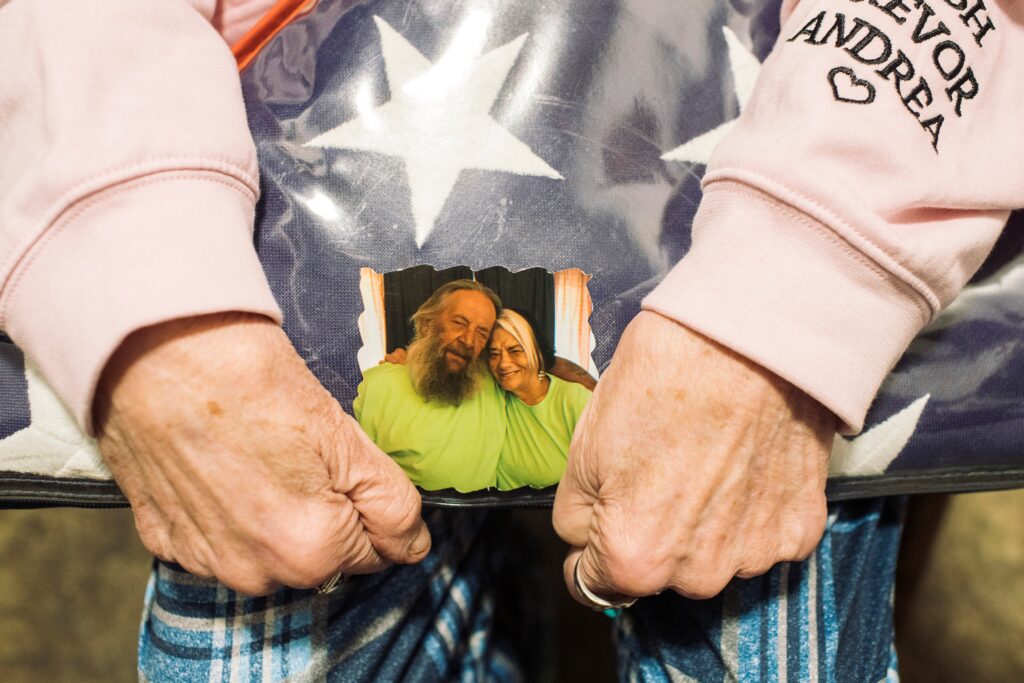
A second death involved a system error that delayed antibiotics for 77-year-old Raymond Sands, who had been diagnosed with metastatic lung cancer, according to VA documents, military records, interviews with his family, and medical records they provided to The Post and The Spokesman-Review.
Sands spent 10 years in the Marines, including a tour in Vietnam. He qualified for VA care because of exposure to the herbicide Agent Orange while in Vietnam, according to his wife, Cheri.
In September 2022, Sands was preparing to start cancer treatment, when he checked into a private hospital in Columbus, struggling to breathe. Doctors at the hospital ordered a prescription of antibiotics, which was logged in the new VA records system. They discharged Sands, and he returned to his home in a Columbus suburb.
When Cheri Sands called VA to check on the antibiotics, she said she was told the medication had been sent by overnight mail. She said VA provided a tracking number.
But the pharmacy employee, relying on the new VA records system, had given her incorrect information, according to an email by VA’s chief pharmacist for the Columbus area that summarizes what went wrong. The prescription that the system falsely identified as Sands’s was actually on its way to Washington state for another veteran. Sands’s prescription, meanwhile, was waiting for him at a nearby VA pharmacy in Columbus — but Cheri Sands did not know that.
Overnight, Sands’s breathing worsened, and he was admitted to the private hospital in Columbus the next day, where he received his antibiotics after a 36-hour delay, medical records show. He died eight days later. A week after that, a letter of condolence from VA arrived at the Sands’s house.
“We have been made aware, that a change in our electronic health record system, contributed to a delay in processing a prescription,” the chief of staff of VA’s Central Ohio health care system wrote to Cheri Sands. “This delay in his care is not acceptable to the leadership of this organization.”
After an investigation, VA later classified the delay in ordering his antibiotics as “catastrophic.”
In the email written within days of Sands’s death, the chief pharmacist in Columbus said the system error that conveyed an “erroneous USPS tracking number” had been reported more than once to Cerner before the tragic turn in Columbus, but it had not yet been fixed.
“Multiple tickets have been placed to Cerner, making them aware of this issue,” the email said.
According to two VA employees familiar with the problem, who spoke on the condition of anonymity because they were not authorized to comment, the software problem was fixed within weeks of Sands’s death.
Neither VA nor Oracle would comment on the case.
Cheri Sands said the error didn’t cause her husband’s cancer, but “VA failed on the prescription.” Had they not, “it might have given us more time.”
A rollout with risk
In February, at the most recent congressional oversight hearing focused on the new EHR system, lawmakers were given two very different pictures of the program in determining whether it was ready for use across VA.
Neil Evans, VA’s official now in charge of implementing the new system, assured lawmakers that the version they plan to roll out next year is “entirely different” from the one deployed at sites in 2020 and 2022.
“I feel confident that we are in a much better place,” said Evans, the program’s acting executive director.
Two VA officials, who spoke on the condition of anonymity because they were not authorized to comment, told The Post that there had been some improvements. But they said VA will deploy essentially the same system that it has at Mann-Grandstaff and the five other networks to the hospitals and clinics in Michigan, Ohio, Indiana, Kentucky and Alaska.
At the same February hearing, David Case, then the acting inspector general, also said VA had fixed some computer flaws, but others — like the system’s management of schedule changes and missed appointments — had persisted.
Case pointed to problems with the system’s pharmacy management system that were identified by a VA safety team in May 2021 as being unresolved.
He said in a prepared statement that he was concerned that the computer system “will continue to be deployed at larger, more complex medical facilities before resolving myriad known issues that remain related to prescribing medications and medication safety.”
Case, who is now deputy inspector general, declined to comment for this story. A spokeswoman for VA’s IG, Jessica Rodriguez, declined to say whether Case’s assessments had changed since the February hearing. “We are engaged in ongoing communications with VA regarding the rollout,” she said.
Three VA administrators, who observed the most recent EHR expansion in March 2024 at the Lovell Federal Health Care Center in North Chicago, said that VA had to bolster staff to make the system work for its pharmacy operations or for managing clinical trials. They questioned whether there would be enough personnel to support expansion to multiple hospitals at once.
While VA has highlighted the transition at Lovell as a success, it has catalogued some harm to patients. Between the system’s launch in March 2024 and August of this year, VA logged 48 safety events at Lovell in which the records system played a role, according to National Center for Patient Safety statistics obtained through FOIA. Of those, 34 were classified as minor, 13 as moderate and one as major.
Steven Braverman, who left VA on Sept. 30 after serving since November 2024 as the chief operating officer for VA’s Veterans Health Administration, said in an interview that he warned the program’s leaders that moving forward too quickly could make it harder to identify and fix problems that arise at one hospital before deploying at the next.
With all but one of the planned launches next year in the same region, he said that other local hospitals may not have the capacity to absorb the veterans whose care is delayed by slowdowns that accompany each new deployment.
“Whenever you have change, you introduce the opportunity for error,” he said. “You’re taking a risk by going quickly with this new process.”
Kasperowicz, the VA spokesman, said the agency plans to hire 400 people in 2026 to support the system expansion.
Shulkin, the former VA secretary, said Lawrence, the deputy secretary, is taking steps to ensure that future rollouts succeed. “He has learned from some of the missteps in the past, that that type of local ownership and engagement must occur, and he’s empowering them to do that,” Shulkin said.
Gordon Winters, 60, served on a VA council that advised the department on the system before and after the implementation. Winters, who retired in July as a nurse at Mann-Grandstaff in Spokane, said that at the beginning he was optimistic about the project and its potential to improve health care for veterans.
But he came to believe that the design was too complex and fostered mistakes — like medication errors without safeguards. He said concerns he had early on have not been fully addressed. For instance, systemwide crashes had become less frequent, but parts of the system still seized up or slowed to a crawl, requiring resets that wasted time, he said.
“The system should make us safer. We shouldn’t have to figure out how to make the system safer,” said Winters, who served in the Army’s elite 82nd Airborne Division. “As I retire, I’m worried about government spending, and it just seems like now we’re throwing good money at what is, at best, a mediocre product.”
Many providers interviewed said that data entered into the system sometimes disappears and other times alerts them with incorrect information.
After a major system update in August, a nurse at Mann-Grandstaff said she opened the record of a patient she had seen a week earlier and was shocked to see a pop-up alert that said he was deceased. When she looked more closely at the patient’s file, she saw that another provider had entered a note saying the alert was incorrect and the veteran was in fact alive and had been discharged from the hospital.
Other VA clinicians using the system said it has cut into the time they can spend with patients.
Rachael Orozco, who resigned in early October from her position as a primary care doctor at White City VA Medical Center in Oregon, said she saw some improvements — such as the addition of a messaging function — but the new system continued to slow care. She said she used to see 13 to 14 patients per day. But after three years using the new computer system, she said she and her colleagues were “just barely able to see about 10.”
She said problems that she or her colleagues reported early still had not been fixed at the time of her resignation. For instance, the system for accessing all of a patient’s medical files, which are sometimes voluminous, was hard to navigate and could not be searched by keyword. That limitation not only wasted time, she said, but it created the risk that medical staff could miss important treatment information.
Orozco said she resigned in large part because of the stress of working with the new system and her fear that one of her patients could be harmed.
“They say they fix one thing, then something else gets broken, and it’s just like a merry-go-round,” she said.
Reach us confidentially
Are you a VA medical provider with experience using the Cerner/Oracle electronic health records system? Please contact Desmond Butler on Signal at desmondbutlerWP.99 or via email at [email protected] with anything you believe is important for the public to know about VA health care.
The post VA staff flag dangerous errors ahead of new health records expansion appeared first on Washington Post.