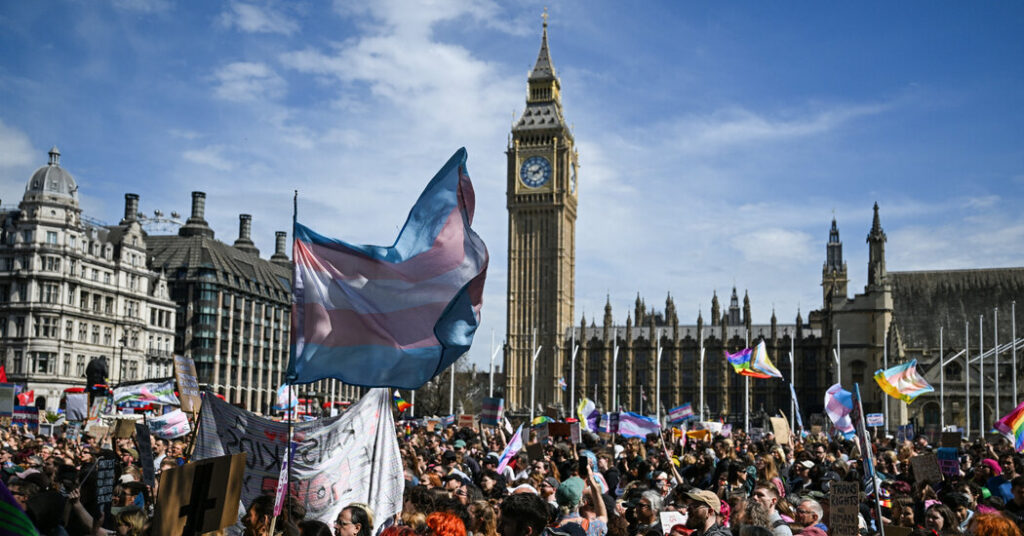
Two of Britain’s largest organizations for women and girls announced this week that they would no longer accept transgender members, citing a top court ruling that said the legal definition of a woman is based on biological sex.
Girlguiding, the British equivalent of the Girl Scouts in the United States, said in a statement on its website on Tuesday that “trans girls and young women will no longer be able to join” the organization. The Women’s Institute said in a statement Wednesday that the 110-year-old organization will “restrict formal membership to biological women only.”
Both groups said they did not want to make the changes, but were doing so because of legal threats in the wake of the ruling made by the Supreme Court of the United Kingdom in April.
Melissa Green, the chief executive of the Women’s Institute, said in the statement that the decision on membership was made “with the utmost regret and sadness” and that it “does not change our firm belief that transgender women are women.”
The Girlguiding statement said that banning trans girls was “a decision we would have preferred not to make.”
Both organizations said they had received legal advice warning that if they continued to accept members who were assigned male at birth, they could be at risk of legal challenges for violating the Equality Act 2010, which was designed to protect people from discrimination.
In a ruling earlier this year, justices for the Supreme Court interpreted the act to mean that the terms “woman” and “sex” in the law refer to biological women and biological sex. Activists who want to exclude trans women from women’s spaces had brought the case because of concerns that the Equality Act was allowing people assigned as men at birth to use women-only rape crisis centers, changing rooms and hospital wards.
Susan Smith, the co-director of For Women Scotland, the group that filed the case, said at the time that it was “just about saying that there are differences, and biology is one of those differences and we just need protections based on that.” Requests for comment from the organization on Wednesday were not answered.
The Supreme Court justices insisted in April that the ruling should not be seen as “a triumph of one or more groups in our society at the expense of another.” But critics said it would inevitably lead to discrimination against trans people.
Helen Belcher, the chair of TransActual, a British group that advocates on behalf of trans people, said in an interview that the decisions by Girlguiding and the Women’s Institute were the consequences of a broader effort to exclude and marginalize trans people.
“What we are seeing now is a wholesale attempt to remove trans people from all aspects of public life,” she said. “People have turned equality law back on itself. It is now being used to discriminate against people.”
The two organizations serve different purposes but have one thing in common: They only accept women and girls as members.
Girlguiding says on its website that it is “by girls, for girls, powered by volunteers” and that “we help all girls know they can do anything.” It runs different groups for ages 4 to 18: Rainbows, Brownies, Guides and Rangers.
The Women’s Institute, which was founded in 1915, says it is the largest women’s organization in Britain and prides “ourselves on being a trusted place for women of all generations, to share experiences and learn from each other.”
In her statement on Wednesday, Ms. Green said the organization had “proudly welcomed transgender women into our membership for more than 40 years,” and said the ban on trans members “is not something we would do unless we felt that we had no other choice.”
Other groups in Britain have changed their policies to accept all genders. The Scout Association in Britain has allowed boys and girls into its programs since 2007 and calls itself “the largest mixed-gender youth organization in the U.K.” In the United States, the Boy Scouts of America began accepting transgender boys in 2017 and became just “the Scouts” in 2019 before rebranding last year as Scouting America.
Ms. Belcher predicted that in the wake of the court ruling and the decisions by the women’s organizations, some trans people would withdraw from society out of a fear that their rights were no longer protected.
“We are already seeing signs of that,” she said. “They are already not going out because they are afraid they will be challenged, refused entrance.”
Michael D. Shear is a senior Times correspondent covering British politics and culture, and diplomacy around the world.
The post Two U.K. Women’s Groups Ban Transgender Girls and Women appeared first on New York Times.