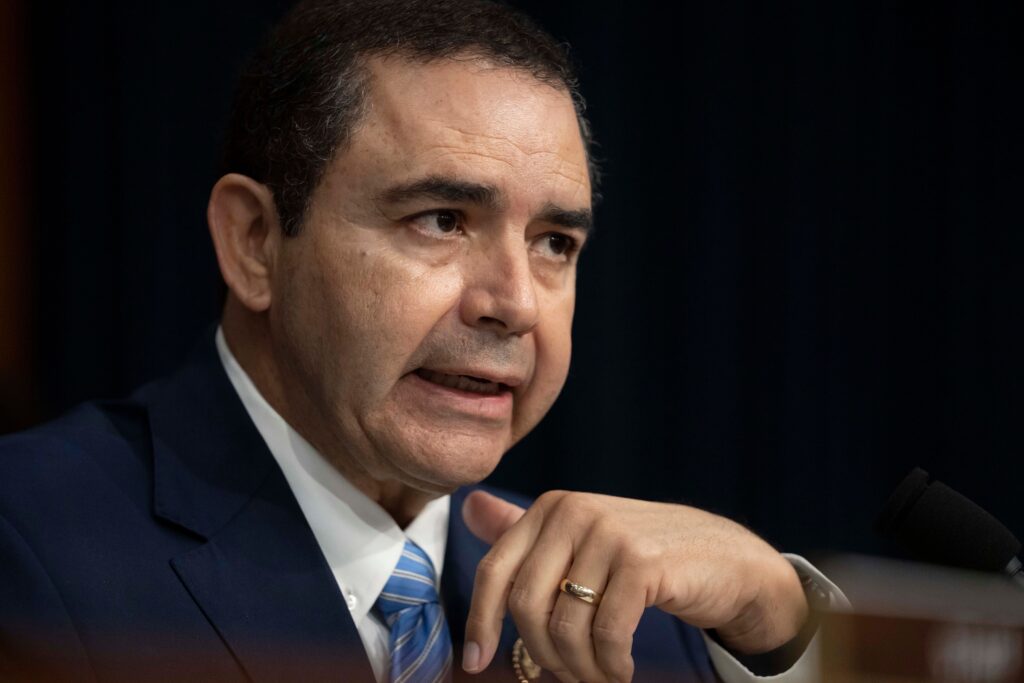
It’s tempting to try to divine some sort of political motive for President Donald Trump’s surprise pardon Wednesdayof Rep. Henry Cuellar (D-Texas), who was indicted last year along with his wife on charges of bribery, money laundering and conspiracy. Is Trump trying to get the moderate to flip parties? Is he trying to draw him under his thumb, as he did with New York Mayor Eric Adams (D)?
Often Trump has helped cronies or loyalists. He has been particularly sympathetic to targets of public corruption probes and white-collar criminals. But even after a string of shocking pardons — most notably for Jan. 6 rioters — the Cuellar decision was still striking.
Trump seems to view the pardon power in a way that’s closer to its origins — a monarchical tradition in which the king has authority to dispense with the law for whoever he sees fit. Maybe he decides to grant a person’s plea because they are famous or have prominent activists behind their cause. Or maybe because that person has boosted Trump’s cryptocurrency business. In this case, Trump appears to have been moved by a letter from the congressman’s daughters, in which they pleaded for his “mercy and compassion.” The reason doesn’t matter exactly; what matters is he is the ultimate arbiter.
That, of course, is Trump’s prerogative. There are no explicit constitutional limits on the clemency power. The Founders intended for presidents to be able to modulate the harshness of the criminal law. But Trump shows little inclination to use that power in the public interest. This personalized system of punishment is already eroding confidence in the rule of law. In that way, the excessive use of clemency is almost as problematic as the lawfare campaign he is waging against his critics.
Earlier this week, Trump released former Honduran president Juan Orlando Hernández after his drug-trafficking convictions — practically the same crimes Trump has suggested necessitate removing Venezuelan dictator Nicolás Maduro. In recent weeks, Trump has also freed from prison private equity executive David Gentile, who served just a few days of his seven-year sentence for defrauding thousands of investors to the tune of $1.6 billion. And he’s wiped away the sentence of Joseph Schwartz, convicted of using his nursing home business to defraud the government of $38 million — a conviction previously touted by Trump’s pick for U.S. attorney in New Jersey.
None of these are sympathetic, but the president seems to care little about blowback. He said he pardoned Hernández because “many friends” asked him to do so, and he didn’t much like the idea of the former president of another country behind bars. Others he has cast as victims of overzealous prosecutors in the Biden era (as in the case of Cuellar). For some, like Schwartz, the reason for Trump’s mercy remains unclear. White House officials would only say “the President is the final decision-maker.”
Cuellar seemed caught off guard by the news. He was scheduled to go on trial in April for allegedly accepting hundreds of thousands of dollars for advancing the interests of an energy company controlled by the Azerbaijan government and a bank headquartered in Mexico. He has always proclaimed his innocence.
Previous administrations attempted to formalize the process by which presidents distribute clemency, tasking career lawyers in the Justice Department with reviewing cases and making recommendations. Some have used the pardon power to enact policy goals for classes of people, such as Jimmy Carter’s unconditional pardon to Vietnam draft dodgers or Joe Biden’s use of clemency for people convicted of federal marijuana crimes.
Trump is far from the first president to abuse this superpower. Biden lied by saying he wouldn’t pardon his son Hunter, only to do so after the election. Biden also issued preemptive pardons to other members of his family and staff. Trump actually resisted doing that at the end of his first term, but it’s unimaginable he won’t follow the Biden precedent before he leaves office in 2029.
Remember Bill Clinton pardoning Marc Rich on his final day in office 25 years ago? The financier was a fugitive from the law, but Clinton let him off after his ex-wife donated to the Clinton Presidential Library and Hillary Clinton’s Senate campaign. That will forever tar Clinton’s legacy, just as Trump’s pardons should his.
The post Trump’s pardon of Henry Cuellar dovetails with broader approach appeared first on Washington Post.