President Trump on Wednesday threw the weight of the federal government behind vehicles that burn gasoline, gutting one of the country’s most significant efforts to address climate change through electric cars and thrusting the automobile industry into greater uncertainty.
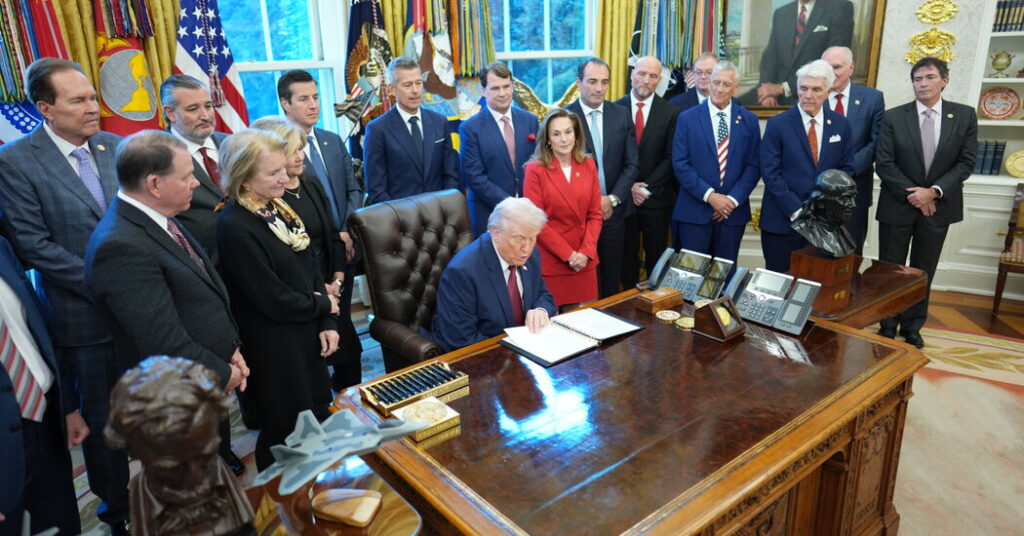
Flanked by executives from major automakers in the Oval Office, Mr. Trump said the Transportation Department would significantly weaken fuel efficiency requirements for tens of millions of new cars and light trucks. The administration claimed the changes would save Americans $109 billion over five years and shave $1,000 off the average cost of a new car.
The Biden administration’s stricter efficiency standards “forced automakers to build cars using expensive technologies that drove up costs, drove up prices, and made the car much worse,” Mr. Trump said. “This is a green new scam, and people were paying too much for a car that didn’t work as well.”
For the past half-century, the efficiency standards have compelled automakers to increase the distance their vehicles can travel on a gallon of gas, reducing fuel consumption and leading to innovations like electric and hybrid cars.
The announcement on Wednesday was the second part of a one-two punch against policies promoting electric cars, a central pillar of President Joseph R. Biden Jr.’s strategy for fighting climate change.
Transportation is the largest source of greenhouse gases in the United States, and Mr. Biden had adopted a carrot-and-stick approach to reducing these emissions. He offered tax credits to encourage motorists to buy electric cars while requiring that automakers meet stringent fuel efficiency standards to pressure them to sell more nonpolluting models.
Mr. Trump and the Republican-controlled Congress got rid of the tax credits earlier this year. They also eliminated fines for automakers who violate the fuel efficiency standards. And now the standards themselves will be watered down.
While auto executives publicly praised the announcement, they have privately fretted that they are being buffeted by conflicting federal policies. During the Biden administration, they invested billions of dollars and reoriented their manufacturing to produce electric vehicles and batteries.
Now the Trump administration’s tariffs on steel and imported car parts have lopped billions of dollars from carmakers’ bottom lines while disrupting supply chains. Inflation has also made it difficult for many people to afford new cars.
The plan announced on Wednesday would require automakers to achieve an average of 34.5 miles per gallon for cars and light trucks in model year 2031, down from the standard of 50.4 miles per gallon set by the Biden administration.
The Biden administration rule, finalized in June 2024, assumed that manufacturers would comply by increasing their sales of electric vehicles, which use no gasoline and would help boost the average fuel efficiency across their product lines. Biden administration officials estimated that the rule would lower fuel costs by $23 billion while preventing more than 710 million metric tons of carbon dioxide from entering the atmosphere by 2050, the equivalent of taking 165 million cars off the roads for one year.
Mr. Trump, who refers to climate change as a “hoax,” initially promised to repeal the rules to end what he falsely called an “E.V. mandate.” But on Wednesday, Mr. Trump said he was motivated to weaken the rules in order to lower the price of new cars. The cost of living has emerged as major concern for voters and a political vulnerability for the president and his party.
“Perhaps grudgingly, the president is increasingly realizing that inflation, affordability, the economy are real concerns across the partisan spectrum,” said Barry Rabe, a professor emeritus at the University of Michigan.
Left unsaid on Wednesday was the fact that analysts expect the president’s tariffs on cars and car parts to increase the price of automobiles built abroad. The average price of a new car in the United States has now exceeded $50,000 for the first time, according to Kelley Blue Book, an automotive research company. It attributed the increase to tariffs as well as low loan rates and new electric vehicle sales.
Mr. Trump has aggressively repealed dozens of federal climate protections. The rollback of automobile standards comes as the administration is also lifting restrictions on greenhouse gas emissions from power plants and oil and gas wells while making it easier for fossil fuel companies to extract and burn more coal, oil and gas, the main drivers of climate change.
Environmentalists said repealing mileage standards would debilitate efforts in the United States to fight climate change. They also challenged the president’s claim that the proposal would lower costs, noting that the efficiency standards have spurred automakers to produce cars that use less gas, saving people money at the pump.
Gutting the program would “make cars burn more gas and American families burn more cash,” Katherine García, the director of the Clean Transportation for All program at the Sierra Club, said in a statement.
Several Republican officials applauded the move. “President Trump won the argument over E.V. mandates on Election Day,” said Russell Coleman, the attorney general of Kentucky who led a lawsuit against the Biden administration. “As a result, Kentuckians can continue relying on our gas-powered trucks, cars and vans.”
Automakers were more circumspect. John Bozzella, the chief executive of the Alliance for Automotive Innovation, a lobbying group for most major carmakers, said the organization was still reviewing the Trump plan. But, he said, the Biden-era standards were “extremely challenging for automakers to achieve given the current marketplace for E.V.s.”
Mary Barra, the chief executive of General Motors, said on Wednesday that her company would continue to seek “significant improvement from a fuel economy perspective,” regardless of the federal rules. She said people should buy electric cars based on their merits, not because of government incentives. “People choose an E.V. because it’s a better performance vehicle and it fits their life,” Ms. Barra said at The New York Times’ DealBook Summit before the White House announcement.
Jim Farley, the chief executive of Ford Motor Co., who also attended the event, said, “Today is a victory for common sense and affordability.” Antonio Filosa, the chief executive of Stellantis, said the move would “realign” mileage standards with “real world market conditions.”
The new policy frees automakers to sell more pickups and sport utility vehicles, which are usually much more profitable than smaller cars. It will be difficult for carmakers to resist pressure to sell these gas guzzlers, despite Ms. Barra’s pledge to keep making fuel-efficient vehicles.
Car sales in the United States are stagnant, and the difficult environment is prompting automakers to “really take a hard look at their portfolio and where they make profit,” said Lenny LaRocca, who leads the automotive practice at consulting firm KPMG. “I would anticipate that more focus would be on the larger S.U.V.’s and pickup trucks.”
But carmakers who neglect smaller cars and electric vehicles could be vulnerable if there is an oil price shock that drives up gasoline prices. They could have trouble competing if people become more concerned about fuel economy.
“There is a market for those vehicles,” Mr. LaRocca said, referring to smaller cars. “The question is going to be, do they want to compete long term in that market?”
The changes also push the United States further out of sync with the rest of the world, where the electric vehicle market is growing, making it harder for companies to design vehicles that they can sell anywhere, said Stuart Taylor, a former Ford executive who is chief product officer at Envorso, a consulting firm that helps companies with digital technology. “The migration to E.V.s, which most of us in the industry believe is inevitable, is now running on two different timelines,” Mr. Taylor said.
Congress established the Corporate Average Fuel Economy, or CAFE, standards in 1975 as a way to curb the country’s dependence on foreign oil. At the time, Arab oil-producing nations had cut off oil exports to the United States, causing prices to rise and long lines to snake around gas stations.
Vehicles on average got only about 13 miles to the gallon, so Congress passed what became the fuel economy standards as an energy security measure. “It was really to reduce oil dependence. That’s the heart of why it started,” said Rebecca Ciez, an assistant professor of mechanical engineering at Purdue University.
The standards remained somewhat stagnant for many years, and popular, until President Barack Obama sought to dramatically tighten them. Linking mileage standards to the effort to fight climate change also politicized and “drew fire” to the policy, Ms. Ciez said.
Economists said repealing Biden-era mileage standards may indeed lower production costs, but only marginally, and at a price to public health and the environment. And in the long run, many noted, Americans will pay more in gasoline prices than they would have otherwise.
Antonio M. Bento, an economics professor at the University of Southern California, said the $109 billion in savings claimed by the Trump administration was smoke and mirrors. “What the administration is doing is not calculating huge benefits that come from fuel economy savings,” Mr. Bento said. The Trump administration also has stopped calculating the damages from global warming that could result from weaker standards.
“If you count only costs, of course you’re going to have this massive number,” Mr. Bento said.
The Transportation Department is expected to solicit public comments on the proposed rule for 45 days before finalizing it sometime next year.
During the 2024 presidential campaign, Mr. Trump made attacks on electric vehicles a mainstay of his bid to retake the White House, claiming that electric cars would “kill” America’s auto industry. But after Elon Musk, the chief executive of Tesla, joined the administration to oversee the so-called Department of Government Efficiency, the president appeared to soften his stance. In March, he said he would personally buy a Tesla, pointing at a bright red Model S parked in front of the White House.
Zolan Kanno-Youngs contributed reporting.
Lisa Friedman is a Times reporter who writes about how governments are addressing climate change and the effects of those policies on communities.
The post Trump Returns to Gasoline as Fuel of Choice for Cars, Gutting Biden’s Climate Policy appeared first on New York Times.