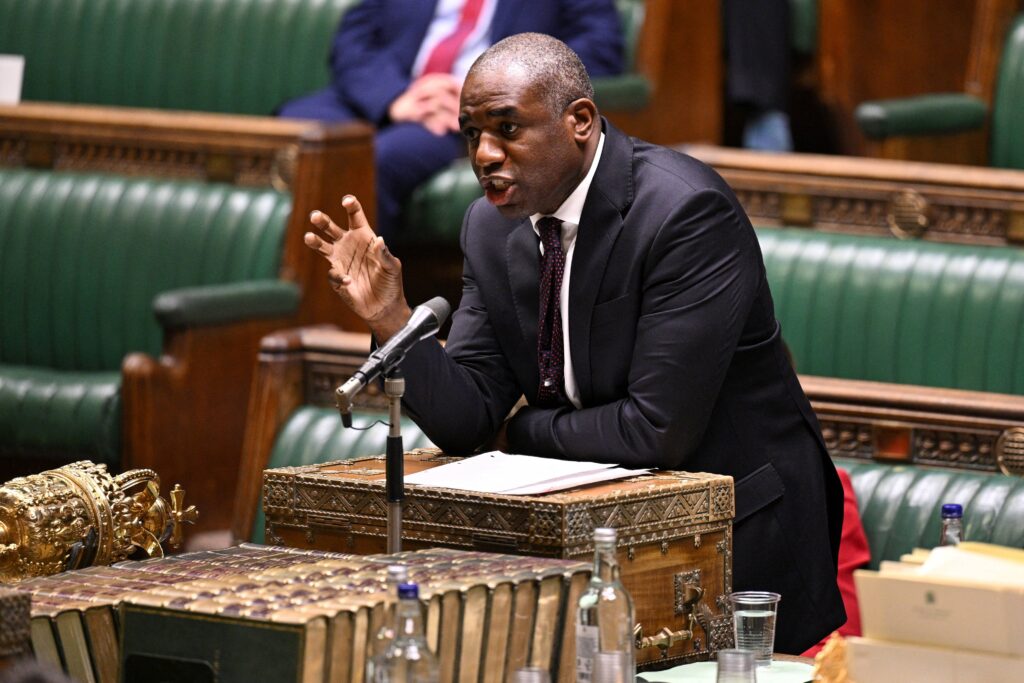
LONDON — Britain will limit the right of some criminal defendants to a trial by jury — a cornerstone of British justice dating to Magna Carta in 1215 — in a bid to clear dangerously clogged court dockets, Justice Secretary David Lammy said Tuesday.
Under the changes, defendants facing potential prison sentences of three years or less will no longer have the option of hearing their cases adjudicated by a panel of their peers. Instead, they will stand before a single judge, some in newly created “swift courts” designed to process cases about 20 percent faster than the traditional system, Lammy said in an address to the House of Commons.
The proposal will require approval by Parliament, which is dominated by Lammy’s Labour Party, and the changes are expected to take force early next year.
The tweak to the jury system — revered by many as a bulwark of blind justice, dismissed by others as a costly option used in only a fraction of cases — is needed to ease the burden on criminal courts that are “on the brink of total collapse” under an 80,000-case backlog, the government said.
Lammy, who also serves as deputy prime minister, cast the changes as an emergency intervention for a judicial system with trials scheduled as far out as 2030, leaving some victims and defendants more than a thousand days from their day in court. Without changes, the bottleneck is on track to reach 100,000 pending cases in the next two years, he said.
“Behind every one of the thousands of cases waiting to go to trial is a human life put on hold,” Lammy said. “If you are raped in London today your case will not be in the courts until 2029.”
The shift affects criminal offenses ranging from nonviolent house burglary to threats to kill — crimes that currently can be tried either in magistrates’ courts or, at the defendant’s election, before juries in Crown Court, where criminal cases are tried. Under the new proposal, that choice would disappear for the lower tier of charges.
The option of a jury trial will remain for murder, rape, robbery and other more serious charges, the government said.
Still, critics were swift to condemn the changes.
“Allowing a single judge, operating in an under-resourced system, to decide guilt in a serious and potentially life-changing case is a dramatic departure from our shared values,” Brett Dixon, vice president of the Law Society of England and Wales, a lawyers advocacy group, said in a statement.
Advocates said the changes would mostly impact minority defendants, who have been found to suffer the highest rates of discrimination in magistrates’ courts, which would take on more cases under the new system. Research indicates that Black and Asian people, as well as other ethnic minorities, are more likely than White defendants to receive immediate jail sentences rather than community service for similar offenses.
In 2017, Lammy, while serving in the opposition as shadow justice secretary, conducted his own review of bias in the courts and found juries were the part of the criminal justice system most consistently free of racial prejudice.
“Debate and deliberation acts as a filter for prejudice,” his report, known as the Lammy Review, found, whereas a single judge making decisions alone concentrates power in ways that might amplify rather than check individual bias.
“Jury trials are a fundamental part of our democratic settlement. Criminal trials without juries are a bad idea,” Lammy tweeted in 2020 in criticism of jury overhaul proposals being considered by the then-Conservative government.
In response to critics who pointed out the inconsistency — and there were many doing so gleefully during his House of Commons Q&A — Lammy said he viewed his changes as “saving” the overwhelmed jury system rather than scrapping it.
He blamed the backlog crisis on budget cuts to the court system by previous Tory governments. Conservatives, now in the opposition, blamed Lammy for wrecking Britian’s vaunted justice system.
“If he gets away with this, it will be the end of jury trials in this country,” Shadow Justice Secretary Robert Jenrick said in the House on Tuesday.
Among legal scholars, however, the jury is still out on juries. That’s in part because, despite their central role in the image of impartial justice — not to mention 271 episodes of “Perry Mason” — they are relatively rare.
More than 90 percent of criminal charges in Britain are settled without juries in the lower magistrates’ courts. And of those cases that reach Crown Court, most end with a guilty plea. In all, only about 3 percent of criminal cases are decided in the jury room.
“Views are divided on the jury trial,” said Nicola Padfield, emeritus professor of criminal and penal justice at Cambridge University.
“Some people see the jury trial as ‘the lamp that shows that freedom lives,’” Padfield said, quoting Lord Patrick Devlin, a renowned British jurist. “Others see it as a sacred cow. We all believe in the trial by jury, but we don’t actually use it very much.”
In any case, legal professionals remain skeptical that trimming jury trials for a subset of the least serious criminal charges will solve the backlog crisis.
The number of waiting cases has been driven up by cuts in the number of Crown Court locations around the country, the number of “sitting days” when judges hear cases, and a shortage of prosecution and defense lawyers to argue them. Until those systemic shortfalls are addressed, limiting access to the already small number of jury cases is unlikely to make much of a dent, Padfield said.
“The backlog of serious cases awaiting trial is a disgrace; there’s no question that something has to be done about it,” she said. “But I would be surprised if this change has the impact that the minister of justice seems to expect it to have.”
The post To clear huge court backlog, U.K. aims to scrap jury trials for some crimes appeared first on Washington Post.