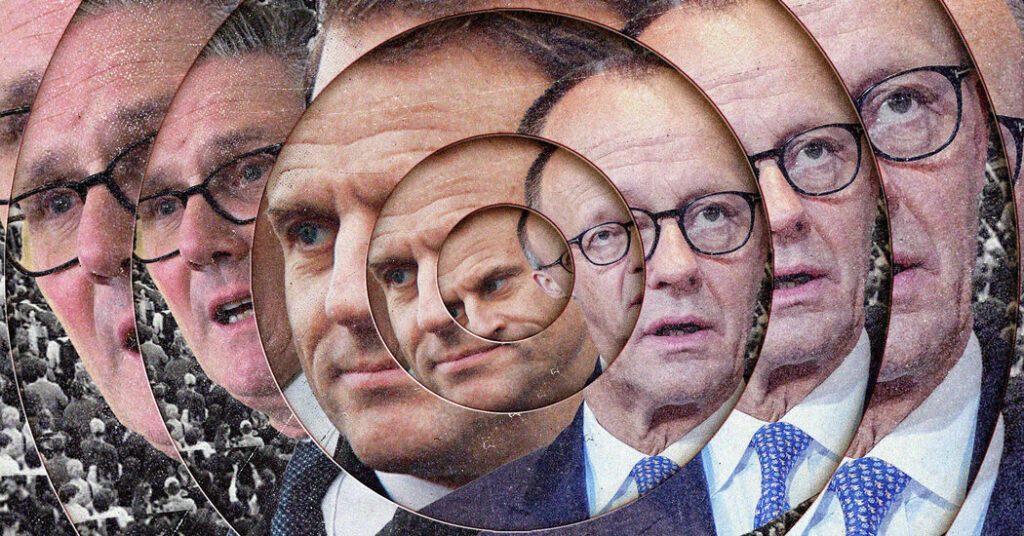
About a decade ago, a wave of populism crashed across Europe. Reeling from the financial crisis, voters flirted with risky alternatives to mainstream parties, threatening tumult in the continent’s usually stable politics. It was an unsettling time for Europe’s leaders. But pundits assured them that the risk of a far-right takeover was overblown. Robust electoral systems, not-so-distant memories of dictatorships and weak support among wealthier voters, they believed, put hard ceilings on the insurgents’ support.
Today it’s clear their confidence was mistaken. Far-right parties have kept piling on votes, established themselves in European institutions, reversed key tenets of the green transition and forced tougher border policies. They rule in Hungary and Italy and will soon in the Czech Republic; even in historically social-democratic Finland and Sweden, conservative leaders rely on their support. They have a cheerleader in the Oval Office and another atop X.
Worse may be still to come. In Europe’s leading economies, centrist governments are failing badly. In France, President Emmanuel Macron’s administration is in free fall as Marine Le Pen’s National Rally dominates the polls. In Germany, Chancellor Friedrich Merz seems unable to turn voters away from the nativist Alternative for Germany, even though the country’s intelligence service has labeled it an extremist threat. In Britain, Prime Minister Keir Starmer is sinking almost as fast as the anti-migrant Reform U.K. is rising. The stage is set for a far-right sweep.
It doesn’t have to be this way. Elsewhere in Europe, pluralist, mainstream governments have shown that it is possible to beat back the far right — not just by denouncing the populist danger but also by convincing voters of a clear project for the future. The far right appeals to the alienated; it prospers when its natural opponents lose hope and stop turning out. To defeat it, governments must build consensus around a stronger, greener, more secure democracy, one able to inspire their own supporters and win back the disillusioned.
Thankfully, this remains possible. Centrist leaders in Paris, Berlin and London are adamant that the far right’s rise is not inevitable. Indeed, they often say that stopping it is one of their core missions. The problem: They’re blowing it.
“I will do everything to make sure you never have reason again to vote for extremes.”
It was May 2017, and France had just elected Mr. Macron president for the first time. Speaking outside the Louvre, he made a pledge to Ms. Le Pen’s voters, insisting that he could answer their insecurities. In the months after that, he often vaunted his plan to sap support for the National Rally. It centered on an economic reboot, turning France into what he called a dynamic “start-up nation.”
From the outset, this was a mission from on high. As a Jupiterian president, standing above ordinary politics, Mr. Macron promised the French pain now for payoff tomorrow. Many might cavil about his policies, from tax cuts for the wealthiest to a higher pension age. They might even be shocked by heavy-handed policing of protests. But eventually, he seemed to believe, they would reap the economic rewards and thank him.
They didn’t. In 2022 voters took away his majority. Mr. Macron responded by circumventing Parliament to push through his pension change and in 2024 called snap parliamentary elections. Instead of giving him a mandate, the French rebuked him, producing a paralyzed legislature incapable of stable government. France has now cycled through five prime ministers in two years. Mr. Macron may limp on to the end of his term in 2027, but Ms. Le Pen and the National Rally are waiting in the wings.
If Mr. Macron is too forceful from a position of weakness, Mr. Starmer is too cautious from a position of strength. Despite his Labour Party winning a thumping parliamentary majority last year, it has governed with striking temerity. Its mantra for shrewd economic stewardship — to rein in spending today and hope for growth tomorrow — hasn’t inspired voters, and its early aura of managerial prudence has evaporated. Cuts in spending for pensioners and disabled people proved so unpopular that they had to be abandoned, leaving the government in disarray.
It doesn’t help that Mr. Starmer has combined this purposelessness with a repressive streak. After harshly disciplining Labour lawmakers over welfare votes, he clamped down on pro-Palestinian demonstrations, outlandishly designating the activist organization Palestine Action a terrorist group. Repeated large protests against the ban, with footage of mild-mannered grandmothers carted off by the police, have made free speech an open wound for him.
This contrasts markedly with the government’s failure to confront the challenge posed by Reform U.K. and its ebullient leader, Nigel Farage. Mr. Starmer has veered erratically between ruminating about the dangers immigration presents to national cohesion — in language he later said he regretted — and calling the party’s policies racist. Throughout, he has failed to fight Reform’s narrative or to take the political initiative elsewhere. No wonder support for Labour has slumped to just 18 percent, compared with Reform’s 30 percent.
In Germany, Mr. Merz — the newest leader of the three — has been more forthright. He can boast one major innovation since winning the election in February: loosening limits on government borrowing to invest in the military. It’s too soon to judge the results, but the stakes are high. Mr. Merz’s Christian Democrats and their coalition partners, the Social Democrats, have gambled Germany’s future on remilitarization not only for defense against Russia but also as a much-needed strategy for industrial revival.
So far, the strategy shows no sign of defanging the ascendant Alternative for Germany. Though the party has resisted the easing of borrowing limits, it too calls for a huge expansion of military industry and the army — albeit under German rather than European leadership. It bemoans E.U. plans for green reindustrialization but is more open to job creation in the weapons industry.
Mr. Merz insists that successful government will counter the Alternative for Germany’s appeal. But the party is going from strength to strength, operating as the main opposition and regularly topping national polls. Part of its support stems from its call to cut off German military support for Ukraine. Yet its ability to capture his flagship agenda, with militarization the means to make Germany great again, should give the chancellor food for thought.
These governments are different, of course. But they have all adopted their opponents’ antipathy to migration. In France, Mr. Macron — denouncing the “decivilization process” wrought by newcomers — has relied on National Rally lawmakers to limit immigrants’ welfare rights. In Britain, Mr. Starmer has apologized for the “incalculable damage” done by mass migration and introduced draconian changes to asylum rules. In Germany, Mr. Merz has increased deportations and pledged to “carry out expulsions on a very large scale,” casting migrants as a danger to women.
If this is meant to win over voters unhappy about immigration, it hasn’t worked. Instead of rewarding pale centrist imitators, they are turning, more and more, to the real thing.
Not, it seems, in Denmark.
In 2014’s European elections, the nationalist Danish People’s Party took nearly 27 percent of the vote — a breakthrough that heralded a big future. Yet in the equivalent election in 2024, it scored just 6 percent. In a decade when the far right surged across Europe, it went backward in Denmark. What happened?
To some, the answer seems clear: The center-left government, under Prime Minister Mette Frederiksen, cracked down on immigration. It’s true that she, in office since 2019, has taken a severe approach to the issue. Treating new arrivals as temporary rather than permanent residents to integrate, she has pushed Syrians to leave Denmark, cut social housing in areas with large minority populations and signed a deal with Rwanda to process migrants on African soil. This approach, admirers say, paid off with her re-election in 2022.
This narrative is one-dimensional at best and, at worst, a myth. Ms. Frederiksen’s first government, which relied on support from left-wingers and a liberal party, was notable not just for its stringent attitude to migration but also for its ambitious program of green reindustrialization. It planned enormous investment in renewables, set internationally advanced targets on cutting emissions and — alone among major oil producers — established a legally binding date to stop drilling.
The government insisted that converting to green jobs wasn’t the end of Danish prosperity but the necessary means of achieving it — and backed this claim up with funding. Economic interventionism, paired with a compelling story about confronting an era-defining challenge, brought electoral success. Today, Danes’ biggest concerns are climate change and health care, not immigration.
Spain is much larger, more internally divided and far less wealthy than Denmark. But if anything, its lessons for keeping the far right at bay are more generalizable. Prime minister since 2018, Pedro Sánchez is the most successful center-left politician in Europe and is among the European Union’s longest-serving heads of government. After nearly six years in coalition with parties to its left, his Spanish Socialist Workers’ Party polls around 30 percent
How? By taking sides. During the pandemic, the government capped energy prices, recognized app-based delivery riders as workers with rights and restored certain labor protections. It went on to steeply increase the minimum wage and tax large fortunes. Giving its base reasons to stick with it, Mr. Sánchez’s party bucked the trend for lower-income, less educated voters to turn away. And it did so while pursuing a broadly welcoming migration policy.
This hasn’t been smooth sailing. Mr. Sánchez has faced tensions within his coalition, a highly politicized judiciary and conflicts over Catalan separatism. He was widely expected to lose the 2023 elections to a right-wing coalition that included the ultranationalist Vox. Yet he thwarted its rise by raising turnout — not just by warning about the far-right threat but also by rallying voters behind his government’s achievements. He told Spaniards a story about their future prosperity and the dangers it faces. And it worked.
Both prime ministers have problems. After Ms. Frederiksen’s re-election, she turned toward more centrist allies and started bleeding support. The main beneficiaries have been the left-wing parties with which she once allied, but small anti-immigration outfits are also rising. Ms. Frederiksen, whose Social Democrats performed poorly in last month’s local elections, is clearly not the electoral force she once was. Yet voter enthusiasm for other progressive options shows that nationalist resentment isn’t the only alternative.
Mr. Sánchez has struggled, too. Without a majority since 2023, he hasn’t been able to pass a budget. In the absence of new redistributive measures, popular support for his left-wing allies has cratered, and scandals in his party have fed furious calls for his resignation. Vox’s polling has ticked up, and a weirder, younger, more conspiracy-theorist far right has taken form. Ominously, it’s named The Party’s Over.
Even if these leaders are more embattled than they once were, their record shows the value of political boldness. They changed national agendas, politicizing issues of economic and tax justice and showing blue-collar voters that mainstream parties are on their side. Other European leaders should learn the lesson — and still can.
In France, that might involve a wealth tax, stabilizing the government and raising much-needed revenue. In Britain, the government could lift living standards by reining in gas bills, taxing energy giants and reviving green investment plans. In Germany, the government could relax investment limits to renew infrastructure, from rail to housing, and provide a different kind of economic stimulus.
Far from pie in the sky, this is all politically feasible: The numbers are there in Parliament, and all have time before the next elections. While far-right parties pose as the voice of ordinary people, most voters haven’t been won to their cause and are yearning for reasons to hope again. It wouldn’t take that much for these governments to give them some.
And if they don’t? Some now settle for the consolation that when far-right parties reach power, they soon run out of steam.
They could point to the recent Dutch elections, in which Geert Wilders’s nationalist Freedom Party — the largest force in the departing government — lost ground to the liberal Democrats 66. The Freedom Party’s short, unsuccessful spell in office tells a reassuring story of populists’ inveterate incompetence. Yet this happy conclusion doesn’t quite reflect the election outcome. While Mr. Wilders tanked, his former supporters mainly turned to similar parties and the overall far-right vote held firm. His march might have been halted, but the far right is still gathering strength.
By 2030, there’s every chance that we will be talking not about voters flirting with populism but of far-right parties heading Europe’s main countries. Figures like Mr. Farage, Ms. Le Pen and Mr. Wilders could hold sway across Europe. If they do, they’ll inherit states with new and dangerous powers. The continental armed forces buildup, as countries drive up military spending and remobilize youth in uniform, is a case in point. So too are the repressive measures that governments have taken to stifle dissent and protest, especially over questions of war and peace.
Even if France’s short-lived governments have a hint of Weimar about them, this isn’t a return to historical fascism. Today’s far-right parties are more likely to summon angry online pile-ons than mass street protests. Their national interests often differ, as do their ideas: Some are more welfarist, others technolibertarian or conspiracy theorist. But for all their differences, they can clearly make deals with more mainstream, pro-business conservatives. They are primed to advance a new creed of embattled Europeanness, not quitting the European Union but transforming it from within.
What would a far-right European Union look like? Europe’s Green Deal agenda would be gone, for one. Instead, European investment would probably go to rebuilding national militaries, expanding the apparatus of mass deportations and hardening Europe’s external borders. Creeping privatization, especially of health care, could be combined with A.I.-based policing to discipline the poor and the precarious.
Ukrainian refugees, as part of a broader turn against Ukraine, would be treated with suspicion, and Muslims and other minorities would be targeted for forced repatriations in a cruel program of so-called remigration. If the continent descends into full-fledged war — a real threat as the international order collapses — the detention of “undesirables” and mass conscription for the rest would not be far behind.
Even such a grim 2030s would differ in important respects from the 1930s. It’s not quite midnight in the century. But a Europe given over to far-right ideologues and beholden to a nativist America could bear its own horrors. Unless the continent’s centrist governments change course, the far right can make Europe its own. After that, all bets are off.
David Broder (@broderly) is the author, most recently, of “Mussolini’s Grandchildren: Fascism in Contemporary Italy.”
Source photographs by WPA Pool, Ludovic Marin, picture alliance and Geoffroy Van der Hasselt/Getty Images
The Times is committed to publishing a diversity of letters to the editor. We’d like to hear what you think about this or any of our articles. Here are some tips. And here’s our email: [email protected].
Follow the New York Times Opinion section on Facebook, Instagram, TikTok, Bluesky, WhatsApp and Threads.
The post They Have a Historic Mission, and They’re Blowing It appeared first on New York Times.