In May 2021, an evangelical Christian preacher stood outside an amphitheater in Mississippi with his protest group, waving posters with pictures of aborted fetuses, passing out fliers and using a loudspeaker to get their message out.
Police in Brandon arrested Gabriel Olivier and charged him with breaking a recently passed city law that confined protests to a designated area near the theater. Olivier pleaded no contest, and received a $304 fine and one year’s probation.
When Olivier sought to challenge the city’s law as a violation of his free-speech rights, federal judges pointed to an obscure rule meant to block defendants from using federal civil rights lawsuits to invalidate their criminal convictions.
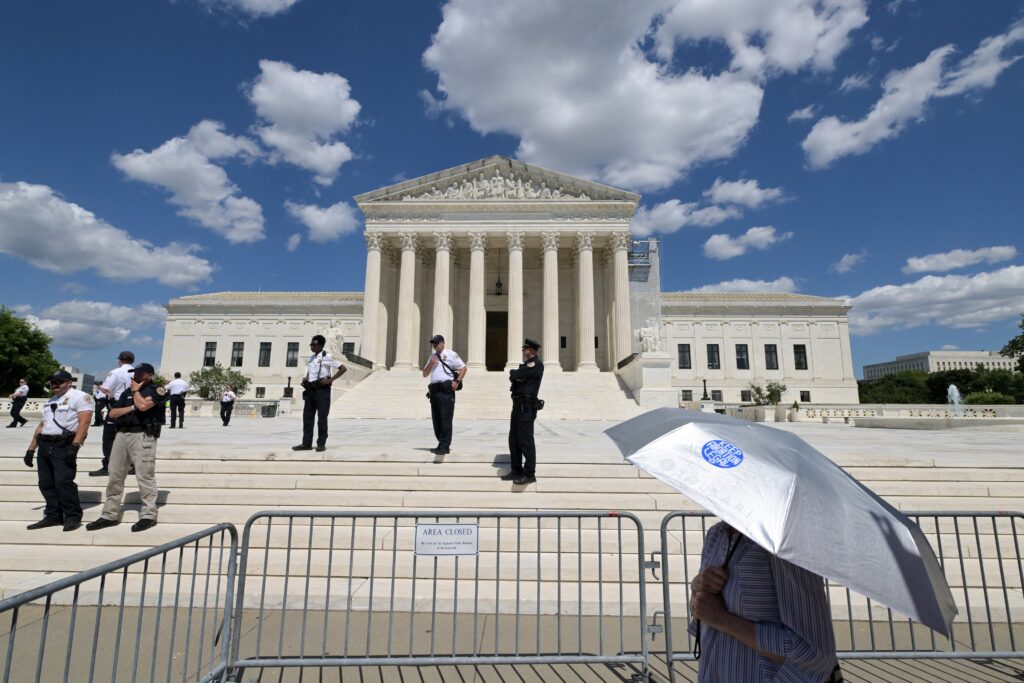
The Supreme Court on Wednesday weighed arguments in the case, which concerns the constitutional right to free speech and when defendants can challenge laws they were convicted of.
A lawyer representing Olivier told the high court his lawsuit seeks to shield him from future charges under the city statute. He served no jail time, and a successful lawsuit would not affect his past conviction, Olivier’s attorney, Allyson Ho, told the justices.
“It doesn’t relieve Olivier of any consequences of his conviction, and it doesn’t compensate Olivier for any potential harm caused by his conviction,” she said.
Lawyers for the city of Brandon told the court that any judgment in Olivier’s favor could invalidate his past conviction and open the door for other defendants convicted of more serious crimes to circumvent their convictions.
At times, the justices challenged the arguments presented by Olivier’s attorney, citing what courts call the “Heck bar,” named for the 1994 precedent Heck v. Humphrey. In that case, a unanimous Supreme Court placed strict limits on when criminal defendants can file civil rights suits as they relate to a conviction. The limits are meant to block criminal offenders from using civil rights lawsuits to short-circuit their sentences.
“If we take Heck for all it’s worth, you can’t win,” said Justice Elena Kagan.
The justices also signaled they were concerned about following the rule too closely. Too strict a reading could block defendants from bringing legitimate civil rights claims.
Justice Clarence Thomas asked repeatedly whether Olivier’s conviction would be invalidated if someone else challenged the same law.
“If a third party can bring the exact same claim, why would [Olivier] be precluded from bringing a legitimate” federal civil rights claim? Thomas asked.
Attorney G. Todd Butler, arguing for the city of Brandon, said Olivier’s conviction changed the dynamics of the case. Olivier could have appealed through the state court system but did not, so he should not have the right to challenge the law in federal court, Butler said.
In its court filings, the city said it had previous run-ins with Olivier and his group. Soon after the city amphitheater opened in 2018, Olivier and his group stood outside the amphitheater and, through a loudspeaker, called patrons derogatory names and waved signs with pictures of aborted fetuses, the city said.
The court filings said that a year later, the city passed a law that directed protests to a designated area near the amphitheater an hour before and after concerts. In 2021, Olivier returned with his group, and police arrested him for protesting outside the designated area, they said.
After pleading no contest to the charges, Olivier filed a federal civil rights lawsuit saying that the city’s law violated his free-speech rights. He still had several months left on his probation sentence. A Mississippi trial court and the U.S. Court of Appeals for the 5th Circuit blocked Olivier’s lawsuit from moving forward, citing the Heck rule.
“Although Petitioner claims in this case that the courthouse doors are closed, that argument ignores the countless doors [Olivier] chose not to enter,” Butler said.
It was unclear when the justices would rule on the case.
The post Supreme Court weighs Mississippi preacher’s argument on civil rights appeared first on Washington Post.