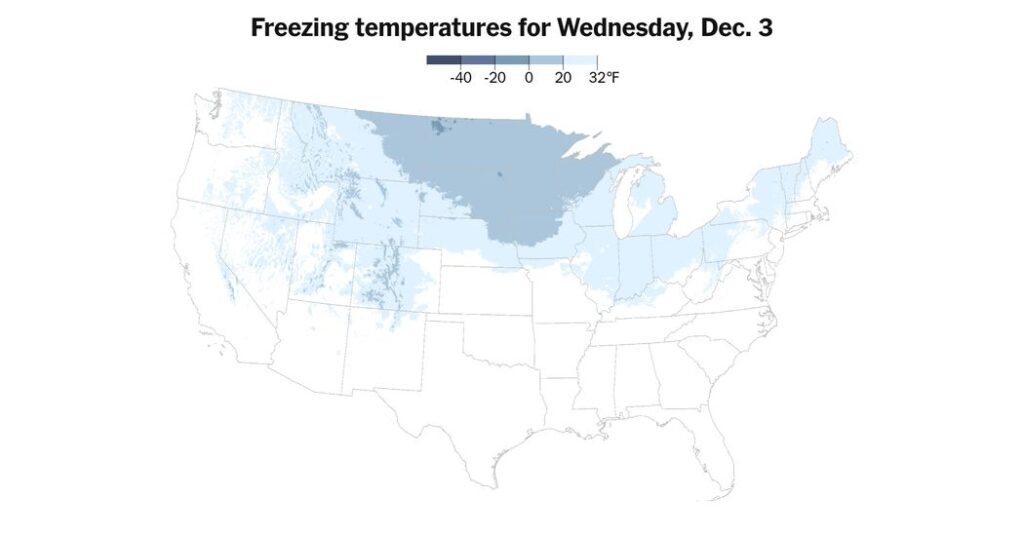
Two separate shots of cold Arctic air moving down from Canada are predicted to send temperatures across a portion of the central and Eastern United States plunging 10 to 25 degrees below normal into early next week, forecasters said.
The first rush of cold air filtered into the Dakotas and Minnesota on Wednesday and will reach the Northeast by Friday. After a brief reprieve, the second push is predicted to arrive in the Upper Midwest on Saturday and follow a similar path east.
It will be a bit of a temperature roller-coaster as the cold air rushes across the country in two swoops. But it will move on relatively quickly. There will also be some snow in the mix, but it won’t bring as much as the storm last weekend.
“The cold air will be transient,” said Tony Fracasso, a meteorologist with the Weather Prediction Center. “It’s not going to sit for days and days.”
Many locations are expected to see the first below-zero temperatures of the season, and Mr. Fracasso said some daily temperature records were likely to be broken, especially in the Midwest on Thursday and in the Mid-Atlantic and the Northeast on Friday.
Here’s where it will get cold, and when.
On Wednesday, the cold air began funneling into the northern Rockies, the Northern Plains and across Minnesota and into the Upper Mississippi Valley.
In far northern Montana, the town of Plentywood hit a low of zero degrees early Wednesday morning.
A snowstorm just ahead of the cold air was bringing snow over the Great Lakes.
On Thursday, the cold will shift into the central Rocky Mountains, the Northern and Central Plains and the Midwest, with the most frigid weather focused over Minnesota, Iowa, Wisconsin, Northern Illinois and Indiana.
The National Weather Service office serving Minneapolis and St. Paul said that Thursday was expected to bring the “first widespread subzero morning of the season,” while the office in Chicago said the Windy City was expected to record a high of 18 degrees, which is about 22 degrees below normal.
“Very chilly for the start of December in Chicago,” said Jake Petr, a meteorologist with the Weather Service.
The chance for snow will push into the Northeast, mainly from upstate New York into Vermont. A snow flurry is possible in New York City.
On Friday, the cold is forecast to linger in the Midwest and spread across the Mid-Atlantic and into the Northeast, with the coldest temperatures most likely in portions of New York, Vermont, New Hampshire and Maine.
In New York, the coldest temperatures will be in the northern most portion of the state, but New York City will be chilly with a predicted high of 30 degrees.
Over the weekend, the first blast of cold air is expected to linger in the Northeast as a second shot filters down into the Northern Plains and the Midwest. Sunday is the more concerning day with below-zero temperatures forecast in western North Dakota, northern Minnesota and northern Wisconsin.
By Monday, the cold will be spread from the Midwest to the Northeast with below-zero temperatures in portions of New York and New England.
Cold weather is also expected across Canada.
The cold weather is already a big conversation in Canada, with temperatures plunging since late November from the Central Prairies all the way to Atlantic Canada.
Jim Tirone, an operational forecaster at the Atlantic Storm Prediction Center of Environment Canada in Nova Scotia, said a cold air mass had been sitting over Hudson Bay and was expected to slump down toward the Atlantic coast, causing temperatures to drop sharply beginning Thursday night.
“We’re forecasting highs on Friday of minus seven degrees Celsius,” or 19 degrees Fahrenheit, he said. “Which is quite a bit below the seasonal average of plus four,” or 39 degrees Fahrenheit.
In Quebec City, Environment Canada forecasts temperatures will reach highs of minus 8 degrees Celsius on Wednesday (17.6 degrees Fahrenheit), dropping to minus 13 degrees Celsius) on Friday (8.6 Fahrenheit). The average maximum December temperature for the city is around minus three degrees Celsius (26.6 Fahrenheit).
What makes this cold weather concerning.
Surges of cold Arctic air can be dangerous, especially when combined with strong winds that create extremely low windchill — a measure of how cold it actually feels on exposed skin when both air temperatures and wind speed are considered.
According to the National Weather Service, prolonged exposure to extreme cold can quickly lead to frostbite or hypothermia. Frostbite most often affects uncovered skin and extremities, like fingers, toes and ears. Hypothermia develops when the body loses heat more rapidly than it can produce it.
Environment Canada warned that young children, older adults, people with chronic illnesses, people working or exercising outdoors and those without proper shelter are most at risk in extreme cold weather.
Amy Graff is a Times reporter covering weather, wildfires and earthquakes.
The post Some of the Coldest Weather of the Season Is Sweeping Through the U.S. appeared first on New York Times.