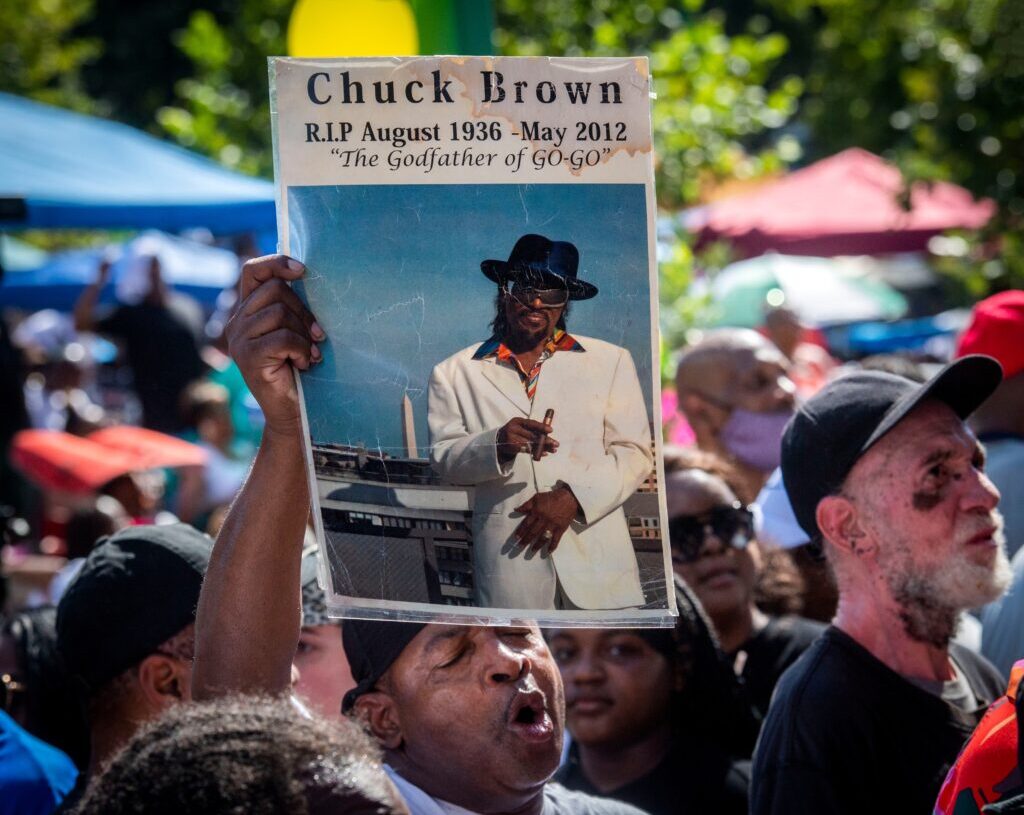
It seemed simple enough: Del. Eleanor Holmes Norton (D), the District’s nonvoting delegate in the House, introduced a bill to name a D.C. post office after Chuck Brown, a beloved local music legend known as the “Godfather of Go-Go.”
But Republicans on the House Oversight Committee removed her bill from the agenda at their Tuesday meeting because of Brown’s criminal record, preventing the bill from moving forward.
“Committee members raised concerns about advancing a postal naming bill for an individual convicted of murder,” a spokesman for the Oversight Committee Republicans said in a statement. The bill, which would name the post office at 3401 12th Street NE after Brown, was withdrawn to “allow for further review and discussion.”
Norton said during the hearing she was “deeply disappointed” by the move.
“D. C. loves Chuck Brown, and he loved D.C.,” Norton said. “He had a significant impact on D.C.’s history and culture as well as music. I regret that Republicans on this committee refuse to honor this legend.”
GOP congressional intervention in District affairs is about as distinctly D.C. as go-go music — so much so that on April Fools’ Day in 2023 the D.C. Council spoofed the House Oversight Committee with a post about a fake GOP bill that would “impose mandatory maximum song length limits at concerts such as go-go performances,” alongside an image of Brown.
The District, which is subject to congressional oversight under the Constitution, is facing more than a dozen GOP bills that would overhaul local laws and policies, namely on criminal justice and policing.
But Tuesday’s decision to block a local post office-naming caught local officials more by surprise given Brown’s image as a D.C. icon.
The Grammy-nominated Brown has a park named after him in Langdon. He has a day named after him in August, an annual celebration complete with go-go performances. And if you call the Division of Motor Vehicles and are put on hold, you’ll hear his 1978 chart-topping hit “Bustin’ Loose” play on loop.
“It’s clear to me that the legacy and culture of D.C. is under attack by congressional Republicans, and we should all be really concerned about it,” said council member Zachary Parker (D-Ward 5). “Chuck Brown is a legend, and Ward 5 continues to celebrate his legacy, and it’s just sad that we’re even having to defend off legislation or have these debates about D.C. culture and our people.”
Raised in D.C., Brown served time for murder in the 1950s after shooting a man, which he had long maintained was in self-defense. At the Lorton Correctional Complex, he traded a few cartons of cigarettes for a guitar — and emerged from prison with a distinct blend of funk and soul that ultimately became the city’s official music, pegged as “go-go” for how the beat just “goes and goes,” Brown once said.
D.C. Council Chairman Phil Mendelson (D) said he considered Brown “an icon to the cultural heritage of the District.”
“It’s completely appropriate to honor him, and I find it ironic that in this administration there are folks who are insisting that a criminal record from long, long, long ago for which Chuck Brown did his time is somehow unacceptable,” he said.
Also on Tuesday, the House Oversight Committee advanced a bill from Rep. Harriet Hageman (R-Wyoming) that would repeal a D.C. law ordering courts to give deference to executive agencies when interpreting city laws. D.C., whose local judges are nominated by the president, passed the law after the Supreme Court overturned a long-standing precedent last year requiring courts to give deference to federal agencies.
Rep. James Comer (R-Kentucky) said that the Supreme Court ruling should be respected and D.C. should not “put its thumb on the scale” by requiring courts to give deference to its executive agencies during lawsuits. “This kind of deference is inherently unfair to citizens who challenge overreaching government action in court,” he said Tuesday.
In a joint letter to Comer and the committee, D.C. Mayor Muriel E. Bowser (D); Attorney General Brian Schwalb (D); and Mendelson had urged them to reject the legislation, calling it a “clear example of federal overreach into local governance.”
“The District has less autonomy over its judiciary than any state, and the federal intervention reflected in this bill disrespects the rights of DC voters and erodes our democracy,” they wrote.
The House Oversight Committee has advanced a historic number of bills this year targeting D.C. policies. In September, it advanced 13 bills that would largely change D.C. justice and policing policies in line with a White House vision for harsher treatment of suspects and a rollback of the city’s autonomy.
Proposals include replacing the city’s elected attorney general with a presidential appointee unaccountable to District residents; overhauling the bail system; and allowing the U.S. attorney to charge 14-year-olds accused of serious offenses as adults. Another would codify President Donald Trump’s March executive order to make D.C. “safe and beautiful,” while also cracking down on immigration.
Jenny Gathright contributed to this report.
The post Republicans nix bill naming D.C. post office after Chuck Brown appeared first on Washington Post.