Over the years, the tire shops and drive-throughs along Williams Boulevard, one of the busiest roadways in Kenner, La., have been joined by taquerias, immigration law offices and Norma’s Sweets Bakery, which adapts a Latin American holiday bread into king cake for Mardi Gras.
The new businesses serve residents from Honduras, Guatemala, Nicaragua and Mexico, many of whom came to Louisiana to help rebuild after Hurricane Katrina in 2005. The strip is one of the most obvious signs of just how much Kenner, a suburb of New Orleans with about 66,000 residents, has changed.
But with dozens of Border Patrol agents expected to arrive in New Orleans this week, following similar immigration crackdowns in Chicago and Charlotte, N.C., the usual bustle on Williams Boulevard has been replaced by an unsettling quiet.
Even before news of the operation broke last month, many in Kenner were on edge. After President Trump took office in January, the local Police Department strengthened its ties with federal law enforcement and pursued an immigration crackdown of its own. In June, the city canceled its annual Hispanic Heritage Festival after a number of sponsors and vendors pulled out.
“We all feel targeted,” said AnaMaria Bech, the publisher of Viva NOLA, a local bilingual culture and lifestyle magazine.
Kenner has made some efforts to welcome its growing immigrant community. In addition to hosting the annual festival, it opened a Hispanic Resource Center, a hub offering English classes, legal advice and health programs. Still, Mr. Trump’s relentless focus on immigration enforcement has resonated with many in the conservative, predominantly white city.
“The community, the city as a whole, they support it,” Keith Conley, Kenner’s police chief, said of the Border Patrol operation that he expects to soon come. “They are totally glad to see the assistance of the federal government, our partners, coming in and doing this mission.”
Chief Conley is particularly grateful for the agreement that his department entered into in March with the Department of Homeland Security, which deputizes his officers to identify undocumented immigrants and turn them over to Immigration and Customs Enforcement.
He said that undocumented immigrants have been involved in murder, sexual assault and human trafficking cases in Kenner. But far more frequent, he said, are nonviolent offenses that can still take a toll, particularly automobile crashes involving undocumented immigrants who are unlicensed or uninsured.
”I was screaming for help,” Chief Conley said.
A recent investigation by Verite News, a nonprofit outlet in Louisiana, found that traffic stops in Kenner had increasingly become a funnel for undocumented immigrants to be taken into federal custody and deported.
The outlet reported that from January to May, ICE issued at least 129 immigration detainers through the Kenner police; 20 had been issued during the same period last year. More than half of those detained this year were initially booked on traffic-related offenses.
The result has been a heightened wariness for many immigrant families, including some who have become deeply rooted in Kenner.
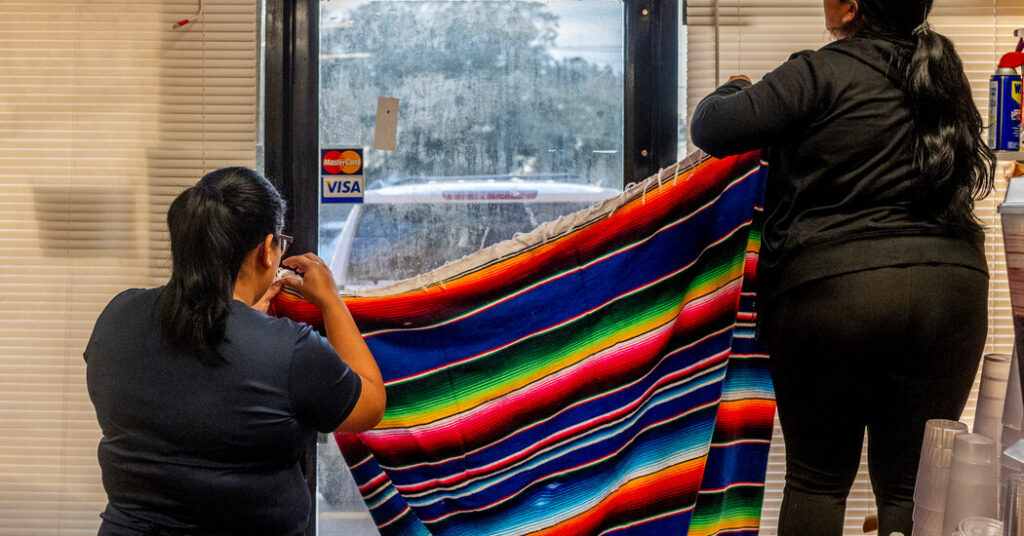
At one Mexican restaurant, the family who owns it has a new routine at closing time. Cesar, 50, pushes aside tables and drags out mattresses to sleep on rather than risk being pulled over on the way home. His daughter, Ximena, 19, closes the blinds. His wife, Sandra, 49, drapes a colorful cloth over the front door. They also keep close watch on a live feed from a camera perched over the back door.
“That way we can see if a truck pulls up that we don’t know, because it could be ICE,” said Cesar, who found his way to Kenner from Mexico after Hurricane Katrina. The family spoke on the condition of using only their first names, because they fear being detained.
“We lived through hurricanes and tornadoes and Covid,” Ximena said, “but nothing compares to the fear we feel now.”
The Hispanic population in Kenner, just west of New Orleans, has grown steadily over the past two decades, now accounting for 30 percent of the people living there. The increase has not been enough to offset population declines caused in part by extreme weather, soaring home and property insurance costs and a shortage of opportunity outside of service industry jobs. But it has helped soften the impacts.
Many came to Kenner because it had affordable housing, with less crime and chronic dysfunction than New Orleans. “Once you hit New Orleans, things get wild,” said Jeremy Allen, 39, a Kenner native who was watching the sun set from a park at the end of Williams Boulevard one night last week. “But here it’s always chill.”
Mr. Trump said during a cabinet meeting on Tuesday that National Guard troops would arrive in New Orleans later this month; Gov. Jeff Landry, a Republican, requested the deployment in September to help with “public safety concerns regarding high crime rates.”
After Hurricane Katrina, the enormous recovery efforts drew people to the region from Mexico and Central America, both undocumented and on temporary work visas. By some estimates, about 100,000 Hispanic people moved into the New Orleans metropolitan area in the decade after storm.
Officials in the region did not exactly roll out a welcome mat for them. In 2005, after Katrina struck, the mayor of New Orleans at the time, Ray Nagin, openly raised concerns with business leaders about making sure the city was “not overrun by Mexican workers.”
A couple of years later, officials in Jefferson Parish, which includes Kenner, adopted onerous rules that effectively banned the taco trucks that had proliferated after the storm. Critics argued the restrictions were a not-so-veiled attempt to run off the customers patronizing the trucks, too.
Chief Conley stressed that it would be unfair to mistake the pursuit of undocumented immigrants in the city for antipathy toward the broader Latino population.
“Kenner is a diverse and inclusive community,” he said, describing it as a point of pride. Noting that Latino residents were among those who had been pleading for more aggressive immigration enforcement, he added: “They’re the ones that stressed the concerns to me with the open borders, and how they came to this country lawfully.”
In the not-so-distant past, Ideal Mart Express might have been one of the most popular shops on Williams Boulevard. The cramped store offered churros filled with dulce de leche, a counter serving tacos and dinner platters, and a stand where horchata was ladled out of barrels into cups. The business has recently had far fewer customers than normal.
George Gibbs, a cashier, pointed to a window where customers usually lined up to wire money to their families back home. “No one is sending money,” he said.
“I understand why it is happening,” Mr. Gibbs added, “but it is hard to see good people feel so scared.”
Wolfgang, 40, moved to Kenner from Honduras as a 5-year-old. He remembered the city being far different when he was younger. “Seeing another Hispanic was like a lottery moment, it was so rare,” said Wolfgang, who gave only his first name because he was wary of drawing the attention of law enforcement officials.
On a recent evening, he brought his 9-year-old son, Ubi, and his friends to a pier on Lake Pontchartrain, where they reeled in mullets and croakers.
“I like it because I can come here to fish,” Ubi said, “or I can play basketball outside, or soccer in the backyard.”
He glanced at his father.
“Or at least,” he added, “I used to be able to play soccer in the backyard.”
A few days earlier, his father explained, Ubi kicked a soccer ball through a rotten fence board, leading to a neighbor calling their landlord and threatening to call immigration officials.
“It didn’t used to be like that here,” Wolfgang said. “Now is the first time we’ve ever had any problems being Hispanic in Kenner.”
Rick Rojas is the Atlanta bureau chief for The Times, leading coverage of the South.
The post Police in a Louisiana City Welcome a Federal Crackdown. Immigrants Are in Hiding. appeared first on New York Times.