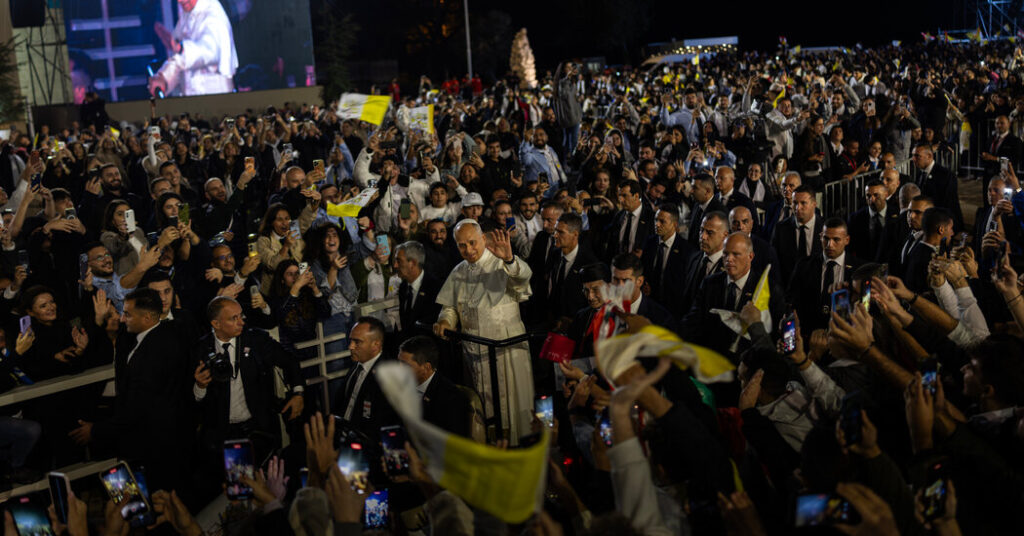
When Leo XIV boarded Shepherd One, as the papal plane is known, for his first international trip last week on Thanksgiving Day, the world wondered if the mild-mannered American pope might suddenly reveal something unexpected with an edgy comment or spontaneous gesture.
Instead, Leo returned to Rome on Tuesday after a highly scripted six-day tour to Turkey and Lebanon that confirmed his stolid, quiet, what-you-see-is-what-you-get character.
Composed and self-effacing, Leo’s traveling style stood in contrast to his predecessor, Pope Francis, whose startling declaration during his first overseas trip to Brazil set the tenor for the rest of his dramatic tenure.
Francis jolted the Catholic world in 2013 when on the return flight from Rio de Janeiro to Rome he was asked about gay priests, and responded, “who am I to judge?” The most surprising disclosure Leo made on Tuesday during the trip back to Rome was that before he was elected pope in a conclave in May, he had been thinking about retirement. He said that as it became clear the voting in the conclave was moving in his direction, he “resigned myself to the fact” he was about to become the head of the Roman Catholic Church.
In content if not in tone, Leo continued in Francis’s footsteps. Like his predecessor, Leo called for the protection of migrants and the environment, and reiterated the Vatican’s longstanding support for a two-state solution to the Israeli-Palestinian conflict. By making Turkey his first destination, Leo was upholding a commitment made by Francis before he died.
Yet if Francis often seemed ready to stray from the script, courting controversy, Leo stuck resolutely to the themes of peace and unity that he had declared would be the primary message of his visits.
In Turkey, Leo quietly worked to soothe tensions between the Catholic and Orthodox churches, which have feuded over doctrinal differences for over a millennium. In Lebanon, he offered a Mass at the site of a devastating blast at the Beirut port in 2020, where he spoke with family members of the victims. And in both countries, he repeatedly called for an end to violence across the often war-torn region.
As he moved through back-to-back events, sometimes appearing to walk with an irregular gait, he rarely sought to draw attention to himself. In Turkey, he sat for two hours of sonorous chanting during a service at the Church of St. George, the main Orthodox cathedral in Istanbul, occasionally consulting the cleric sitting next to him to help find his way in the order of service. At another point in Turkey, the Armenian Patriarch of Constantinople asked Leo to bless a plate of traditional bread and dip it in salt. When the patriarch told Leo he had used “too much” salt, the pope, seemingly unfazed, asked, “do I eat it?”
“He’s not emotive or telling you what he feels all the time,” said Kathleen Sprows Cummings, a history professor who specializes in Catholicism at the University of Notre Dame. But “he’s able to be fully present to people.”
With Francis, “there was a self-consciousness,” said Ms. Cummings. “What he was doing was going to get attention. It didn’t mean that it was false,” she added. But “Pope Leo doesn’t seem to care about that.”
When Francis traveled to Turkey in 2014, he, like Leo, visited Istanbul’s Sultan Ahmed Mosque, also known as the Blue Mosque. But where Francis prayed with Istanbul’s senior Muslim cleric as they both faced Mecca, Leo did not visibly do so.
Leo remained focused on his message of unity to the very end of the trip. When a journalist on the papal plane asked whether Muslims are a threat to Christian identity in Europe, the pope dismissed the idea.
“All of the conversations that I had during my time both in Turkey and in Lebanon, including with many Muslims, were precisely concentrated on the topic of peace and respect for people of different religions,” Leo said.
By traveling to Turkey as well as Lebanon for his first trip, Leo signaled that he was not afraid to address thorny geopolitical challenges. The timing of his visit to Beirut coincided with the anniversary of the cease-fire between Israel and Lebanon and came amid continuing airstrikes from Israel in the country’s south.
Showing a consistency in his priorities, he warned — as he has since his election — of the risks of rapidly advancing technologies such as artificial intelligence “that could otherwise exacerbate injustice instead of helping to overcome it.” He spoke about the importance of women in social and political life and how they represent “a factor of true renewal throughout the world.” That raised the question, for some observers, of whether he intends during his papacy to allow women a greater role in church life and leadership.
But he never strayed far from the overarching message of peace. At a final Mass at the waterfront in Beirut attended by about 150,000 people, according to local officials, he made an appeal for the faithful to “be artisans of peace, heralds of peace, witnesses of peace.”
He offered prayers not only for the Lebanese, but for the victims of the fire at a housing estate in Hong Kong that killed more than 150 people last month, and for the people of Guinea Bissau, where the president was deposed in a coup last month.
On the plane back to Rome, Leo offered a glimpse into his practical efforts to help secure peace in regions troubled by conflict. In Lebanon, he said, he met with religious leaders “who represent in reality political authorities,” and “have something to do with the internal or international conflicts in the region.”
Once again, the pope demonstrated that he prefers discretion over attention.
“Our work, primarily, is not a public thing that we declare in the streets,” he said of the Vatican’s diplomatic efforts. “It is a bit behind the scenes.”
Leo acknowledged that, to many traveling reporters, he is somewhat inscrutable. He said he has been amused by journalists trying to interpret his facial expressions.
“Sometimes I get really great ideas from all of you because you think you can read my mind or my face,” he said, standing in front of the divider that separated economy class from the front of the plane.
“You’re not always correct,” he added.
Josephine de La Bruyère contributed reporting from Rome.
Motoko Rich is the Times bureau chief in Rome, where she covers Italy, the Vatican and Greece.
The post On First Trip Abroad, Pope Leo Echoed Francis’s Message, Not His Style appeared first on New York Times.