Presidential pardons are in fashion in the United States, even for people who haven’t yet been found guilty of a crime. Israeli Prime Minister Benjamin Netanyahu is a well-known Americanophile. Now he, too, wants a preconviction pardon, a never-go-to-jail card.
On Sunday, his lawyers submitted his request, stressing that freeing Netanyahu from his marathon corruption trial would be purely for the public good.
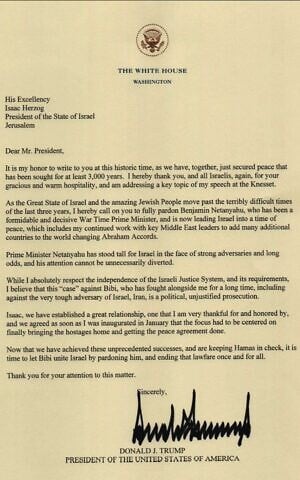
Because Netanyahu faces Israeli, not U.S., charges, he had to seek relief from Israel’s president, Isaac Herzog, rather than from Donald Trump. But Trump has already weighed in. In a letter last month, he urged Herzog to issue a pardon. The case against Netanyahu is “political, unjustified prosecution,” Trump wrote, concluding with his standard line to an implied underling: “Thank you for your attention to this matter.”
The U.S. connection doesn’t end there. If Herzog accedes, he will put Israel firmly in the American camp, where the ruler is above the rule of law.
[Yair Rosenberg: Netanyahu just admitted he’s unfit to lead Israel]
The police began investigating Netanyahu in 2016. He went on trial in 2020 on charges of fraud and breach of trust in three separate cases, and bribery in one of them. One charge held that he used his office to help a billionaire, from whom he and his wife received gifts that included a steady supply of expensive cigars and champagne. Another alleged that he granted regulatory favors in return for favorable coverage on a popular news site.
The legal and financial complexity of the cases, the long list of witnesses, and the defense team’s tactics have all served to drag out the trial. So did the coronavirus pandemic and the war in Gaza. Over the past year, Netanyahu has had to appear in court as a witness for the defense, and then for cross-examination. The three judges presiding over the trial have repeatedly allowed him to miss days or testify for fewer hours because of what he presented as pressing matters of state. From the start, Netanyahu has accused the police, the prosecution, and the media of a political witch hunt.
The pardon application, though, is a new gambit. And Trump’s letter is likely one reason for the timing. Netanyahu may believe that the U.S. president’s backing could make Herzog more amenable, while providing cover with some part of the Israeli public.
Besides that, another stratagem to end the trial without a verdict has stalled. Since March, the Netanyahu government has sought to dismiss Attorney General Gali Baharav-Miara. The cabinet formally voted to do so in August. In Israel, the attorney general has a quasi-judicial role that includes heading the state prosecution, and she has the power to stay proceedings mid-trial. Baharav-Miara has steadfastly refused to do what a more pliant replacement might. But the supreme court has blocked her dismissal and is expected to issue a final ruling against it on procedural grounds.
Testifying, especially under cross-examination, may be what has pushed Netanyahu to look for a way out. For most of the trial, he was not required to be present in court. But since his testimony began last December, he has had to appear on the witness stand as the defendant, a constant blow to his self-image. Worse, since the cross-examination began in June, he has been caught in contradictions, and his lawyers have probably told him that he stands a strong chance of being convicted.
The pardon request is an extraordinary document. Contrary to the standard legal advice in Israel for those appealing to the president, Netanyahu does not “express sincere remorse for his actions.” Logically, this makes sense: Remorse would be a mid-trial admission of guilt. Rather, his lawyers insist that he is innocent, and that his purely personal interest is in letting proceedings continue until he is acquitted. He’s asking for a pardon, they claim, for the good of the nation.
Presidential clemency before a verdict is close to unheard-of in Israeli law. Netanyahu’s attorneys turned to the United States for precedents. “Recently U.S. presidents have given numerous pardons before conviction,” they wrote. And they cited the classic example: “In a case similar to ours, President Ford pardoned his predecessor, President Richard Nixon,” even though Nixon had never been charged or tried and “openly refused to recognize any guilt on his part.”
[Listen: Even some J6ers don’t agree with Trump’s blanket pardon]
They didn’t mention one minor difference: Nixon resigned his office when his offenses became obvious and never returned to politics. Netanyahu’s request is predicated on him staying in office. The request lists his accomplishments, including “leading the campaign to destroy Hamas rule and return our hostages.” Now, “alongside the United States,” it says, Israel is moving forward toward agreements to end the war and expanding peace deals with Arab countries. Freeing Netanyahu from “the burden” of the trial, his lawyers say, will allow him to devote “his full strength, energy, time, and understanding to lead Israel in these historic days.”
Hidden here is an admission that fulfilling the duties of prime minister while being a criminal defendant is hard. The obvious solution to this problem—and to Netanyahu’s stated desire to prove his innocence—would be to resign. As is normal in a parliamentary democracy, the Knesset would decide on a new prime minister or call new elections. The implication running through the request, however, is that Benjamin Netanyahu has no possible replacement. He alone is the great leader, protector of the nation.
A single relevant precedent exists in Israel for pardon before conviction, and the prime minister’s request cites it at length. In 1986, President Chaim Herzog—the current president’s father—granted pardons to top officials in the Shin Bet security service, before any charges had been filed, for their role in covering up the murder of two captured terrorists. The elder Herzog explained that the officials would not be able to defend themselves without “divulging security information of the utmost secrecy.” He was acting, he said, in the interests of the public and state security.
In a controversial decision that followed, the supreme court upheld the president’s authority to issue a pardon before a verdict, but only in “the most exceptional circumstances of paramount public interest or personal plight.” The court noted, however, that the Shin Bet officials had “admitted having committed the criminal acts for which they asked to be pardoned.” And the most senior among them—the head of the agency—resigned.
Netanyahu, by contrast, is admitting nothing, and his claim of a “public interest of the first order” rests largely on how purportedly essential it is for him to stay in office. In addition, his lawyers write, “granting a pardon will enable the prime minister to act to mend the rift in the nation” caused by the trial.
This comes very close to the classic definition of chutzpah: killing your parents, then asking for mercy in court because you are an orphan. The causes of the national divisions to which Netanyahu refers have been his insistence on clinging to power through the investigation, indictment, and trial, and his escalating attacks on the judicial system. In 2023, his government instigated a “judicial reform” aimed at making the justice system subservient to an all-powerful ruling coalition. If the constitutional revolution had moved as quickly as the government planned, Netanyahu might already be safe from criminal conviction.
Since the investigation began, Israeli politics have undergone a realignment: Rather than right versus left, the most significant divide is between political parties willing to join a coalition with an antidemocratic prime minister accused of corruption and those who refuse to do so. The first step in healing that rift would be for Netanyahu to leave the stage.
[Dennis Ross: Yitzhak Rabin knew what Netanyahu doesn’t]
For now, the pardon request is in Isaac Herzog’s hands. Granting pardons is one of the few powers of his office. Israel’s president is supposed to be above partisan politics but speak for the state as a whole. In that role, a president with a strong democratic compass would reject Netanyahu’s request immediately.
Herzog, however, is a weak figure. A former leader of the Labor Party, he was elected by the Knesset with Netanyahu’s surprising help. Rather than speaking out against the “judicial reform,” he proposed a compromise that would have given the coalition much of what it wanted. Now he has promised to weigh Netanyahu’s request “with the good of the state and society” in mind—a formulation that leaves room for accepting Netanyahu’s arguments.
If Herzog does grant a pardon, it’s certain to be challenged in the supreme court. How the court would rule is entirely uncertain. Two years ago, it handed down a narrow, landmark decision overturning a constitutional measure—a central part of the coalition’s “reform”—on the grounds that it violated the state’s democratic character. But since then, three liberal justices have retired, creating a more conservative court.
The crucial decision, therefore, is Herzog’s. He can, at last, stand for principle and insist that equality before the law applies even to the country’s leader. Or he can accede to Netanyahu’s request, and to Trump’s, and deliver another blow to democracy.
The post Netanyahu Wants a Never-Go-to-Jail Card appeared first on The Atlantic.