It has northern Canada’s only railway to the populated south, the only Arctic deepwater port and a runway capable of handling some of the world’s largest military and commercial aircraft, a legacy of the town’s Cold War past.
Now, as the world’s superpowers flex their muscles in a warming Arctic, the tiny town of Churchill, on Hudson Bay’s western shore, seems poised to play an outsize role as Canada prepares to move aggressively into one of the newest global arenas.
“Canada is looking to secure its Arctic sovereignty, and we can fill that role naturally,’’ said the town’s mayor, Mike Spence. “We’ve got the infrastructure here — I mean, at least you’ve got that foundation.’’
If the mayor is hedging, that’s because years of underinvestment, ill-fated decisions by past Canadian governments and climate change have left the Port of Churchill and Hudson Bay Railway — two of the country’s biggest pieces of Arctic infrastructure — in rough shape. Their new owner is just starting to repair the port and is increasingly confronting the difficulties of running trains on rapidly thawing permafrost.
Though Canada has the world’s second-largest Arctic landmass after Russia, its Far North is isolated, mostly dotted with tiny Inuit communities, often without paved roads or an independent power supply. Its only all-weather road to the Arctic Ocean was completed less than a decade ago.
But jolted by a trade fight with President Trump and his threats of annexation, Canada’s prime minister, Mark Carney, is seeking to assert the country’s Arctic sovereignty with big, nation-building’ infrastructure projects.
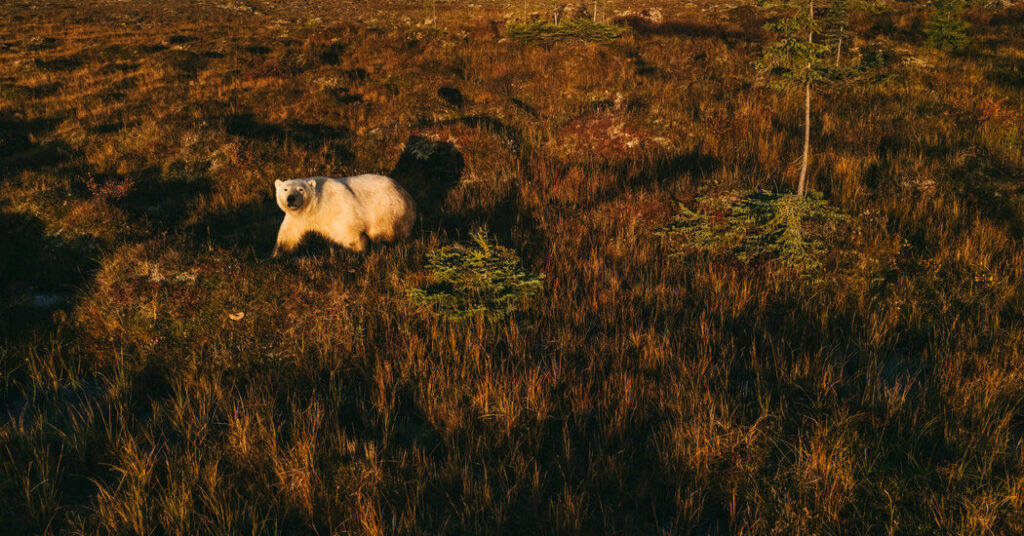
Nowadays, Churchill is best known for its polar bear tourism.
But in a proposal the federal government calls “Port of Churchill Plus,’’ it is considering a major upgrade — including building an all-weather road linking Churchill to the south and the use of icebreakers to extend the navigable season — to develop Churchill’s commercial and military potential. As a first step, the federal and provincial governments announced earlier this month more money for the railway and the construction of critical minerals storage at the port.
A modernized port could provide a faster route for ships transporting critical minerals, potash, agricultural goods and other commodities from Western Canada, said Chris Avery, chief executive of Arctic Gateway, the port and railway’s owner. And with Mr. Carney announcing the biggest military spending increase in decades, the port could serve as a naval supply and coast guard base, he added.
Still, Canada has a lot of catching up to do.
Russia’s Arctic region has large cities and major military and commercial infrastructure, including nuclear reactors. China, a self-described “near-Arctic state,’’ recently sent a cargo ship to Europe through an Arctic shortcut for the first time.
Mr. Trump is pushing to buy Greenland and wants to militarize the Arctic by erecting a “Golden Dome” missile defense shield.
Churchill’s history, though, points to the complexities of building in the Arctic, the region hardest hit by climate change.
“Building in the Arctic is like building on the moon,’’ said Pooneh Maghoul, a geotechnical engineer at Polytechnique Montreal, a university. “The remoteness is a challenge; accessibility is a challenge; resources are a challenge; the ground, climate change and the environmental conditions are a challenge.’’
Yet another challenge is political. Like other northern communities, Churchill is largely populated by Indigenous people whose ancestors were subjected to official discrimination by the government. Today, with more power, many Indigenous leaders have pushed back against Mr. Carney, fearing he would steamroll ahead in the North without consulting them.
So the future of Churchill will also depend on its residents, who are split over a vision for their town and who harbor deep suspicions about the federal government’s and big businesses’ intentions.
In fact, Churchill and Mr. Spence led efforts to buy the port and railroad in 2018 from an American company, Omnitrax. They and others, including 29 First Nation communities in the region, formed Arctic Gateway to operate the two.
Sitting at the edge of town, the port and its gigantic grain elevators loom over the rest of Churchill. But no ship was waiting to be loaded on a recent visit. No cargo train was expected for a week. About two dozen ships a year called at the port two decades ago, but that number is down to the single digits.
Instead, workers were busy repairing the loading dock’s foundation, removing deep layers of rotten wood. Inside the main building, old grain-handling instruments gathered dust in a large room.
“There’s a lot of work to be done, and it’s basic work,’’ Mr. Avery said during a tour.
When the Canadian government built the railroad and port a century ago, in an earlier era of nation-building, the goals were similar. A port in the sub-Arctic would help farmers export to Europe, instead of relying on U.S. ports. The 500-mile railway — crossing vast stretches of boreal forests, peatland, permafrost and tundra from central Manitoba to Churchill — would help populate Canada’s North and strengthen its hold on the region.
“We often talk about the Alaska Highway in North America as one of the seminal moments for the birth of permafrost science and engineering, but the Hudson Bay Railway is even older,” said Pascale Roy-Léveillée, a permafrost scientist at Laval University in Quebec, who is working with Arctic Gateway.
Churchill became a staging ground for Canadian and U.S. soldiers during World War II. Later, military and civilian personnel from both countries worked on projects out of Churchill — from building the Cold War-era Distant Early Warning radar network to carrying out research on rockets.
Churchill’s population swelled to more than 6,000 at its peak. Indigenous people from the region were urged by the authorities to settle in Churchill.
Many Indigenous families lived for decades in a flood-prone neighborhood called the Flats, a narrow strip between the water and the railroad tracks. Though the homes were no more than shacks with no running water or electricity, Verna Flett, 67, and Georgina Berg, 62, two Cree sisters who grew up there, also recalled a town buzzing with activity.
“It was exciting,’’ said Ms. Berg, a schoolteacher. “There were so many people around.”
With the end of the Cold War, the military departed, leaving behind a rocket launch facility. The Canadian government sold the port and railway to Omnitrax in 1997, and after it deregulated the export of wheat and barley in 2012, grain exporters stopped using the port.
The port and railway deteriorated because of insufficient maintenance. In 2017, flooding washed out parts of the rail line to Churchill for about 18 months.
With access to Churchill limited to prohibitively costly flights, Mr. Spence, the mayor since 1995, knew it was time to act. The railway was a lifeline to Churchill and to other Indigenous communities in the region, he said, but an outside owner would not run it in their interests.
Mr. Spence — a Cree who grew up in the Flats and went on to own several businesses in town — successfully lobbied the government to invest 117 million Canadian dollars ($90 million), in 2018, so that Indigenous communities could buy the facilities under the Arctic Gateway Group.
“Regional ownership is important because you can have a say in terms of what the hell is going on here,’’ said Mr. Spence, who is also co-chairman of Arctic Gateway.
Mr. Trump’s threats against Canada and the Carney government’s Port Churchill Plus plan suddenly opened possibilities in a way that Mr. Spence said he had never anticipated. Even climate change was working — partially — in the town’s favor.
Ice has been shrinking in Hudson Bay, making it navigable to ships for about five months a year, or about one month more than in the 1980s, said Feiyue Wang, a sea ice expert at the University of Manitoba.
“By the end of the century, the bay will be navigable to open water vessels most of the year, if not the entire year,’’ Mr. Wang said at the university’s new research center, the Churchill Marine Observatory, near the port.
But for Churchill, a warming climate is double-edged: thawing permafrost has created sinkholes under the rail line’s tracks. Maintenance crews have to fix them sometimes several times a year, said Brett Young, the railway’s general manager, adding that trouble spots have increased rapidly in recent years.
Ground-penetrating radars mounted on locomotives and thermal imaging by drones constantly monitor ground along the tracks.
The idea of Port Churchill Plus has yet to win over some residents, especially those who lived through the end of the Cold War. In recent decades, Churchill has reinvented itself as the so-called polar bear capital of the world, and they fear the effects of increased commercial and military activities on tourism.
“With this big Canada project, are they going to come here and say, ‘Hey, this is for Canada. Too bad, you with your boating business down the slipway, you’ve got to get out because we need this area and it’s port property,’ ’’ said David Daley, the owner of a dog sledding business and a representative of the Indigenous Tourism Association of Canada.
Leroy Whitmore, the owner of a polar bear tour company, said he discovered late in life that his mother belonged to the Ahiarmuit, inland Inuit forcibly relocated several times by the Canadian government.
An all-weather road to Churchill, he said, would make it easier to go shopping down south. But it could also draw so many people that the town would be changed irrevocably.
“I’m torn,’’ he said. “I want a road, but I don’t want a road. I want a road, but I don’t want anyone else to use it.’’
Norimitsu Onishi reports on life, society and culture in Canada. He is based in Montreal.
The post Is This Polar Bear Town Canada’s Key to the Arctic? appeared first on New York Times.