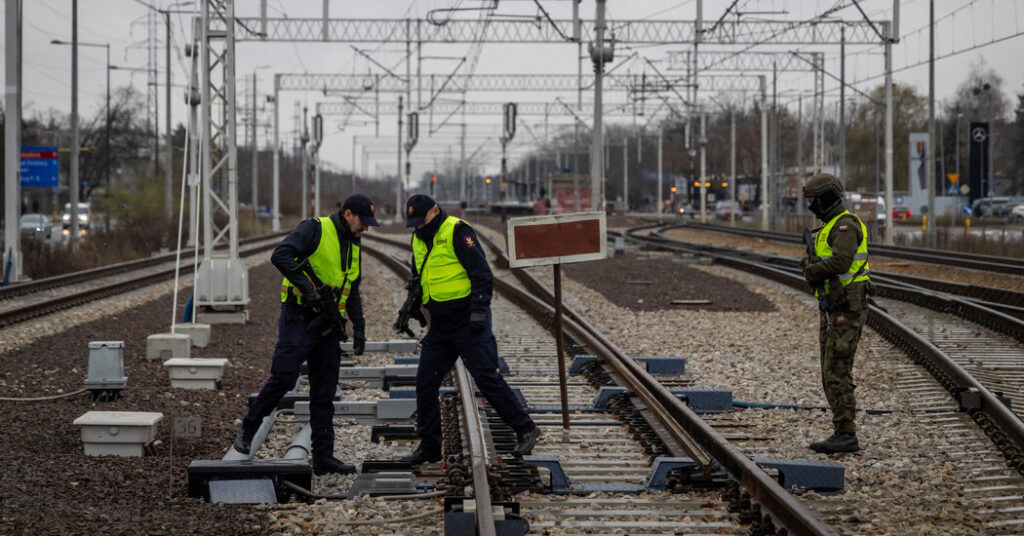
When Prime Minister Donald Tusk of Poland accused Russian agents last month of planting explosives on a rail line, he called it “perhaps the most dangerous situation for the security of the Polish state” in years, even though no one was hurt.
Around the same time, Defense Minister Guido Crosetto of Italy urged Europe to protect itself better from disinformation that he said Russia directed at his country. “We are under attack, and the hybrid bombs keep falling,” he concluded in a report.
The European Union’s top diplomat, Kaja Kallas, was even more blunt. “Russia is committing state-sponsored terrorism,” she said recently.
Hybrid attacks against Europe — a barrage of drone incursions, cyberstrikes and acts of sabotage that stop short of open warfare — are on the rise from a relative lull earlier this year, according to military officials and experts who have long believed that Russia is to blame for the assaults and is using them to test NATO allies. In the past few months alone, the hybrid assaults included jamming aviation-navigation systems over Sweden, sending drones over Danish and Belgian airports and smuggling explosives into Poland in cans of corn, officials have said.
In response, European countries are changing their tone. Officials are rebuking Russia more forcefully and more often, embracing a naming-and-shaming strategy that just a year ago divided the North Atlantic Treaty Organization.
There are risks. President Vladimir V. Putin of Russia warned Europe on Tuesday about appearing more assertive. “We are not planning to fight with Europe, but if Europe suddenly starts a war with us, we are ready right now,” Mr. Putin said.
The NATO secretary general, Mark Rutte, appeared to brush off the Russian leader’s comments. “I’m not going to react to everything Putin is saying,” Mr. Rutte said Wednesday at the start of a NATO meeting in Brussels.
The previous approach by European allies, who had been hesitant to publicly cast blame in order to avoid escalation, failed to deter attacks. Some NATO members grew frustrated with what they saw as a vague, ineffective policy.
The changing strategy reflects allied countries’ growing willingness to confront Russia more aggressively. It also raises public awareness about Russia’s threat to a European public that may be reluctant to invest more taxpayer funding in defense.
“We will see more” sabotage attacks, the Dutch foreign minister, David van Weel, said at the NATO meeting. Protecting against hybrid warfare, he said, includes “having great awareness amongst our population.”
“I’m afraid this is a sign of our times — this is the way Russia operates,” he said.
For years, officials have suspected Russia of using a covert mix of military, cyber, economic and political tactics to disrupt and destabilize Europe. The pace increased when NATO supported Ukraine after Russia’s full-scale invasion in 2022, and they have since included disrupting Western energy systems, meddling in national elections, plotting to put incendiary devices on cargo planes, and hacking into health service and other government networks.
This week, the Polish authorities charged a Russian man with organizing sabotage, espionage and propaganda plots in Poland in 2023. And the European Commission president, Ursula von der Leyen, accused Russia’s main partner in Europe, Belarus, of sending balloons into neighboring Lithuania to disrupt its air traffic in what she described as “worsening” hybrid attacks.
While the impact of the attacks has been more unnerving than catastrophic, officials and experts fear that a miscalculated Russian plot could eventually cause widespread destruction or even deaths.
Moscow typically denies any involvement in hybrid attacks, and it has shrugged off European accusations as “Russophobia.” Mr. Putin has long demanded that NATO retreat from Eastern Europe.
Until recently, NATO largely sought to keep a lid on the sabotage, trying to deter Russia by thwarting its strikes. That strategy has shortcomings. Much of Europe’s critical infrastructure is vulnerable to attack, in part because networks are outdated and easy for hackers to penetrate. And governments do not always share intelligence with one another about the shadowy attacks.
“The nature of hybrid is that it is complex and diverse,” Foreign Minister Oana Toiu of Romania said Wednesday at the NATO meeting. “So here, we think we need a better coordination among us as allies, NATO, to step up its role.”
Many NATO states also remain secretive about how they retaliate against Russia individually, although that is also starting to change. Last December, NATO officials debated whether to blame Russia openly for hybrid strikes, for fear of causing public anxiety and making Moscow seem, as one senior strategist put it, “bigger than they are.”
NATO’s ability to defend its member countries relies on Russia and other aggressors’ viewing the alliance as a force not to be underestimated. Its Article 5 principle considers an armed attack on one member as an attack on all. But if NATO is unwilling to go on offense and can’t find a way to stop the hybrid attacks otherwise, officials said, it risks losing its credibility.
“If you want to destroy NATO, all you need is to create a situation when there’s an unquestionable need for collective defense and activation of Article 5 and it doesn’t work,” Gen. Karel Rehka, the chief of the Czech Armed Forces, said in an interview. “And if you create one situation when this doesn’t work, it’s end of NATO.”
A report by the Czech Security Information Service for 2024 concluded that Russian agents were behind cyberstrikes against Czech government networks, an arson attack at a Prague bus depot and the sowing of political unrest across the country.
Concern that sabotage is growing ever more dangerous has led some European leaders not just to blame Russia for hybrid activity more frequently but also to talk more openly how they will defend themselves.
“This is a lot about ‘Now, Russia is at war with the West,’” said Charlie Edwards, a hybrid-warfare expert at the International Institute for Strategic Studies and a former intelligence and security strategist for Britain. “That’s an important change.”
“But if you’re going to say that, you’ve got demonstrate to your publics that you’re serious about doing something about it,” Mr. Edwards added.
In Italy, Mr. Crosetto recommended creating a new force of up to 5,000 personnel and creating a command center to counter hybrid threats.
In Poland, Mr. Tusk’s government activated about 10,000 military personnel to protect critical infrastructure after last month’s rail attacks.
A passing freight train detonated one of two devices planted on the tracks, but the explosion was so minor that the conductor did not notice it, Mr. Tusk said. Nonetheless, he said at the time, “a line has been crossed.”
“Don’t be surprised that people are experiencing this so emotionally,” Mr. Tusk said after the attack. “I think we all realize that this is an unprecedented event.”
The Polish government also told Russia to close its last consulate in Poland, in Gdansk. And on Monday, Polish officials restricted air traffic along the country’s eastern borders with Ukraine and Belarus until March “to ensure state security.”
Russia flew as many as two dozen unarmed drones into Poland in September, scrambling NATO fighter jets and putting other air-defense systems on high alert. Mr. Edwards said the drones appeared to be carrying SIM cards from Poland and Lithuania to allow them to use local cellular towers to conduct reconnaissance while circling over cities.
No one expects the naming and shaming to stop Russia entirely. But without it, officials and experts predicted, Moscow will become only more emboldened.
“Every time NATO and the E.U. don’t do something, the credibility of the alliance is questioned,” Mr. Edwards said, “for the simple reason that there seems to be no obvious, public response.”
Lara Jakes, a Times reporter based in Rome, reports on conflict and diplomacy, with a focus on weapons and the wars in Ukraine and the Middle East. She has been a journalist for more than 30 years.
The post Europe Wants to Get the Word Out: Russia Is to Blame for Sabotage appeared first on New York Times.