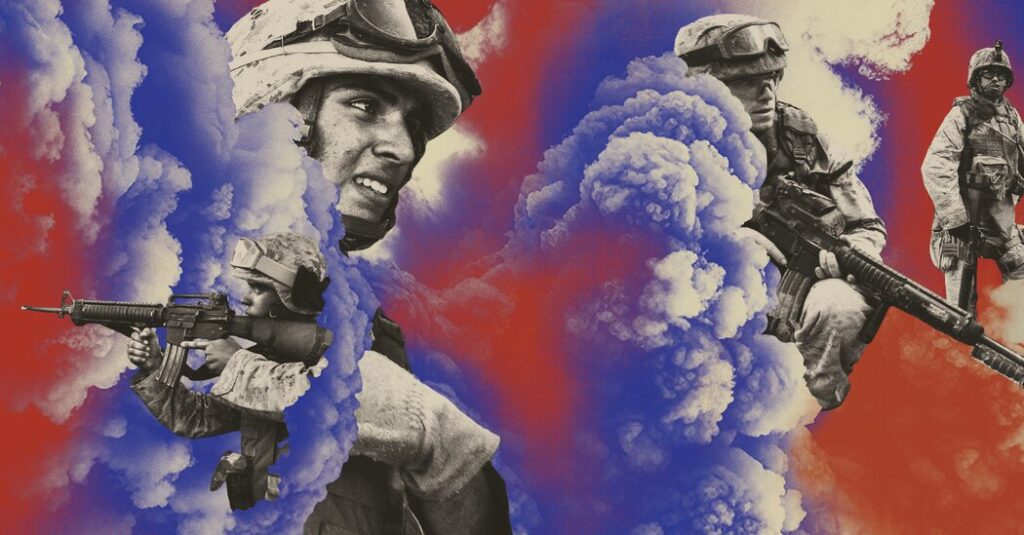
It’s 2004 in Najaf, Iraq, on a night so dark that all you can see are U.S. Marines. There are roughly two dozen of them — special operators from a storied force known as the Alpha Raiders. Grainy video shows them standing at attention before their commander, a man with a razor-shaved head and an assault rifle slung over his left shoulder. He steps onto a platform and punctures the air with a partial recitation of William Shakespeare’s exalted St. Crispin’s Day speech in “Henry V.” The man paces back and forth while tightly grasping onto a few pieces of loose paper. Most likely these are battle plans, though in this context, they resemble a script.
“Whoever returns safely tomorrow morning will rouse himself every year, on that day, to show his neighbors his scars and tell embellished stories of all their great feats of battle,” he says. “And these stories you will teach your son. And from this day, until the end of time, we shall be remembered.” Then there’s a smash cut to a shot of troops rushing out from the shadows and into the glaring streetlights.
These scenes appear midway through “The Last 600 Meters,” a new PBS documentary depicting the intense Iraq war battles of Najaf and Falluja, during which scores of Americans were killed. This was some of the heaviest urban combat for American forces since the Vietnam War. During the especially intense second Battle of Falluja, 12,000 American and allied forces, aided by tanks and air power, fought a few thousand Iraqis, with an estimated 1,400 insurgents and 700 civilians killed. The documentary draws its name from a line delivered 30 seconds into the film by the Army sniper Karl Erickson. He explains the literal myopia of his job. “Foreign policy?” he says. “I don’t make it. I just deliver the last 600 meters of it.”
The film was directed by Michael Pack, and one of its executive producers was Steve Bannon — who, at the time of production, fancied himself a right-wing cinema auteur. It was supposed to be televised in 2008, when the Pentagon surged troops into Iraq just as public support for a withdrawal peaked. Pack, who served as President Trump’s chief executive of the U.S. Agency for Global Media, recently told The Washington Examiner that PBS initially shelved his film because of its perceived pro-military bias; as of last month, 17 years later, it has finally premiered. Pack explained that the programming shift came after the network’s longtime president watched the film “with fresh eyes.” (PBS declined to comment.) In a recent report in Semafor, Bannon seemed to reason that this old movie was now an antiwar missive, one that he wants to screen at the White House — “so maybe we won’t go into Venezuela.”
The film certainly shows plenty of perilous moments and is thrumming with violent images: kill shots, burned bodies, even a feral street dog holding a severed leg in its mouth. In a historical sense, though, the film is strangely sanitized, both a stage-managed tale of battle and armchair media criticism over how the fighting was framed at the time. In one moment, Maj. Jeff Stevenson objects to reports that his troops impeded a hospital’s functions, saying the accounts were printed without a response from U.S. forces. “No one ever came to ask me: ‘Were any of these things true?’” The question is never meaningfully answered.
Bannon’s support of the film implies that he sees a new political moment for it. Simply revisiting the carnage could be interpreted as an antiwar argument — it is, after all, a capsule of military members bending the arc of what we now know to be a losing narrative. But “The Last 600 Meters” can’t help relishing in the story of “ground truth” — it’s a story that quickly dispenses with dry talk of institutional failures to focus on arresting scenes of dominance and survival. Today, the war against terrorism still looms large, its muddled memory at once fueling anti-interventionist attitudes and stoking America’s unrealized dreams of violence and victory. Under these conditions, even what some might see as critical of conflict can slide into martial agitprop.
Whether any film can be truly “antiwar” is a question that divides cineastes. Steven Spielberg, the director of the 2001 HBO mini-series “Band of Brothers,” once said, “Every war movie, good or bad, is an antiwar movie.” But the French filmmaker François Truffaut believed that these films always ended up supporting the aims of war planners. “Violence is very ambiguous in movies,” he argued. In 2019, Francis Ford Coppola reasoned that all war films, including his epic “Apocalypse Now,” inevitably “inspire a lust for violence.” A truly antiwar film, Coppola argued, would be “filled with love and peace and tranquillity and happiness.”
The incoherence of the war against terrorism exacerbated the inherent challenges of war filmmaking. This was a sprawling conflict, but Najaf and Falluja provided the rare opportunity for a simple, riveting narrative — a series of conventional battles in which two sides fight over inches. Kinetic frames are interspersed with interviews of troops grousing that their boots-on-the-ground experiences were minimized or misinterpreted by news coverage. The remit of these men was, of course, brutally simple: gain ground, secure a high body count and ensure collective survival. With such a narrow lens, we’re reminded that there are two kinds of conflict represented: the debate in the media and Washington about the war machine, and glorified military violence on the ground. Whether “The Last 600 Meters” is an antiwar film depends on which one you’re talking about.
Only once does the film’s fog machine of war truly sputter and fail, when the platoon commander Jesse Grapes tries to triumphantly mark Falluja as a turning point. “What our enemies respect over there is not candy and soccer balls — they respect the hammer,” he contends. “And we gave it to them in Falluja. And that’s why they haven’t replicated that again in the country.” Grapes then sheepishly qualifies his last line, describing the reality of brutal ambushes, hidden improvised explosive devices and spiking casualties. It’s a telling moment, one in which a U.S. Marine tasked with articulating the broader meaning of his service simply can’t.
Once American troops reach the finish line of Falluja’s 600 meters, they march on cue, telling the filmmakers they were thinking of a scene from Stanley Kubrick’s “Full Metal Jacket,” in which men march buoyantly through a literal hellscape of fire while singing the “Mickey Mouse Club March.” Kubrick’s film is widely seen as effective antiwar art; still, like “Band of Brothers,” it has inspired countless numbers of young men to seek out their local recruiting station. In the film, Cpl. Garrett Slawatycki, recalling the Kubrick scene, says: “I guess you could say, ‘War is hell,’ and you know, ‘Bad things happen,’ and stuff like that.” He then expresses unconcealed excitement over the prospect that tales of Falluja would soon “be everywhere.”
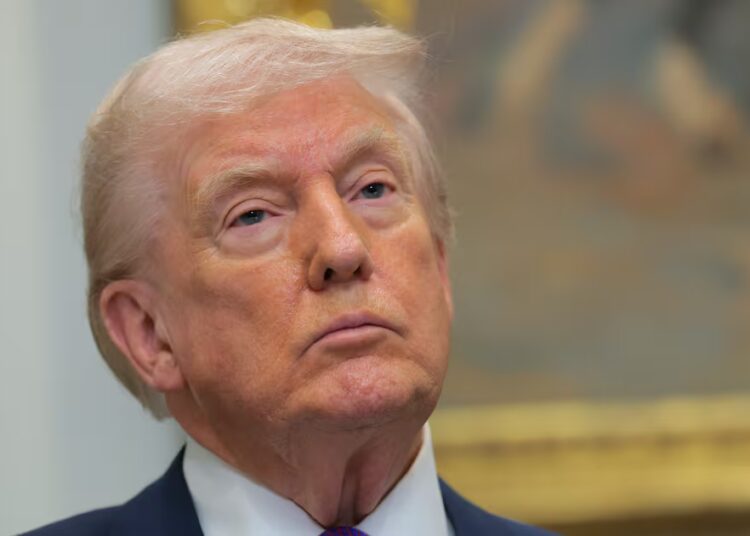
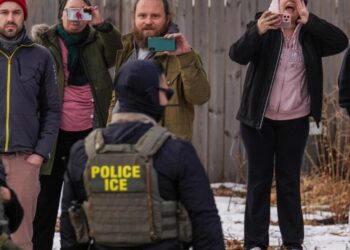
During last year’s presidential campaign, Donald Trump also embraced “Full Metal Jacket.” Characterizing his first term as commander in chief in a way that might justify a second one, he compared the attitude of his generals to the film’s hard-charging boot-camp commando, gushing that his military brass came straight out of “central casting.” It’s true that Trump caught on earlier than most Republicans to the failures of the Iraq war. But he, too, is drawn to the powerful imagery of a triumphant battle, and not just rhetorically. After running as a “peace candidate,” his second term has been marked by the bombing of Iranian nuclear facilities, a series of dramatic but dubious strikes on boats in the Caribbean Sea and ICE raids at home. Surrounded by such ubiquitous, theatrical violence, it becomes harder to tell what counts as war and what does not — and what it would mean to oppose it.
Source photographs for illustration above: Lucian Read/Manifold Productions; Monica Todica/500px, via Getty Images.
The post A Revived War Documentary, Backed by Steve Bannon, Can’t Decide What It Believes appeared first on New York Times.