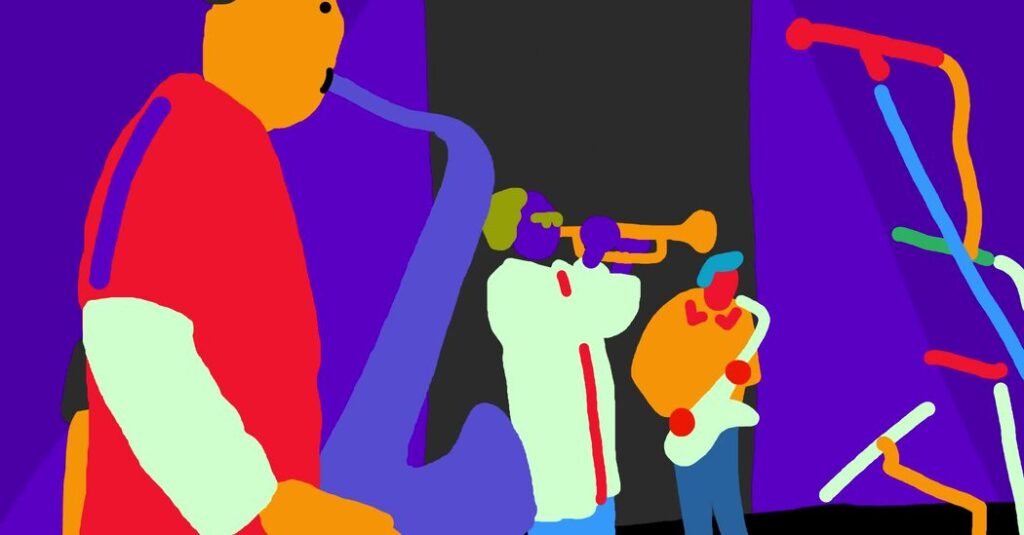
In 1965, when Chicago’s South Side brimmed with artistic possibility, a group of idealistic Black musicians started sketching a future for like-minded creators to follow. They called themselves the Association for the Advancement of Creative Musicians, and even that name felt like a declaration. At its core, the A.A.C.M. stood for a refusal to conform, a commitment to new thought, and a belief that Black experimental music deserved not just room, but reverence.
Formed by the multi-instrumentalist Muhal Richard Abrams, the organization set out to build an infrastructure where abstract composition thrived. At a time when the jazz world leaned heavily on standards or commercial swing, the A.A.C.M. emphasized personal — if not eccentric — expression. Members took classes, studied theory, learned multiple instruments and presented concerts that doubled as communal rituals. The music they created — by Abrams, Roscoe Mitchell, Anthony Braxton, Henry Threadgill and the Art Ensemble of Chicago — didn’t sound like anything the broader industry was prepared for. Their pieces could be playful or austere, filled with silence or overflowing with sound. They embraced “creative music” as both a philosophy and a practice, stretching the limits of what improvisation could mean.
Sixty years later, the A.A.C.M.’s influence remains undeniable, its teachings echoed in the boundary-pushing work of contemporary artists like Isaiah Collier and Angel Bat Dawid. Its commitment to community-based creativity stands as a model for how art can operate outside mainstream systems. Read on for a primer on the A.A.C.M. by a mix of musicians and jazz scholars. Scroll down to find playlists of the selected tracks, and don’t forget to leave your favorites in the comments.
◆ ◆ ◆
Jack DeJohnette, ‘This (Live)’
Chad Taylor, percussionist and composer
The master drummer Jack DeJohnette, who died in October, is well known for his contributions to bands led by Miles Davis, Keith Jarrett, Charles Lloyd and others, but his contributions to experimental and creative music are perhaps less familiar. This live recording with the bassist Larry Gray, Muhal Richard Abrams and DeJohnette’s old classmates at Wilson Junior College in Chicago, Roscoe Mitchell and Henry Threadgill, demonstrates not only his versatility as a drummer but also the incredible musicianship, brilliance and originality of three master A.A.C.M. musicians. The track “This,” written by Mitchell, is a master class in patience and control. I love how sound and texture isn’t used as a supplement to the music but as a focal point. The flutes, bass and piano are blended so well that they create the aural illusion of a mysterious new instrument. The fact that it was recorded live at the 2013 Chicago Jazz Festival makes it all the more impressive.
 Listen on Spotify, Apple Music and YouTube
◆ ◆ ◆
Maurice McIntyre, ‘Humility in the Light of the Creator’
Angel Bat Dawid, musician
This song reminds us to see our struggles honestly and with compassion. Today, and for far too long, Black communities have been suffering deeply from the substance abuse crisis — lives lost, families torn apart and a cycle of pain that feels endless. It’s humbling to recognize how systemic neglect and exploitation have played a part in this devastation. Kalaparusha Maurice McIntyre’s song “Humility in the Light of the Creator” offers a spiritual refuge amid all this suffering. His life, marked by struggles with addiction and time in prison, shows a journey from darkness to a place of humility and connection. His music, rooted in the powerful motto of the A.A.C.M. — “A power stronger than itself” — encourages us to acknowledge our flaws, seek healing and find strength through humility. The Creator’s light reveals all our grime and toxins, but it’s also a source of cleansing. Listening to Kalaparusha’s piece invites us to release sorrow and embrace peace, love and humility even in the hardest moments.
Listen on Spotify, Apple Music and YouTube
◆ ◆ ◆
Kelan Phil Cohran and Legacy, ‘White Nile’
Damon Locks, musician and visual artist
Kelan Phil Cohran, after being a member of Sun Ra’s Arkestra from 1959 to 1961, was a co-founder of the A.A.C.M. in 1965. Signature elements of much of Cohran’s recorded output could be considered large-band compositions that lurch with funky esoteric grooves and group vocals with Afrocentric lyrics. The song “White Nile” stands out in sharp contrast, though. Originally released in 1993 on the album “African Skies,” “White Nile” is hauntingly sparse, beautifully hypnotic. Beginning with the harp, instruments step forward one at a time to take solos, adding dynamic color to the looping construction. The solo vocals of Aquilla Sadalla soar with wordless determination, and the Cohran horn solo that comes five minutes in begins with one sustained note so perfectly placed (and lasting longer than you can anticipate) that it elicits excited admiration. Each instrument is given its moment, and the solos feel more like a dance. Meditative yet soul stirring, inside a catalog of raucous tunes that feel akin to musical gatherings to address issues of the community, “White Nile” drifts and floats along the shores of a land where the meal is finished, the sun is setting and all are allowed to dream of what tomorrow may bring.
Listen on Apple Music and YouTube
◆ ◆ ◆
Nicole Mitchell’s Black Earth Sway, ‘How It Was Born’
Devon Gates, musician
I’ll never forget the first time I saw Black Earth Sway, an innovative quartet featuring the former A.A.C.M. president Nicole Mitchell (flute, electronics, vocals) and fellow members Coco Elysses (self-built Black traditional instrument called the diddley bow, vocals, percussion), Alexis Lombre (keyboards, vocals) and JoVia Armstrong (an original percussion kit, electronics, vocals). While effortlessly commanding multiple instruments each, they naturally cultivated an infectious band chemistry, embodying pure sisterhood and radical joy.
In this live-recorded track, the group seamlessly weaves together threads from past, present and future eras of Black music, mixing Mitchell’s celestial electronics with the twang of Elysses’ diddley bow, over Lombre and Armstrong’s deep-pocket groove. Elysses’ powerful vocals synthesize this Afrofuturist time travel as she breaks down the unmistakably Black and female origins of jazz: “We build foundations from our hips.” “Yes, mama with her hands raised high calling the Holy Ghost.” “That’s just how it was, and that’s just how we be.”
Listen on Spotify, Apple Music and YouTube
◆ ◆ ◆
Air, ‘Untitled Tango’
Ken Steiner, jazz historian
“Untitled Tango” opens “Air Song,” the debut album by the trio Air, recorded in 1975. It was the “radio tune” I loved to play at the top of the hour on WPFW, which had just begun broadcasting full-time in Washington, D.C., in 1977. I still have my high-quality (and then hard-to-obtain) Japanese pressing. Catchy and swinging, “Untitled Tango” was perfect for prime-time airplay; the trio’s more abstract pieces I saved for 2 a.m.
The track unfolds like a miniature drama. An opening drum solo arrests your attention, then slips into a tango or march groove, as if two dancers were stepping out onto the floor. It kicks into double time, leading to a warm, rich solo by the bassist Fred Hopkins before returning to the theme. Though Henry Threadgill wrote most of Air’s compositions, Hopkins and the drummer Steve McCall were full creative partners. The three had known each other since the early A.A.C.M. days. Their communication was on a level achieved by longstanding groups such as the great Miles Davis quintets. “Air Song” is beautifully recorded, and captures Hopkins’s deep, woody bass and McCall’s light, impressionistic touch — perfect counterparts to Threadgill’s reeds.
Threadgill would win a Pulitzer Prize in 2016. Hopkins and McCall died far too young. Now would have been their time.
Listen on Spotify, Apple Music and YouTube
◆ ◆ ◆
Art Ensemble of Chicago, ‘Sun Precondition Two/Theme for Sco’
Rob Mazurek, musician
The first three vinyl records I ever purchased were Charlie Parker’s “Live at Birdland,” Miles Davis’s “Bitches Brew” and the Art Ensemble of Chicago’s “Urban Bushmen.” “Urban Bushmen” was released in 1982. In 1983 I moved to Chicago in order to find my way in music and art. Soon after, I found myself studying with the great Billy Brimfield, Jodie Christian, the under-known brilliant pianist and composer Kenny Prince and others. This early introduction to musicians associated with the A.A.C.M. would have a lasting impression on me for years to come and to this day.
“Urban Bushmen” is for me one of the greatest recordings ever made. It covers so much ground in such little time. “Sun Precondition Two/Theme for Sco” exemplifies this, moving from the energy and ebullience of Famoudou Don Moye’s drum solo into a quirky march that swaggers and swings and at the same time. It manages to convey the ridiculousness of war while simultaneously transporting you into this street parade mode. Lester Bowie’s trumpet leads the way with the support of Roscoe Mitchell, Joseph Jarman and Malachi Favors Maghostut’s bass holding it down. Then the storm hits and the sky opens. Repeating lines transformed, long tones creating color and density, Moye pushing it all forward with such power and beauty, and my goodness, Lester Bowie! What a sound — a sound not heard in a long time. Thank you A.A.C.M. for spawning such immense creativity and life!
Listen on Spotify, Apple Music and YouTube
◆ ◆ ◆
8 Bold Souls, ‘Odyssey’
JoVia Armstrong, percussionist and composer
In 1999, I moved to Chicago as a very young musician. I walked to the Hot House one night to hear music. 8 Bold Souls was performing. I never heard anyone like them before. Their album “Last Option” starts with the tune “Odyssey,” a beautiful waltz. It opens with phrasings from the clarinet, asking my young mind questions, “What brings you to Chicago? What are you searching for?” The bending of notes made the clarinet seem human. The drums, tuba and bass had a conversation of their own in the background. I loved the sound of orchestral instruments, but hearing them in this context opened my young mind to a world I had never known existed. I could hear their souls, their personalities and their thoughts speak through the music. The structure wasn’t predictable — they didn’t teach this in school. This song was my introduction to the A.A.C.M. and the beginning of my future.
Listen on Spotify, Apple Music and YouTube
◆ ◆ ◆
Anthony Braxton, ‘Opus 51’
Seth Colter Walls, writer
This tune can’t wait to get going. Its brazen opening chord has been rhythmically patterned for swinging excitement. But what’s that harmony? Thick and static: pure experimentalism. Then, in a swerve, the composer writes fluid bop lines for multiple saxophonists.
“A wild eight seconds,” the listener may reply. “Can I hear that combination again?”
Braxton and his ensemble oblige. Eventually, members of what he calls a Creative Orchestra improvise at length, or execute quick handoffs, as in the days of the Ellington and Henderson big bands. This capacious artist’s galvanizing solo, on alto, comes after baritone and trumpet features. Meanwhile, his writing embraces the orchestral complexity of Charles Ives — plus the advanced arranging strategies of Charles Mingus. After establishing this on the first track of “Creative Orchestra Music 1976,” Braxton can then go anywhere he likes. His next curveball? The contemplative “Opus 56,” which helps the album achieve classic status.
Listen on Spotify, Apple Music and YouTube
◆ ◆ ◆
Renee Baker’s CMOP, ‘Warm Broth’
Renee Baker, musician and AACM president
“Warm Broth” lives in that space where sound tilts a little off-center — where things get strange, playful and wonderfully unpredictable. It’s music that doesn’t straighten itself for anyone. CMOP holds the bowl steady while the score bubbles and sends up small scents and surprises.
The A.A.C.M. legacy gave me the freedom to build my own universe, and “Warm Broth” sits right inside that legacy — unexpected and fully alive.
Our music is important because it expands how people hear. It gives the listener and the performer the chance to flex new muscles. It makes room for risk and rampant imagination. Above all, it reminds listeners that Black creative music is not a genre but a force and a selfish way of thinking. It’s a door that every member of the A.A.C.M. keeps walking through again and again. It’s sound and what music can be.
Listen on YouTube
◆ ◆ ◆
Art Ensemble of Chicago, ‘We Are on the Edge’
Chris Ryan Williams, composer and improviser
This song is everything I love about the A.A.C.M.: spirit, looseness, that unruly “crossover” the Art Ensemble of Chicago has always done so well. It looks forward and backward at once, exactly how the A.A.C.M. has moved since its birth. Original music, improvisation, poetry and groove.
I can’t pick a favorite from the boundless wealth the A.A.C.M. has given us, but this one gathers so many qualities I find awe-inspiring: longevity, intergenerational camaraderie, a fearless commitment to uncategorizable sound, and wit. It draws on a depth of feeling Black American culture has cultivated and manifested into beauty of the highest regard, and it’s just groovy.
Moor Mother’s text and delivery become both the centerpiece and the frame, a way of hearing the long and present journey of being Black in America. Her entrance, ushered by hand percussion, is ceremonial. And Lester Bowie’s saying, about musicians as messengers spreading the good word, is here, fully alive.
Listen on Spotify and Apple Music
◆ ◆ ◆
Henry Threadgill, ‘Try Some Ammonia’
Brandon Ross, guitarist and composer
It has been my good fortune to have connected with several musicians who are or were affiliated with the A.A.C.M. Muhal Richard Abrams; Leroy Jenkins; Wadada Leo Smith; and, enduringly, Henry Threadgill. I have been a member in each of their bands at varying times and each opportunity was a lesson in freeing oneself of negative restrictions.
“Try Some Ammonia” is a great example of the range of creative expression encouraged by the ethos of the A.A.C.M. The Art Ensemble of Chicago, among the internationally recognized A.A.C.M.-affiliated groups, uses the phrase “Great Black Music, Ancient to the Future,” which this song embodies. This song makes the body move! It’s playful, exigent, driving and hip. It’s Black African diaspora top to bottom. Celebratory, invigorating and no “math” involved, deterring some when thinking “jazz” or, worse, “avant-garde.”
Wanna hear it again? I do!
Listen on YouTube
◆ ◆ ◆
Anthony Braxton, ‘Composition No. 76’
Paul Steinbeck, bassist and author
All the A.A.C.M.’s key innovations — multi-instrumentalism, extended forms and new kinds of musical notation — can be found in this late-1970s work by Anthony Braxton. In “Composition No. 76,” three musicians playing dozens of woodwind and percussion instruments set out on a journey through a vivid, 27-page musical score. Some passages are through-composed, with intricate melody lines that move in unison or counterpoint. But much of “No. 76” is spontaneously constructed by the performers, who veer away from the composed lines to play micro-improvisations guided by the bold colors, geometric shapes and alphanumeric codes that appear throughout Braxton’s score.
As with every Braxton piece, though, a technical description is insufficient. What listeners hear — and what the performers experience — is a joyful musical adventure, inspired by a score so striking to behold that it was once exhibited at the Museum of Contemporary Art in Chicago, the A.A.C.M.’s hometown.
Listen on Spotify, Apple Music and YouTube
◆ ◆ ◆
Isaiah Collier & the Chosen Few (featuring Dee Alexander), ‘Love’
Ugochi Nwaogwugwu, singer, writer and author
“Love,” by Isaiah Collier & the Chosen Few featuring Dee Alexander, resonates with positivity and purpose. This song appears on Collier’s 2024 release, “The Almighty.” It appeals to listeners with a delicate demand that becomes a powerful plea, drawing them into a whirlwind of masterful song, sound, instrumentation and execution. It is a pensive and enchanting collaboration pairing deeply expressive vocals that wrap you warmly as the composition penetrates heart and mind, connecting soul to substance. Collier represents the new era of A.A.C.M. artists. His work speaks for this present age. It is a call for change and transformation of the human kind. This “Love” song reflects on the tumultuous times we find ourselves navigating, spreading hope and optimism. The veteran A.A.C.M. vocalist Dee Alexander brings vintage style, poise and projection to this work with her breathtaking performance on this recording. The melody and message remain with you long after the music stops.
Listen on Spotify, Apple Music and YouTube
The post 5 Minutes That Will Make You Love the A.A.C.M. appeared first on New York Times.