MEXICO CITY — Juan Orlando Hernández, a convicted drug trafficker whom prosecutors said “paved a cocaine superhighway” to the United States, walked out of a West Virginia prison this week a free man.
That was thanks to President Trump, who on Monday granted a full pardon to Hernández, the former right-wing leader of Honduras who was serving a 45-year sentence for supporting what a U.S. attorney general had called “one of the largest and most violent drug trafficking conspiracies in the world.”
Trump’s extraordinary reprieve outraged many in Latin America and raised critical questions about his escalating military campaign in the region, which the president insists is aimed at combating the drug trade.
On Tuesday, Trump warned of imminent “strikes on land” in Venezuela, whose leftist leader, Nicolás Maduro, the White House describes as a “narcodictator” and seems intent on forcing him from power.
“If Trump is supposedly a drug warrior, why did he pardon a convicted trafficker?” said Dana Frank, a professor emerita at the UC Santa Cruz specializing in recent Honduran and Latin American history. She described the drug war narrative embraced by the White House as little more than a pretext to push U.S. economic and political interests in the region and justify “a hemispheric attack on governments that are not following what the United States wants.”
The U.S. has killed dozens of alleged low-level drug traffickers in missile attacks on boats in the Caribbean and Pacific, and has massed 15,000 troops and a fleet of warships and fighter jets off the coast of Venezuela.
Venezuela, home to the world’s largest known oil reserves, has been controlled by Maduro’s leftist authoritarian government since 2013.
The White House has gone to great lengths this year to cast Maduro as a drug trafficking mastermind who leads a smuggling network known as Cartel de los Soles that is composed of high-ranking Venezuelan military officials. Last month the administration designated Cartel de los Soles as a foreign terrorist group.
But security experts in Venezuela and law enforcement officials in the U.S. say Cartel de los Soles is not a well-organized drug smuggling organization like the cartels of Mexico. They say it also is unclear whether Maduro directs illicit activities or whether he simply looks the other way, perhaps in a bid to build loyalty, while his generals enrich themselves. Maduro says the accusations are false and that the U.S. is trying to remove him from office to gain access to Venezuelan oil.
The evidence against Hernández, on the other hand, was much more damming.
Hernández was implicated in multiple drug trafficking cases brought by U.S. authorities, who accused him of helping traffic 400 tons of drugs through Honduras and of accepting millions of dollars in bribes from Mexican cartel kingpin Joaquín “El Chapo” Guzmán. Hernández, prosecutors said, used his army to protect traffickers and once boasted that he was going to “shove the drugs right up the noses of the gringos” by flooding the U.S. with cocaine.
Hernández insisted that the case against him was politically motivated and that his 2024 conviction relied on testimony of witnesses — largely convicted drug traffickers — who were not credible. The Trump administration cited those reasons this week when explaining the president’s pardon.
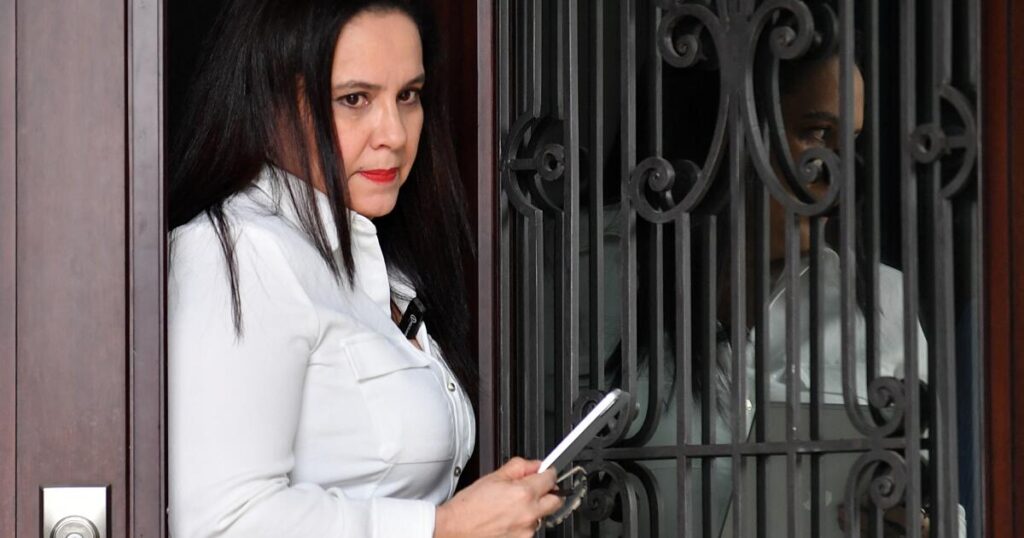
Hernández’s wife, Ana Gracía de Hernández, cast the pardon as an act of justice, writing on social media, “After nearly four years of pain, waiting, and difficult trials, my husband Juan Orlando Hernández RETURNED to being a free man, thanks to the presidential pardon granted by President Donald Trump.”
The pardon appears related to a Trump administration effort to sway the results of the recent Honduran presidential election.
Ahead of Sunday’s vote, Trump threatened on social media to withhold aid from Honduras if voters did not elect the conservative candidate Nasry “Tito” Asfura, who is a member of the same conservative National Party that Hernández belongs to.Trump also slammed the current Honduran president, leftist Xiamora Castro.
Election results were still being counted Tuesday but showed Asfura neck-and-neck with another conservative, Liberal Party candidate Salvador Nasralla. Castro was trailing far behind.
Since returning to the White House this year, Trump has sought to exert dominancein Latin America like few presidents in recent memory, cutting deals with right-wing leaders such as Argentina’s Javier Millei and El Salvador’s Nayib Bukele and punishing leftist governments with tariffs and sanctions.
Trump and his officials have overtly sought to influence other elections, supporting right-wing candidates in recent elections in Argentina and Peru.
“It’s a bullying of the democratic process,” Frank said. “It’s a heartbreak for the sovereignty of these countries.”
At home, Trump has repeatedly intervened in the justice system with pardons.
Trump’s decision to pardon Hernández comes amid a flurry of clemency actions from the president, whose pardon attorney, Ed Martin, has openly advocated for Justice Department investigations that would burden Trump’s political enemies, paired with leniency for his friends and allies. “No MAGA left behind,” Martin wrote on social media in May.
Legal experts say the president’s pardons and commutations appear targeted toward individuals accused of abuses of power and white-collar crimes — the sort of crimes that Trump has been charged with throughout his adult life.
Just in the last several weeks, the president has offered commutations to George Santos, a former congressman convicted of defrauding donors, and David Gentile, a private equity executive convicted of a $1.6-billion scheme that prosecutors say defrauded thousands of ordinary investors.
He also pardoned Changpeng Zhao, a crypto finance executive with ties to the Trump family who pleaded guilty to money laundering, as well as Paul Walczak, a nursing home executive who pleaded guilty to tax crimes, only for his mother to secure clemency for him at a Mar-a-Lago dinner.
The clemency actions have divided Trump’s base of supporters, some of whom see the president as protecting conservative voices that faced political prosecutions under the Biden administration. Others still see Trump protecting rich allies as much of the country faces an affordability crisis.
Linthicum reported from Mexico City and Wilner from Washington.
The post Trump’s pardon of a convicted trafficker undermines his drug war narrative appeared first on Los Angeles Times.