“Writing a play,” Tom Stoppard told an interviewer in 1977, “is like smashing that ashtray, filming it in slow motion, and then running the film in reverse, so that the fragments of rubble appear to fly together. You start—or at least I start—with the rubble.”
In life, of course, this kind of reversal is impossible. As the physicist Valentine Coverley puts it in Stoppard’s masterpiece Arcadia, “You can’t run the film backwards. Heat was the first thing which didn’t work that way. Not like Newton. A film of a pendulum, or a ball falling through the air—backwards, it looks the same … But with heat—friction—a ball breaking a window … It won’t work backwards … You can put back the bits of glass but you can’t collect up the heat of the smash. It’s gone.”
But making the fragments fly together was the kind of thermodynamic miracle that Stoppard pulled off regularly. His plays do strange things to time. Arcadia, set between 1809 and the Present Day in an ever more disorderly room in an English manor house, braids together the messy strands of two eras in a story of love, math, landscape architecture, and the looming shadow of Lord Byron. Stoppard plays tend to be about such thrilling lists of seemingly unconnected themes, which, in someone else’s hands, would be fit for parody. But by the time Stoppard is done with them, you will never again think of scholars hunting for a hermit in a 19th-century landscape without also thinking of chaos theory.
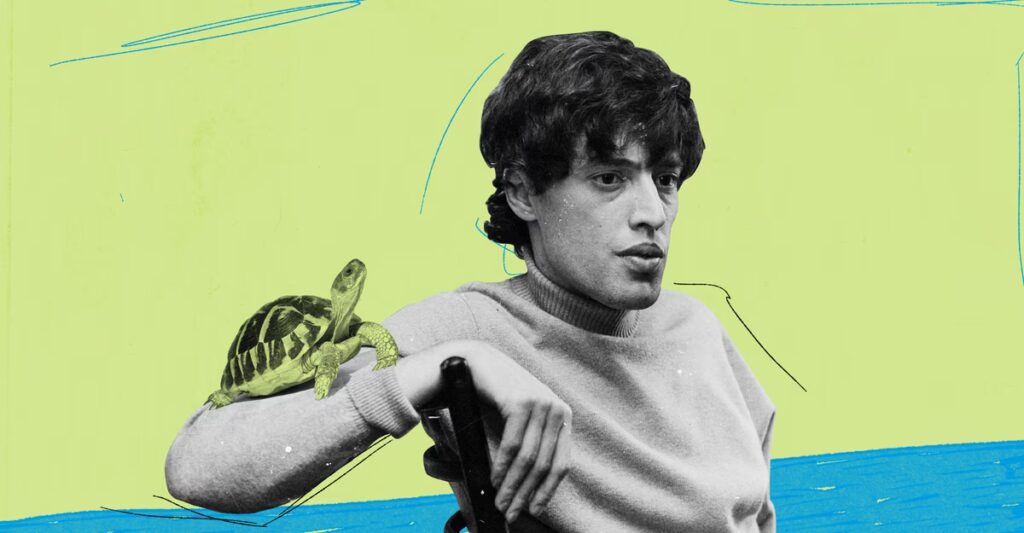
Since Stoppard’s death, last weekend, I’ve been returning to Arcadia. Never has a play about the inevitable heat death of the universe been so hilarious and full of life. (“Septimus,” Thomasina says in the first line, “what is carnal embrace?” “Carnal embrace is the practice of throwing one’s arms around a side of beef,” Septimus replies.) It abounds in puns, in juicy monologues, in stage directions worth the price of admission—a tortoise plays two roles and serves as a paperweight across time.
My favorites of his plays all burst with this enthusiasm—for life, for science, for literature, for art. Here’s Stoppard’s version of the poet and classicist A. E. Housman in The Invention of Love: “I would join Sisyphus in Hades and gladly push my boulder up the slope if only, each time it rolled back down, I were given a line of Aeschylus.” Here’s Valentine again on physics: “It makes me so happy. To be at the beginning again, knowing almost nothing. People were talking about the end of physics. Relativity and quantum looked as if they were going to clean out the whole problem between them. A theory of everything. But they only explained the very big and the very small. The universe, the elementary particles. The ordinary-size stuff which is our lives, the things people write poetry about—clouds—daffodils—waterfalls—and what happens in a cup of coffee when the cream goes in—these things are full of mystery, as mysterious to us as the heavens were to the Greeks.”
If all the world’s a stage, then quite a few of Stoppard’s plays take place in the wings. “I’m dead then. Good,” Stoppard’s Housman says at the start of The Invention of Love. He comes to revise this opinion later, when he realizes that the boatman transporting him across the River Styx has only the fragments of Aeschylus that he himself already knows. But Housman is not the only Stoppard character to hover in the margins of being; he just happens to be in a classical vision of the afterlife rather than, say, just offstage, waiting for his cue, where Rosencrantz and Guildenstern wrangle their own questions of existence.
Entropy comes for us all—but then the lights go down, the curtain rises, and for a moment, the pieces have all flown together and you get back the heat of the smash. Resisting that inevitable heat death, finding a clever loophole, stirring things together so they’re irreversibly linked—that was the feat Stoppard performed again and again. As his Ada Lovelace–inspired, Byron-adjacent math prodigy Thomasina Coverley puts it elsewhere in Arcadia, “You cannot stir things apart.”
Death hovers beyond the curtain. We know what becomes of everyone: of Rosencrantz, Guildenstern, Thomasina, Housman, Stoppard himself. But his plays hold us in the moment before, outside of time, when the impossible is always happening.
Before Thomasina goes upstairs with the lit candle that will spell her death, she pauses to dance with her tutor, Septimus. When the lights go down, they are still dancing.
The post Tom Stoppard Achieved the Impossible appeared first on The Atlantic.