More than 71 years ago, the United States embarked on an ambitious project to desegregate the nation’s public schools.
That goal was never fully realized. And today, America’s largest 100 school districts are more segregated by race and economic status than they were in the late 1980s, according to research from Stanford University and the University of Southern California.
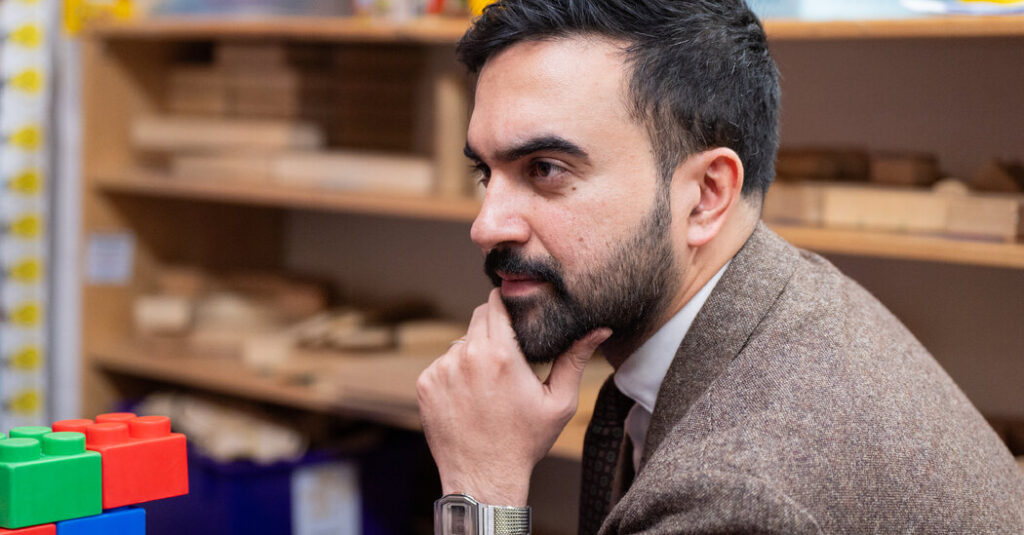
But in New York City, Mayor-elect Zohran Mamdani has spoken about the issue in striking terms. He will soon lead one of the country’s most diverse cities, home to the nation’s largest school system — one in which nearly 900,000 students speak more than 180 different languages.
Though Mr. Mamdani’s mayoral campaign shared only a limited vision for public education, he was the only candidate who ran in the general election to identify integration as a priority.
He described the issue as a crisis and called disparities in access to elite schools jarring. And last week, Mr. Mamdani appointed several prominent integration advocates to his transition committee on education.
Already, Mr. Mamdani has taken one concrete step that advocates say could help address the issue, saying that he would phase out a gifted and talented program for kindergartners that has been criticized for admitting low numbers of Black and Latino children.
“We have the most segregated school system in America,” Mr. Mamdani said before the election, referring to a well-known 2014 finding from the Civil Rights Project at the University of California, Los Angeles.
Integration has been a political tinder box ever since the Supreme Court ruled in Brown v. Board of Education seven decades ago that racial segregation in schools was unconstitutional. There are no longer explicit laws creating it, but it persists through social and economic factors — and many political leaders have abandoned their quest for change. The debate has also become more complicated as America’s schools grow increasingly diverse.
The Trump administration has slashed grants meant to promote diversity in schools and ended longstanding court-ordered desegregation plans in several Southern states.
“We’re now getting America refocused on our bright future,” Harmeet K. Dhillon, who leads the Justice Department’s Civil Rights Division, said in the spring. “It is past time to acknowledge how far we have come.”
Still, some education experts argue that at a time when the nation’s academic performance has stagnated — and the achievement gap between high- and low-performing children is widening — school segregation is exactly what some large cities should be talking about.
“You have to attack this problem in every possible way,” said Sean F. Reardon, a professor at Stanford whose work focuses on poverty and inequality. “If New York can find a way to move the needle, maybe that helps other places believe that it’s possible and start to try.”
The Pendulum Swings
Not long ago, entrenched school segregation inspired teenagers in New York to walk out of class in protest. The superintendent in an affluent Baltimore suburb declared it a threat to equity. And Democratic presidential candidates sparred over their records on the issue.
That was the late 2010s. Times have changed.
In a new cultural moment, the issue has lost widespread attention. Some large cities that once served as models of integration — such as Minneapolis and St. Paul — have slid backward, even as residential segregation in neighborhoods has gradually declined.
The U.S. Education Department’s crackdown on efforts promoting diversity, equity and inclusion has been on the minds of many education leaders.
“It’s chilled actions across the country,” said Stefan Redding Lallinger, a senior fellow at the Century Foundation, a progressive think tank.
“It’s unfortunate,” he said, “because we continue to have students languishing in high-poverty schools with less resources.”
The nation’s shift on integration makes it all the more notable that Mr. Mamdani has highlighted the issue.
It remains unclear how much political capital Mr. Mamdani might expend on desegregation — at a time when he will be seeking support for his ambitious agenda to make New York more affordable.
Many U.S. leaders have long been reluctant to embrace integration, worrying about middle-class flight and outrage. Matt Gonzales, a member of Mr. Mamdani’s transition committee on youth and education, said that some New York mayors had been “afraid to engage with the controversy.”
“This issue has invited backlash for over 70 years,” Mr. Gonzales said, adding that public education should “make policy based on people who don’t have the privilege to leave.”
In a school system in which more than 70 percent of children come from low-income families and just under two-thirds are Black or Latino, it is tough to create integrated schools everywhere. Housing patterns also help fuel segregation as families often separate into neighborhoods — and school zones — by race and income.
But it is not the only explanation for what happens in education. In many large districts, school segregation has increased even as residential segregation has declined, research shows.
Desegregation efforts tend to focus on several diverse but divided areas. Take District 3, which covers an especially diverse section of Manhattan’s West Side. In some schools, more than 90 percent of students are Black and Latino; in others, most are white and Asian.
Mr. Mamdani has not released a full integration plan. But he has said his administration will confront “the hard work of desegregating the system and ensuring that each and every student is actually getting access to a high-quality education.”
His team has said it expects to rely on recommendations from a former school-diversity advisory panel — which was convened during Mayor Bill de Blasio’s second term — to shape its own plan.
Should the school system appoint a chief of integration? Redraw neighborhood school zone lines? Double down on traditional gifted and talented programs? (Yes, maybe and no, the recommendations say.)
Nyah Berg, the executive director of New York Appleseed, a group that supports integrated schools, said she was cautiously optimistic that Mr. Mamdani would revive efforts to tackle desegregation. Still, she noted: “We have yet to see leadership that had the political will and moral fortitude to truly move integration forward.”
‘What Parents Really Want’
A renewed focus on integration could prompt a complex question in New York and other large cities: Do today’s families still care whether their children attend diverse schools?
National polling is mixed, but often shows that most parents agree that racial and economic integration is important and that they would like their children to attend schools with diverse enrollment. But the issue rarely ranks among their top priorities.
And in practice, many families choose schools based on other factors.
“What parents really want is a great school, and it doesn’t matter where they get it from,” said Amy Tse, a Queens mother on the executive board of the Asian Wave Alliance, a political club that endorsed former Gov. Andrew M. Cuomo for mayor.
In New York, the divide between public schools and who attends them is often shaped by selective admissions. The city has historically relied on selective standards — considering report cards and sometimes essays or interviews — to admit children far more often than other U.S. districts.
That system could receive renewed scrutiny during Mr. Mamdani’s term.
The diversity panel’s recommendations call for dozens of top middle schools — often pipelines into well-regarded high schools — to phase out selective admissions, a move that helped boost integration in one group of Brooklyn schools. And it suggests pausing the creation of new selective high schools.
These schools tend to enroll more children from higher-income families and more white and Asian children, and loosening admissions standards regularly ignites debate about fairness and opportunity. The federal education secretary, Linda McMahon, has criticized diversity efforts in admissions, saying they ignore the values of “merit and accomplishment.”
And in New York, some Asian families remain skeptical after the city sought to scrap an entrance exam at eight of the city’s specialized high schools, considered crown jewels of the system. Many felt overlooked by the plan, and the outrage helped push some away from the Democratic Party.
That backlash could complicate how Mr. Mamdani, whose coalition included many South and East Asian voters, approaches the issue. (A former critic of the entrance exam, he pledged during his campaign to maintain the test.)
Still, Vanessa Leung, the co-executive director of the Coalition for Asian American Children and Families, said she believed that many hesitant families might embrace integration under a new mayor. But the city must abandon “what often becomes really divisive rhetoric,” and the idea that “things are being taken away from you.”
“It has to be a discussion that’s not just about moving people,” Ms. Leung said. “To say, ‘This is why it’s actually really beneficial to be in a school with diverse experiences.’”
Other education leaders believe that as enrollment declines and school mergers ramp up, the school system has a natural opportunity to integrate. Decades of research show integration can boost outcomes for all children, and some hope that promise could ease a measure of backlash to the decisions.
In District 3, a local superintendent, Kamar Samuels, recently combined two schools with different shares of low-income families in a move that could serve as a model for the Mamdani administration.
Marlon Lowe, the principal at the school, Mott Hall II, said he had been struck by how many families were finding its mission of “diversity and high expectations” appealing as they visited during the high school admissions season.
Often, he said, parents are open-minded when selecting schools — “more than they’re given credit for.”
Troy Closson is a Times education reporter focusing on K-12 schools.
The post School Integration Has Lost Steam. Will Mamdani Revive It in New York? appeared first on New York Times.